
A research team headed by Dr. Eugenio Culurciello, associate professor of engineering at Yale University, has developed a field programmable gate array (FPGA) processor that has been specifically designed for artificial vision. It operates about 100 times faster than a laptop computer, effectively bringing supercomputing power to synthetic vision. A system using this FPGA would be capable of analysing full-motion video in real-time. It could simultaneously monitor multiple video streams, looking for certain objects or behaviours with clear possibilities for UAS applications.
US Air Force Wants Hybrid-Powered One-Man UAS
The U.S. Air Force is calling for industry to build a hybrid-powered unmanned aircraft able to be carried and operated by only one person on battlefield situational awareness missions. It should weigh less than 20 pounds and be able to carry a 4-pound electro-optical payload on missions over rough terrain for at least four hours. The total cost of the programme is expected to be about $2.2 million.
Aurora Centaur Begins Flight Test Programme
Aurora Flight Sciences announced that the Centaur Optionally Piloted Aircraft (OPA) has begun its flight test programme. The first fully-configured Centaur made its first flight on Saturday, January 22, 2011 from Aurora’s base at Manassas, Virginia.
UAS Detects Water Leaks
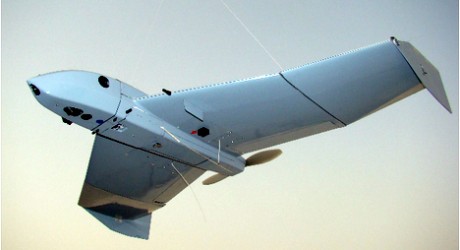
UAS adapted for water leak detection Photo: Arad
An Israeli company, Arad Technologies, a world leader in wireless automatic meter reading systems, has recently developed a two pound Unmanned Aircraft that can travel 900 feet above ground and detect water leaks. It can collect data from water meters every 11 to 30 seconds and capture readings of a whole city in less than one hour.
Brock Launches the Shark – A New Small UAS
Brock Technologies has announced its new Shark Unmanned Aircraft System. A small UAS capable of performing silent ISR at low altitudes for long periods of time, it is designed to fit within a five inch inner diameter launch tube. The Shark is built with the latest in composite materials and processes to produce an affordable system that weighs only 5.5 pounds.
Insitu CEO Steps Down
Steve Sliwa, chief executive of Insitu Inc., a subsidiary of The Boeing Co., will retire April 1 after 10 years with the company. A replacement is currently being sought.
EC Views UAS Petition Favourably
Yesterday, in reply to its petition, UVS International received a letter from Mr Siim Kallas, Vice-President of the European Commission, and Responsible for Transport, in which Mr Kallas indicated that he fully shared the views of UVS International. In addition, in reference to the European Commission’s High Level Group, which is being constituted “to develop a single European Roadmap dealing with the structural, institutional and regulatory measures that need to be tackled”, Mr Kallas indicated “Without wanting to pre-empt any decisions that will be taken in this regard, I am confident that the close involvement of UVS International to this work will be ensured”.
AeroVironment Gets $7.8M for Raven Upgrades
AeroVironment, Inc. has announced that it received a firm fixed-price order valued at $7,800,003 under an existing contract with the U.S. Army on January 25, 2011. The order comprises 919 digital module upgrade kits for the U.S. Marine Corps. The upgrade kits allow digital Raven unmanned aircraft systems to operate using a different frequency band than provided by the regular configuration.