
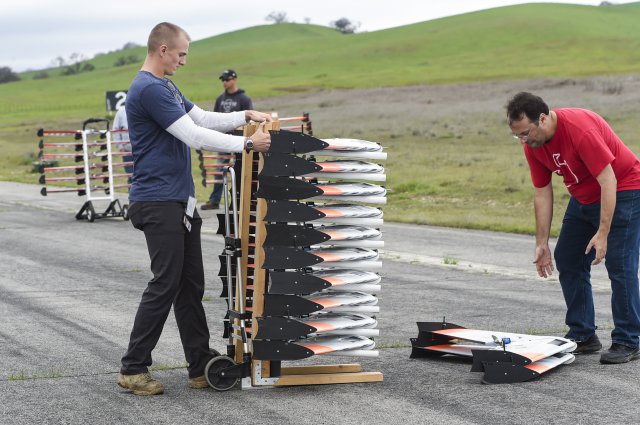
 Aerial dogfighting began more than a century ago in the skies over Europe with propeller-driven fighter aircraft carried aloft on wings of fabric and wood. An event held recently in southern California could mark the beginning of a new chapter in this form of aerial combat.
Boeing Invests in ‘Hybrid to Electric’ Aircraft Startup
 Boeing’s newly launched venture investment division, HorizonX, along with JetBlue Technology Ventures, are investing in a startup developing an electric-powered aircraft with the potential to transform short-haul flights.
Improved Maneouverability for UAVs
 Modified UAV with actuators enabling rotor tilt.
Investigators at the Institute of Systems Optimization (ITE) at the Karlsruhe Institute of Technology (KIT) in Germany have undertaken a project to increase the level of control of quadrotor drones by adding tilt-able rotors and associated control systems.
Gartner Forecasts 3M US Drone Shipments in 2017
Globally, the market for drones is projected to grow to almost three million units and more than $6 billion in revenue this year, according to a February forecast from Gartner. That represents 39 percent unit growth and 34 percent revenue growth over 2016. Continue reading
3W-International Presents New Hybrid Wankel Engine

The world first will be presented for the first time to the specialist audience at the XPONENTIAL Trade Fair taking place in Dallas (USA) in May. Thus, the German engine manufacturer 3W-International is expanding its range of drive products for UAVs by a further engine sector. Just as the two-stroke engines already in use in the marketplace, the new 3W-180 SRE Hybrid Wankel engine can be fuelled by petrol or kerosene, too. Continue reading
E.ON Invests in Drone-Based Airborne Wind Energy
 Ampyx Power and E.ON have entered into a cooperation aiming at furthering Ampyx Power’s Airborne Wind Energy technology into commercial deployment. As part of the cooperation E.ON has committed to development and, if successful, construction and operation of a demonstration site for Airborne Wind Energy concepts in County Mayo, Ireland.
US Army Releases Counter-Drone Manual

Having developed and utilized unmanned aerial systems (UAS, or drones) for surveillance, targeting and attack, the US military now finds itself in the position of having to defend against the same technology. Continue reading
Non-GNSS Approach to UAV Navigation
 Investigators at the Institute of Systems Optimization (ITE) at the Karlsruhe Institute of Technology (KIT) in Germany have been working on a promising approach that does not use GNSS.