
MIT Lincoln Laboratory’s Airborne Sense and Avoid (ABSAA) Radar Panel is a stepped-notch antenna array that marks a substantial advance in the fabrication of wide-bandwidth radar systems for use aboard unmanned aerial systems (UAS). Continue reading

UAS VISION
an independent online news service for the Unmanned Aircraft Systems world
MIT Lincoln Laboratory’s Airborne Sense and Avoid (ABSAA) Radar Panel is a stepped-notch antenna array that marks a substantial advance in the fabrication of wide-bandwidth radar systems for use aboard unmanned aerial systems (UAS). Continue reading
The professor heading up the project, Inna Sharf, is a mechanical engineer at McGill University’s Aerospace Mechatronics Laboratory. Sharf’s team has been tasked with a new project to create autonomous landing UAS software. Continue reading
 Work is underway at BAE Systems to give aircraft human-like ‘skin’, enabling the detection of injury or damage and the ability to ‘feel’ the world around them. Engineers at BAE’s Advanced Technology Centre are investigating a ‘smart skin’ concept which could be embedded with tens of thousands of micro-sensors. When applied to an aircraft, this will enable it to sense wind speed, temperature, physical strain and movement, far more accurately than current sensor technology allows.
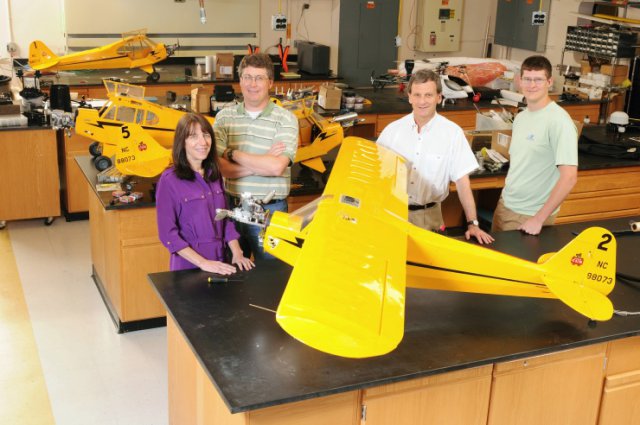 In one of the first autonomous demonstrations, the Georgia Tech Research Institute (GTRI) has successfully commanded three fully autonomous, collaborating UAVs. The machines flew in close formation at the same altitude, separated by approximately 50 meters as they executed figure-eight patterns.
Researchers from the University of North Texas (UNT) have demonstrated an unmanned aerial vehicle (UAV) capable of supplying Wi-Fi to disaster-struck areas with a range of up to 5 km (3.1 miles). The team says these figures represent a marked improvement on existing solutions and could lead to new forms of wireless communication. Continue reading
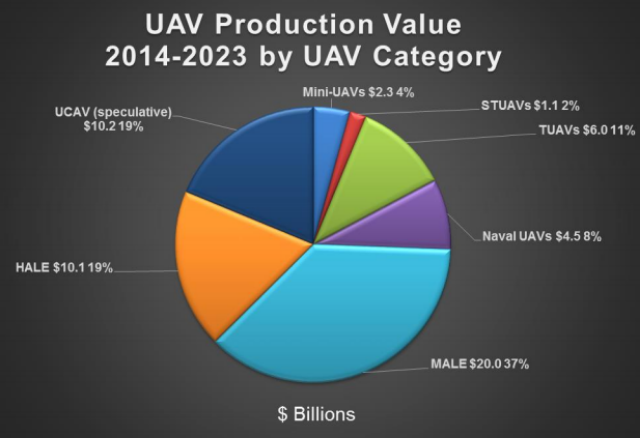 Spending on unmanned aerial vehicles is expected to “nearly double over the next decade,” according to the executive summary of a new study by the Teal Group. The study, which asserts that “enemy air defense is basically non-existent except in the crudest sense, small arms fire,” projects “it is quite possible that [UAVs] will become ubiquitous over the next decade as a standard means of reconnaissance for infantry squads.”
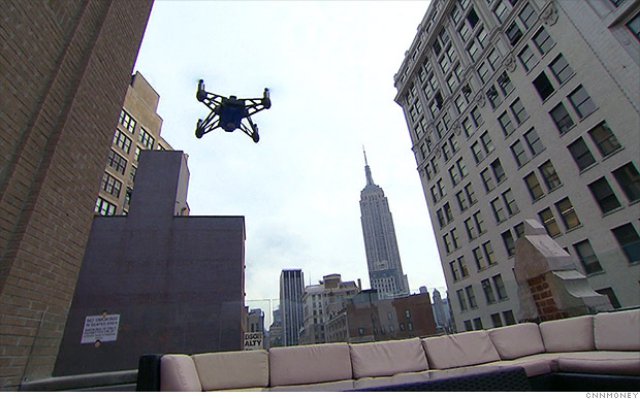 Beginning this summer, CNN and Georgia Institute of Technology will embark on a joint research initiative to better understand the opportunities unmanned aerial vehicles (UAVs) present for media organizations, and to explore the access and safety issues that need to be addressed as part of any new regulatory framework. The project team will be staffed by senior members of CNN’s newsgathering team and researchers at the Georgia Tech Research Institute.
Researchers from MIT’s Computer Science and Artificial Intelligence Lab (CSAIL) have developed a lightweight unmanned aerial vehicle (UAV) that can perch on a power line like a bird. This opens up the possibility for UAVs to recharge their batteries using the magnetic fields emitted by power lines. Continue reading