
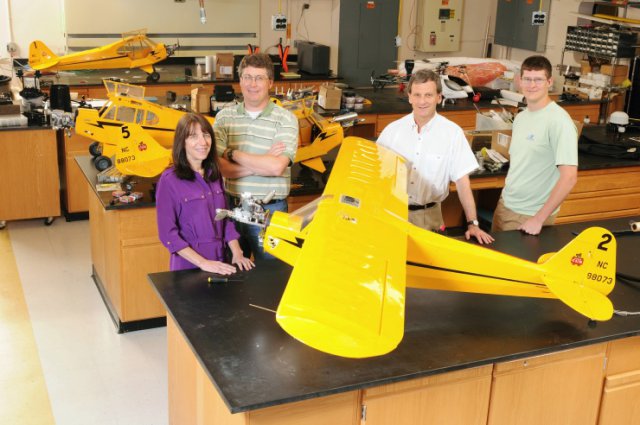
 In one of the first autonomous demonstrations, the Georgia Tech Research Institute (GTRI) has successfully commanded three fully autonomous, collaborating UAVs. The machines flew in close formation at the same altitude, separated by approximately 50 meters as they executed figure-eight patterns.
Category Archives: Research
UAS Antenna Expands Wi-Fi Range for Disaster-Struck Areas
Researchers from the University of North Texas (UNT) have demonstrated an unmanned aerial vehicle (UAV) capable of supplying Wi-Fi to disaster-struck areas with a range of up to 5 km (3.1 miles). The team says these figures represent a marked improvement on existing solutions and could lead to new forms of wireless communication. Continue reading
Study Projects UAS Spending to Double by Fiscal 2024
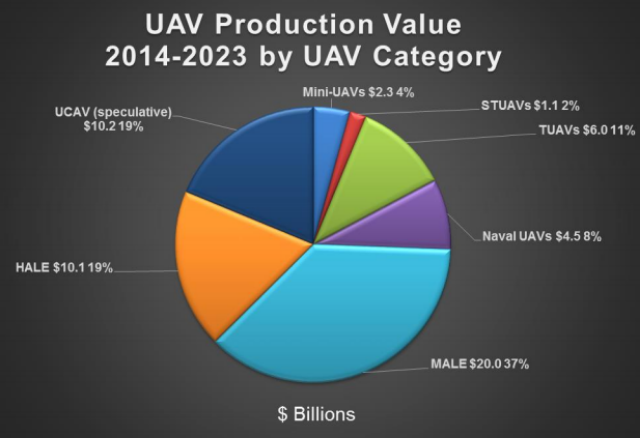 Spending on unmanned aerial vehicles is expected to “nearly double over the next decade,” according to the executive summary of a new study by the Teal Group. The study, which asserts that “enemy air defense is basically non-existent except in the crudest sense, small arms fire,” projects “it is quite possible that [UAVs] will become ubiquitous over the next decade as a standard means of reconnaissance for infantry squads.”
CNN & Georgia Tech to Explore Media UAS Use
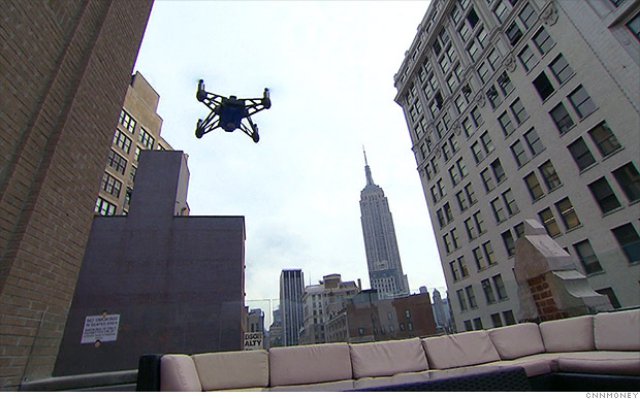 Beginning this summer, CNN and Georgia Institute of Technology will embark on a joint research initiative to better understand the opportunities unmanned aerial vehicles (UAVs) present for media organizations, and to explore the access and safety issues that need to be addressed as part of any new regulatory framework. The project team will be staffed by senior members of CNN’s newsgathering team and researchers at the Georgia Tech Research Institute.
MIT Researchers’ UAS Recharges Batteries by Perching on Power Lines
Researchers from MIT’s Computer Science and Artificial Intelligence Lab (CSAIL) have developed a lightweight unmanned aerial vehicle (UAV) that can perch on a power line like a bird. This opens up the possibility for UAVs to recharge their batteries using the magnetic fields emitted by power lines. Continue reading
Nature Inspires UAS of the Future
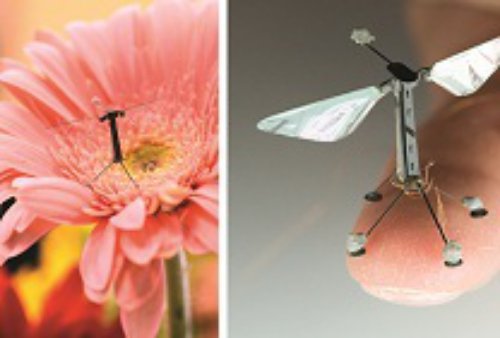 Based on the mechanisms adopted by birds, bats, insects and snakes, 14 distinguished research teams have developed solutions to some of the common problems that UAS could be faced with when navigating through an urban environment and performing novel tasks for the benefit of society. Continue reading
Quadrotor uses Google’s Project Tango for Autonomous Flight
Early this year, Google unveiled its Project Tango smartphone, a mobile device equipped with a depth sensor, a motion tracking camera, and two vision processors that let the phone track its position in space and create 3D maps in real time. The device is particularly useful for robots, which have to navigate and locate themselves in the world. Continue reading
DARPA Unveils Hack-Proof UAS
 The Pentagon’s research arm unveiled a new UAS built with secure software that prevents the control and navigation of the aircraft from being hacked. The programme, called High Assurance Cyber Military Systems, or HACMS, uses software designed to thwart cyber attacks. Continue reading