The U.S. Department of Defense and the Japanese Ministry of Defense signed a project arrangement for joint research on Overwhelming Response through Collaborative Autonomy, Dec. 22, 2023. Continue reading


UAS VISION
an independent online news service for the Unmanned Aircraft Systems world
The U.S. Department of Defense and the Japanese Ministry of Defense signed a project arrangement for joint research on Overwhelming Response through Collaborative Autonomy, Dec. 22, 2023. Continue reading

Researchers at NASA’s Langley Research Center in Hampton, Virginia recently flew multiple drones beyond visual line of sight with no visual observer. The drones successfully flew around obstacles and each other during takeoff, along a planned route, and upon landing, all autonomously without a pilot controlling the flight. Continue reading

Unmanned aircraft systems have emerged as a novel method of inspecting power lines, allowing power utility companies to review the health of their infrastructure more quickly and more safely. But drone operators must maintain a delicate balance, flying close enough to power lines to capture highly detailed images while staying far enough away so as not to be affected by the electromagnetic fields generated by power lines, which interfere with drone operations. Continue reading

According to DataHorizzon Research, The Drone Taxi Market was valued at USD 11.1 Million in 2022 and is expected to grow CAGR at 67.3% to reach USD 1,891.3 Million by 2032 Continue reading

DZYNE Technologies has been awarded a seven-year, $49 million contract through the Small Business Innovation Research program to conduct research and development on advanced unmanned aerial systems for the U.S. Air Force. Continue reading

Ten years from now, we could be in for a new sort of traffic jam. In the near future, posits a new study led by two members of the Johns Hopkins Institute for Assured Autonomy, some 65,000 drones—weighing up to 55 pounds each, most of them programmed to operate without a pilot—will be “taking off, flying, or landing” per hour in what is so far largely uncontrolled lower U.S. airspace. Continue reading

Inspired by the adaptable nature of organic brains, researchers from MIT’s Computer Science and Artificial Intelligence Laboratory (CSAIL) have introduced a method for robust flight navigation agents to master vision-based fly-to-target tasks in intricate, unfamiliar environments. The liquid neural networks, which can continuously adapt to new data inputs, showed prowess in making reliable decisions in unknown domains like forests, urban landscapes, and environments with added noise, rotation, and occlusion. Continue reading
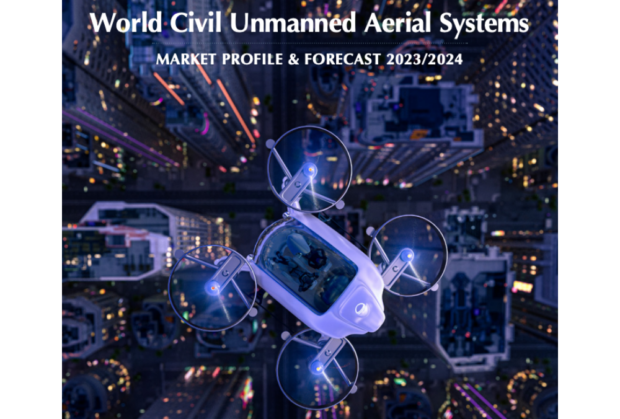
The dynamic growth in Civil Unmanned Aerial Systems (UAS) over the next decade will create significant rewards for smart investment as nations open their airspace, commercial applications take off, and civil governments adopt systems for new roles in border security and public safety. Continue reading