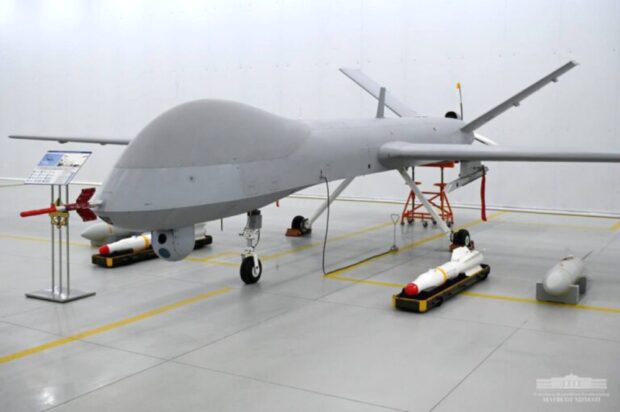
DZYNE Technologies has been awarded a seven-year, $49 million contract through the Small Business Innovation Research program to conduct research and development on advanced unmanned aerial systems for the U.S. Air Force. Continue reading
UAS VISION
an independent online news service for the Unmanned Aircraft Systems world
DZYNE Technologies has been awarded a seven-year, $49 million contract through the Small Business Innovation Research program to conduct research and development on advanced unmanned aerial systems for the U.S. Air Force. Continue reading
Ten years from now, we could be in for a new sort of traffic jam. In the near future, posits a new study led by two members of the Johns Hopkins Institute for Assured Autonomy, some 65,000 drones—weighing up to 55 pounds each, most of them programmed to operate without a pilot—will be “taking off, flying, or landing” per hour in what is so far largely uncontrolled lower U.S. airspace. Continue reading
Inspired by the adaptable nature of organic brains, researchers from MIT’s Computer Science and Artificial Intelligence Laboratory (CSAIL) have introduced a method for robust flight navigation agents to master vision-based fly-to-target tasks in intricate, unfamiliar environments. The liquid neural networks, which can continuously adapt to new data inputs, showed prowess in making reliable decisions in unknown domains like forests, urban landscapes, and environments with added noise, rotation, and occlusion. Continue reading
The dynamic growth in Civil Unmanned Aerial Systems (UAS) over the next decade will create significant rewards for smart investment as nations open their airspace, commercial applications take off, and civil governments adopt systems for new roles in border security and public safety. Continue reading
Researchers at the Escuela Politecnica Nacional in Ecuador have just published a paper which examines a formulation for the sizing of ducted fans for BLI configurations with a distributed propulsion system, based on the NASA X-48B. Continue reading
A team of Embry‑Riddle Aeronautical University students is conducting research using swarm microdrones that could change the way 3D mapping is done, especially in complex, hard-to-reach locations. Continue reading
Traditionally, remotely piloted aircraft systems, or drones, have used onboard flow sensors to measure wind effects, producing in-flight metrics on which operators rely. Leveraging GPS instead, however, might provide more robust measurements, leading to safer, more efficient flights, according to Embry-Riddle Aeronautical University researchers. Continue reading
Engineers at The University of Manchester have built and flown the world’s largest quadcopter drone. The drone, made from a cardboard-like material called foamboard, measures 6.4m (21 ft) corner to corner and weighs 24.5kg – 0.5kg less than the weight limit set by the Civil Aviation Authority. Continue reading