
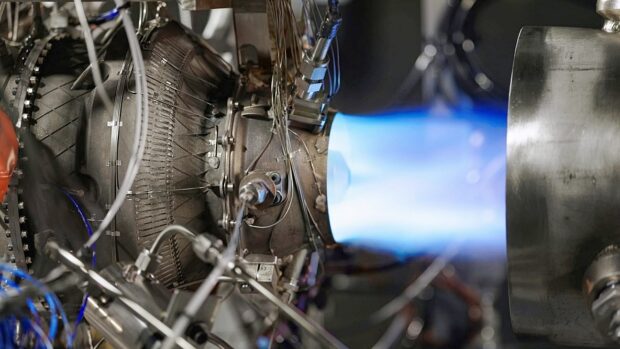
Beehive Industries, an American manufacturer of advanced propulsion systems for unmanned aerial defence applications, announced that it has been awarded a $29.7 million contract from the U.S. Air Force to complete vehicle integration, flight testing, and qualification of the company’s 200 lbf Frenzy 8 engine—a pivotal step toward operational readiness and scalable production of Beehive’s flagship propulsion product.
The award also includes funding to advance Beehive’s 100 lbf Frenzy 6 engine, beginning with the manufacturing of a First Engine to Test (FETT) asset and options for further testing, vehicle integration, and flight demonstration.
The award, managed through the SOSSEC consortium, supports a Small Expendable Turbine (SET) — Family of Affordable Mass Munitions (FAMM) prototyping effort led by the Air Force Life Cycle Management Center (AFLCMC). The SET engine program is a critical component of the U.S. Air Force’s broader strategy to develop, produce, and qualify low-cost, disposable jet engines for unmanned aerial systems and standoff systems.
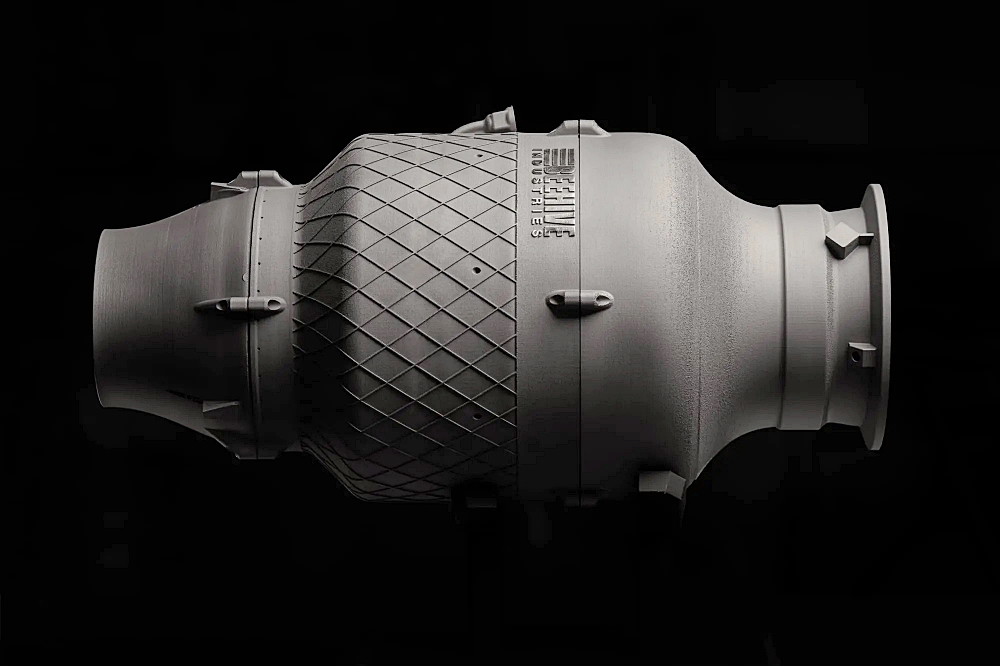
FAMM is a FY2026-focused, Pentagon-wide initiative designed to shift from high-cost, low-quantity weapons to a large-scale, cost-effective arsenal. Beehive uses additive manufacturing to produce low-cost jet engines at high speed, and its Frenzy engine is specifically designed for mass-produced munitions and swarm-class drones.
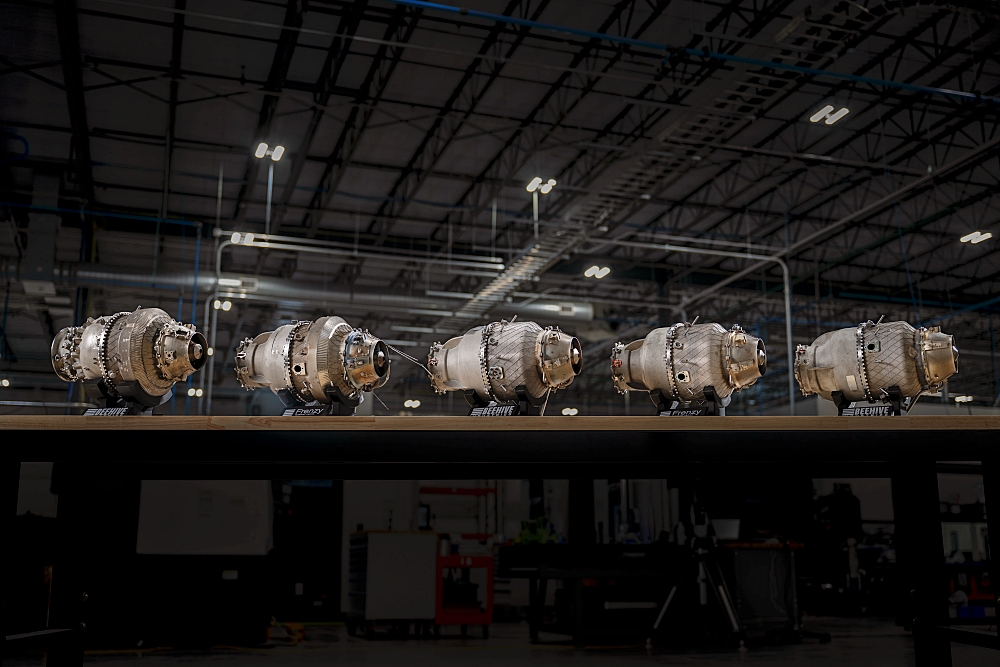
Frenzy 8 Evolution (L-R): From First Engine to Test (FETT) to the flight-ready production unit—achieved in less than a year
“Beehive is honoured to partner with the U.S. Air Force in redefining the speed of defence. By harnessing additive manufacturing to collapse complex supply chains into scalable, 3D-printed propulsion, we are providing the ‘affordable mass’ essential to modern deterrence,”
said Gordie Follin, Chief Product Officer at Beehive Industries.
“This collaboration ensures our warfighters will have the high-volume, mission-ready capabilities they need to maintain a competitive edge in any theater.”
The award builds directly on Beehive’s achievements over the past year, during which the team validated the Frenzy 8 engine through ground testing and high-altitude testing in record time while demonstrating scalability. Amid ongoing ground testing, Beehive launched a “Pathfinder” program to validate production scalability and the results proved out Beehive’s path for mass engine production starting this year.
By balancing critical testing milestones with an aggressive production ramp-up, Beehive demonstrated its transition from a development-focused company to a production-ready propulsion provider.
Source: Beehive Industries
Why This Matters
This development illustrates a significant shift in how modern military power is being conceived, produced, and scaled. At its core is the U.S. Air Force’s investment in low-cost, mass-producible propulsion systems—specifically engines designed for expendable drones and munitions. Rather than prioritizing a small number of highly sophisticated and expensive weapons, initiatives like the Family of Affordable Mass Munitions (FAMM) signal a doctrinal pivot toward quantity, scalability, and rapid deployment.
The emphasis on “affordable mass” reflects lessons drawn from recent conflicts, where large numbers of relatively inexpensive drones have proven capable of overwhelming traditional defenses. By funding companies like Beehive Industries to develop engines such as the Frenzy series, the United States Air Force is actively building the industrial foundation for swarm warfare—where coordinated fleets of unmanned systems can saturate and outmaneuver adversaries.
Equally important is the role of additive manufacturing. Beehive’s use of 3D printing to “collapse complex supply chains” represents a broader transformation in defense production. It reduces dependency on traditional manufacturing bottlenecks and enables faster iteration, testing, and scaling. This could dramatically shorten the timeline from concept to battlefield deployment, altering the pace at which military capabilities evolve.
The involvement of entities like the Air Force Life Cycle Management Center and the SOSSEC Consortium highlights how public-private partnerships are central to this transformation. Innovation is no longer confined to large defense primes; smaller, agile firms are becoming కీల players in shaping next-generation warfare technologies.
Ultimately, this matters because it underscores a strategic transition: from precision scarcity to scalable abundance. The implications extend beyond the U.S., as other nations are likely to pursue similar capabilities, accelerating a global shift toward mass-produced autonomous systems and raising new questions about deterrence, escalation, and control.