
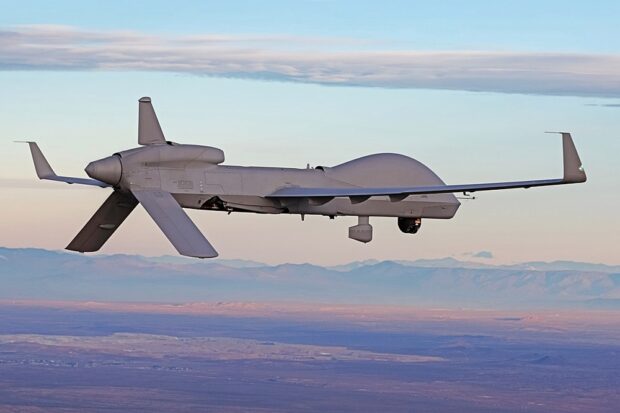
The U.S. Army is upgrading its MQ-1C Gray Eagle Extended Range (ER) with enhanced electronic intelligence capabilities via a contract awarded to General Atomics Aeronautical Systems, Inc. .
ELINT supports long-range sensing for the Integrated Air Defense System (IADS), providing critical information to ground commanders. This capability allows Gray Eagles to operate outside threat ranges while looking deeply into the battlespace and enables advanced manned-unmanned teaming to increase survivability for manned Army aircraft.
“Combining long-range detection with the range and persistence of the Gray Eagle platforms ensures that commanders always know when an adversary IADS is operating,” said GA-ASI President David R. Alexander. “Gray Eagle’s open systems architecture makes this a simple but impactful upgrade.”
The ELINT sensor identifies and geo-locates critical threats vital to Joint Force Operations. To further enhance the Gray Eagle ERs electronic support capabilities, GA-ASI, along with Capability Program Executive Intelligence and Spectrum Warfare, will partner with SNC to integrate advanced radar detection and signal collection technology.
In addition to ELINT, the Gray Eagle ER has also been configured with modernized Communications Intelligence (COMINT), Synthetic Aperture Radar/Moving Target Indicator (SAR/MTI), and Mobile Ad Hoc Network (MANET) radios in multiple Army demonstrations, highlighting the platform’s C5ISR Modular Open Suite of Standards (CMOSS) architecture. The aircraft also supports the integration of best-of-breed sensors, payloads, and weapons to rapidly adapt to threats or specific missions.
Gray Eagle ER was featured in the U.S. Army’s Project Convergence Capstone-5 (PCC-5) last year. The multi-mission, multi-sensor Gray Eagle ER performed persistent Detect, Identify, Locate, and Report (DILR) missions in an electronically contested environment, simultaneously providing mesh network aerial tier support to maneuver units and connecting the soldiers and launched effects that might otherwise be obstructed by terrain or be out of range.
PCC-5 demonstrated Gray Eagle ER’s ability to transform contact, fight, and survive capabilities, automating operator input with easy-to-use human-machine interfaces. Resilient to jamming while integrating and cross-cuing ELINT, COMINT, SAR, and Aerial Tier Network Expansion (ATNE), Gray Eagle ER enhanced the survivability of the maneuver forces while supporting the Combined Joint Task Force (CJTF).
Source: General Atomics Aeronautical Systems, Inc.
Why This Matters
This story highlights a crucial evolution in how modern militaries gather intelligence and manage risk on increasingly complex battlefields. By upgrading the MQ-1C Gray Eagle Extended Range with advanced electronic intelligence (ELINT), the United States Army is prioritizing information dominance—arguably the decisive factor in contemporary warfare.
At the center of this upgrade is the ability to detect and analyze enemy air defense systems without entering their engagement range. Integrated Air Defense Systems (IADS) are among the most dangerous threats to aircraft, and the ability to map, track, and understand them remotely reduces risk to pilots and high-value assets. This reflects a broader strategic shift: using unmanned systems not just for strikes, but as forward sensors that extend situational awareness deep into contested environments.
The involvement of General Atomics Aeronautical Systems underscores the growing importance of modular, upgradeable platforms. The Gray Eagle’s open architecture allows rapid integration of new capabilities like COMINT, SAR/MTI, and MANET networking. This adaptability is critical in an era where electronic warfare evolves quickly, and static systems can become obsolete within years rather than decades.
Equally significant is the emphasis on manned-unmanned teaming. By pairing drones with crewed aircraft, the Army enhances survivability while maintaining operational reach. Drones can take on the riskiest sensing roles, feeding real-time intelligence back to human operators who remain at safer distances.
Exercises like Project Convergence Capstone-5 demonstrate how these capabilities integrate into a larger networked force. The Gray Eagle is not operating in isolation—it is part of a connected ecosystem that links sensors, shooters, and decision-makers across domains.
Ultimately, this matters because it shows how warfare is becoming more data-driven, networked, and autonomous. Success increasingly depends not just on firepower, but on who can see, understand, and act faster in a contested electromagnetic environment.