
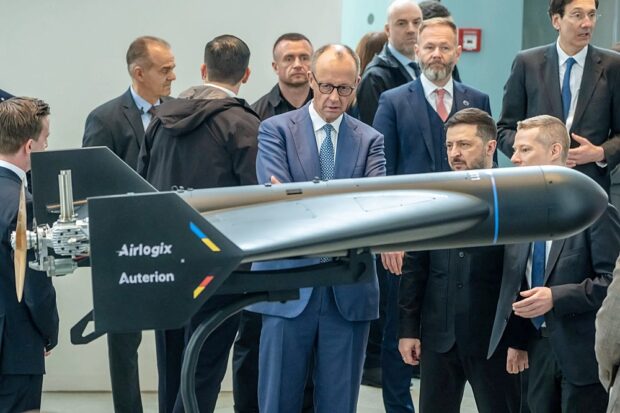
Germany has signed a cooperation agreement with Ukraine to enable the Auterion Airlogix Joint Venture GmbH to execute its first production contract for thousands of mid range, heavy AI-guided autonomous strike systems.
The contract covers mid-range X-wing and delta-wing unmanned aerial systems manufactured in Germany for the Armed Forces of Ukraine. This is the largest German production order for heavy autonomous strike drones to date.
The contract converts what was announced at the Munich Security Conference in February 2026 into funded production at industrial scale (thousands of systems per year) from German production lines. They are production-rate munitions designed for contested, GPS-denied environments, built on combat-tested Ukrainian airframes and powered by Auterion’s combat-tested AI guidance, autonomous navigation, and electronic warfare resilience software.
The systems have long term potential for the German market as well. While the initial contract is strictly for systems for Ukraine, this enables Berlin and Kyiv in the future to draw from the same production line on a long term basis.
What this Means for Operators
For Ukraine, a reliable European-manufactured supply of autonomous strike coordinated through the German Federal Ministry of Defence. German industrial depth behind every unit. For the Bundeswehr, the fastest path to fielding autonomous strike at scale: combat-proven systems shipping with Auterion’s Skynode flight computer and Nemyx autonomy stack, integrating into western command architectures on day one.
For allied nations: the production line is open for scaleup beyond Germany.
The Economics
The JV pairs Ukrainian engineering, forged in the most intense drone warfare environment in history, with German manufacturing precision and supply chain resilience. Mass production drives per-unit costs down fast. The result is autonomous strike at the volumes modern warfare demands.
Dr. Lorenz Meier, CEO, Auterion:
“This contract proves that Europe can move at scale. We are enabling Airlogix to manufacture thousands of autonomous systems on German soil, drawing on Ukrainian combat expertise and the best autonomy software in the world. This is what allied defense industrial cooperation looks like.”
Vitalii Kolesnichenko, CEO, Airlogix:
“Our engineers built these systems under fire. Now German industry is producing them at a scale that changes the equation on the battlefield. Every unit that rolls off this line carries years of real combat learning.”
Background
The Auterion Airlogix Joint Venture GmbH was established in February 2026 at the Munich Security Conference with the backing of both governments. Airlogix contributes battle-tested UAV platforms.
Auterion contributes AuterionOS, AI-guided terminal navigation, GNSS-denied autonomy, and swarm coordination through Nemyx. Production takes place entirely in Germany under Ukrainian export permissions.
Photo: Auterion CEO Dr. Lorenz Meier, Airlogix CEO Vitalii Kolesnichenko, Ukrainian President Volodymyr Zelenskyy, and German Chancellor Friedrich Merz with an Airlogix autonomous strike system at the contract signing ceremony
Source: Auterion
Why This Matters
This agreement represents a major turning point in Europe’s defense posture: the shift from supporting Ukraine with equipment to jointly producing next-generation weapons at scale. The partnership behind Auterion and Airlogix formalizes a new industrial model where combat-proven designs are rapidly translated into mass production within allied economies.
At its core, the deal signals that autonomous strike systems are no longer experimental or niche—they are becoming standardized, industrially produced munitions. By manufacturing thousands of AI-guided drones in Germany, the initiative embeds Ukraine’s battlefield innovations into Europe’s long-term defense infrastructure. This is reinforced by political backing from leaders like Volodymyr Zelenskyy and Friedrich Merz, indicating alignment at the highest strategic levels.
The technological implications are equally significant. These systems are designed for GPS-denied and electronically contested environments, meaning they rely on advanced autonomy rather than continuous human control. This reflects a broader evolution in warfare: resilience and independence from vulnerable communication links are now essential features, not advantages.
Economically, the partnership blends Ukrainian wartime innovation with German industrial scale. This reduces costs while increasing output, enabling “affordable mass” in Europe—a concept previously associated more with U.S. or Ukrainian approaches. It also creates a shared production base that could supply not just Ukraine, but Germany and other allies in the future.
Ultimately, this matters because it accelerates Europe’s transition into large-scale autonomous warfare production, reshapes alliance cooperation, and signals that AI-driven strike systems will be central to future conflicts.