
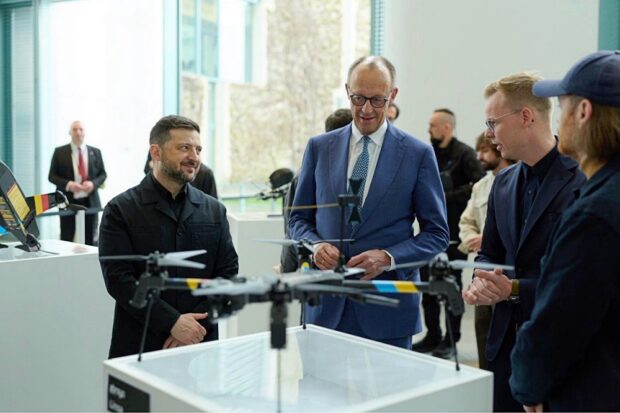
In Berlin, ahead of a bilateral meeting, President of Ukraine Volodymyr Zelenskyy and Federal Chancellor of Germany Friedrich Merz were shown seven types of drones manufactured by Ukrainian enterprises, for which memoranda have already been signed on the potential establishment of joint Ukrainian‑German ventures.
Six of them are aerial, and one is ground-based.
The Linsa 3.0 drone (first joint Ukrainian-German production by Frontline Robotics and Quantum Systems) has a 12-inch platform. It can carry up to 4 kg over a distance of up to 15 km and remain airborne for up to 60 minutes. In 2026, at least 10,000 of these Ukrainian-designed drones are planned to be manufactured in Germany.
The TerMit unmanned ground vehicle is intended for evacuation and logistics. It is adapted to different types of terrain and has a range of up to 40
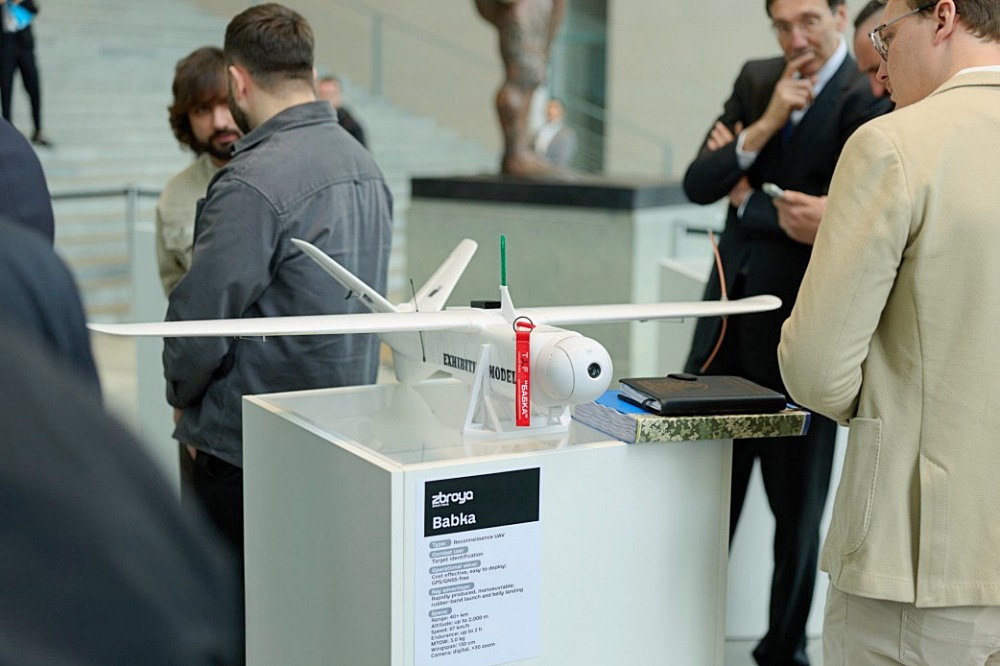
The Babka reconnaissance drone is used for target identification.
The Anubis middle strike drone is intended for strikes against manpower, tactical and strategic targets, as well as armoured vehicles.
The Seth-X short strike drone is designed to eliminate personnel and light armour, including logistics and transport.
The KOLIBRI 10″ FPV kamikaze drone is intended for target strikes and interception.
The STRILA interceptor drone ensures the interception of high-speed aerial targets such as ‘Shaheds’. Its maximum speed is up to 415 km/h.
Also today, at the Embassy of Ukraine in Germany, six new cooperation agreements were signed within the framework of the Build with Ukraine initiative:
TAF Industries and Thyra signed a Memorandum of Understanding on the establishment of a Ukrainian-German joint venture for the production of UAV interceptors.
WIY and Quantum Systems signed a Memorandum of Cooperation on the establishment of a joint venture for the production of anti-”shahed” interceptors WIY STRILA.
Ukraviasystem and POINToX signed a Memorandum of Cooperation on the joint production of missile and aviation systems.
The German company Helsing and the Ukrainian company Culver Aviation agreed on the joint production of drones.
In addition, two agreements on technological cooperation were concluded between Diehl and the Ukrainian companies FirePoint and Luch.
Source: Presidential Office of Ukraine
Why This Matters
This event highlights a deepening integration between Ukraine’s wartime innovation ecosystem and Germany’s industrial base—marking a shift from ad hoc support to structured, long-term defense collaboration. The presence of leaders like Volodymyr Zelenskyy and Friedrich Merz underscores that this is not مجرد technical cooperation, but a strategic alignment shaped by ongoing conflict and future deterrence needs.
At the core is the industrialization of drone warfare. Ukraine has rapidly developed a diverse portfolio of unmanned systems—from reconnaissance to strike to interception—under battlefield pressure. By partnering with German firms such as Quantum Systems and Helsing, these designs can now be scaled, standardized, and produced within Europe. The planned production of thousands of systems like the Linsa 3.0 illustrates a move from improvisation to mass manufacturing.
Equally important is the breadth of capabilities: interceptor drones targeting threats like Shahed UAVs, FPV strike drones, and ground-based logistics systems. This reflects a modern battlefield defined by layered, interconnected unmanned systems rather than single platforms. The inclusion of companies like Diehl Defence also signals integration with more traditional missile and air industries.
The “Build with Ukraine” initiative suggests a new model of defense cooperation—co-development rather than simple procurement. Ukraine contributes real-world combat experience and rapid innovation cycles, while Germany offers industrial scale and supply chain stability.
Ultimately, this matters because it accelerates Europe’s adaptation to drone-centric warfare, strengthens Ukraine’s long-term defense capacity, and signals a broader shift toward multinational, networked defense production in response to evolving threats.