
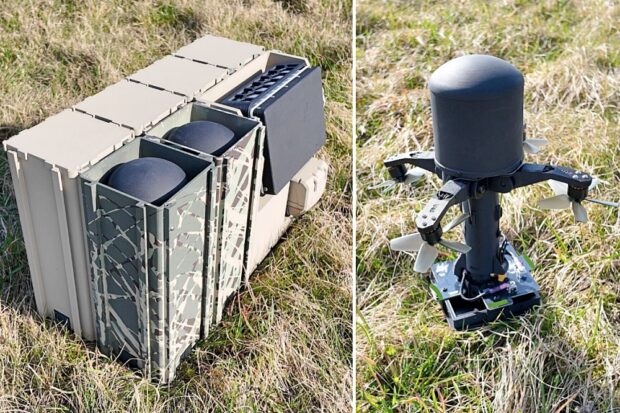
Talon Avionics, a defence technology company based in Boise, Idaho, has developed SECTR, an autonomous drone-intercept system designed to detect, track, and neutralize aerial threats using AI-driven acoustic sensing.
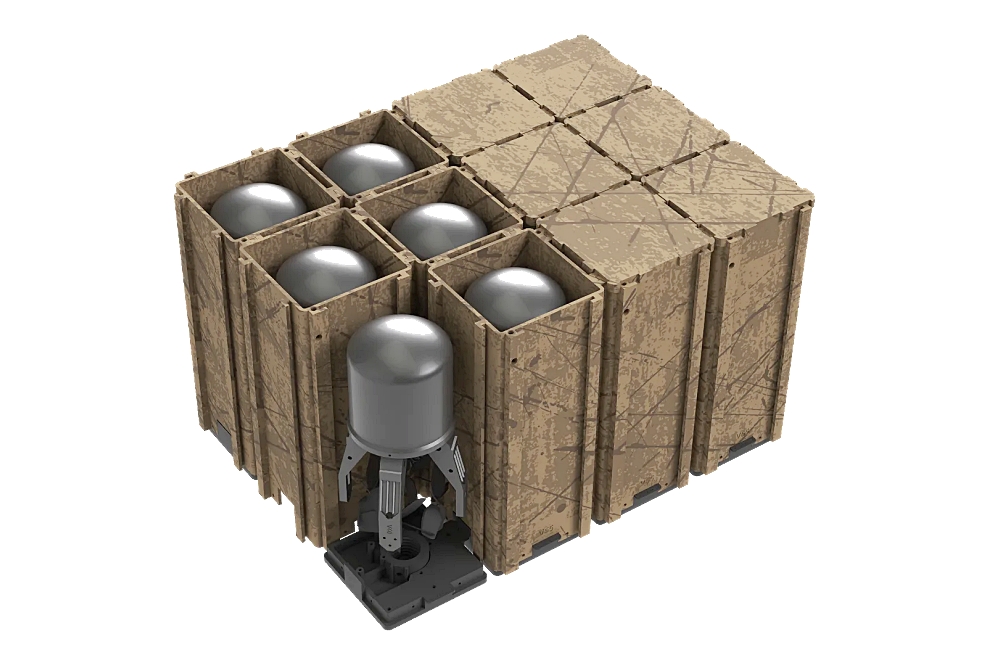
The SECTR system is built around a modular 10×10 launch platform — designated the SECTR-IK-02 interceptor station — that scales up to 100 launch tubes and is operated from a single control station. The platform can be deployed in vehicle-mounted or static configurations, making it suitable for convoy escort, forward base protection, and critical infrastructure defence.
Each interceptor unit, including its launch tube, weighs 700 grams and fits within dimensions of 100×100×250 millimeters, allowing large quantities to be stockpiled and transported with minimal logistical burden. The system operates on a single charge for up to 24 hours when configured with 100 interceptors and functions across a temperature range of -40°C to +85°C, covering the full spectrum of environments from Arctic conditions to desert operations.
At the center of the SECTR architecture is a detection suite combining proprietary acoustic sensing with conventional radar integration. The acoustic array detects targets at distances of up to 100 meters by identifying the sound signatures produced by drone motors — including from threats that have not yet become visible on radar. The radar component provides comprehensive airspace awareness at ranges between 200 and 1,000 meters, with the 1,000-meter capability scheduled for availability in Q2/2027. Together, the two sensor layers feed a multi-modal fusion engine that continuously analyzes acoustic patterns and radar returns to classify drone type and threat level before committing an interceptor to engagement.
The interceptor drone itself carries 16 microphones arranged in an array. A beamforming algorithm scans the surrounding airspace in all directions, forming a narrow acoustic beam that searches for the sound signatures of hostile drones. Once the system locks onto a confirmed target, it flies directly toward it. An onboard AI model allows the interceptor to distinguish between the sound of a target drone and the noise produced by its own motors and ambient wind — a critical capability that prevents false engagements and ensures reliable guidance to the point of intercept.
The stated single-interceptor hit probability is 95% or greater, with a maximum interceptor speed of 135 km/h (85 mph) and a maximum flight time of five minutes per engagement. The system is designed to counter FPV and camera drones weighing up to 1 kilogram.
A defining characteristic of the SECTR system is its fully passive detection layer. Unlike radar-dependent counter-drone solutions that emit signals and can thereby reveal the location of the protected unit, SECTR’s acoustic detection component emits nothing.
Michael Mayer-Rosa, Co-Founder and Strategic Executive of Talon Avionics, described the significance of this design choice directly:
“A major advantage of our system is the fully passive acoustic detection layer. Unlike many counter-drone systems, it does not emit any signals, meaning it does not reveal the position of the protected unit. This allows forces to detect and track drone threats while remaining hidden, which is critical for military operations, convoy protection, and forward positions.”
The passive architecture also provides specific capability against what the company terms “sleeper drones” — threats pre-positioned near roads or terrain that activate when vehicles or troops approach. Because SECTR’s acoustic sensors detect the sound signature of a drone’s motors the instant they start, the system generates early warning before the threat becomes visible on conventional radar, providing seconds of additional response time that autonomous systems can translate into an intercept. The entire detection-to-engagement sequence, from acoustic detection through classification and interceptor launch, completes in under one second.
Mayer-Rosa framed the broader strategic rationale for the system’s design:
“As drones rapidly proliferate — particularly low-cost FPV and loitering systems — the nature of aerial threats is fundamentally changing. Traditional counter-UAS solutions are increasingly challenged: they are complex, require trained operators, and rely heavily on radar or RF signals that can be limited in real-world environments.”
Manufactured in the United States, SECTR is positioned for military customers, law enforcement, border security, and critical infrastructure protection. Talon Avionics states that its high-capacity domestic production capability is intended to support both U.S. forces and allied militaries, with regional manufacturing expansion planned where partners require it. The system’s software-defined architecture allows detection and engagement algorithms to be updated in the field, enabling rapid adaptation as threat types evolve — a design philosophy drawn directly from the iterative development cycles observed in the drone warfare environment over Ukraine and the Middle East.
The autonomous operation model — described by Talon Avionics as “zero-expertise autonomy” — requires no skilled drone pilots or specialized counter-UAS operators. Once activated, the system conducts automated target tracking and engagement without direct human input at the point of intercept, reducing both the personnel burden and the response latency inherent in systems that require human confirmation before firing.
Source: Defence Blog