Category Archives: Research

Warsaw University of Technology & Lockheed Martin Conclude UAS Research

unnamed (6)

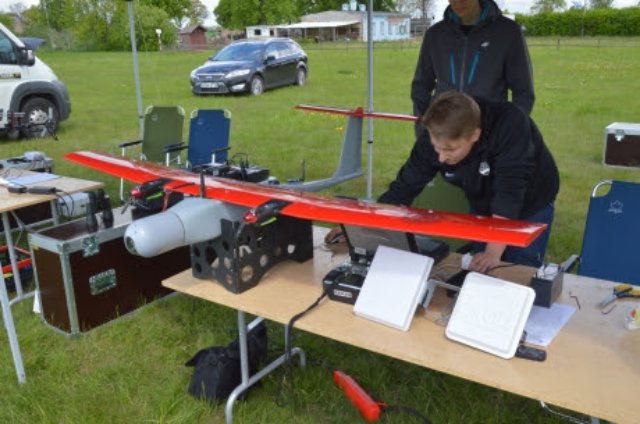
The Warsaw University of Technology (WUT) and Lockheed Martin celebrated the successful conclusion of a joint advanced applied research program focused on the integration between manned and unmanned airborne platform systems. The program builds on the strong industrial and academic partnership between Poland and Lockheed Martin aimed at motivating young Polish engineers to address tomorrow’s defense and industrial needs. Continue reading
Invisible Cloak for Military UAS

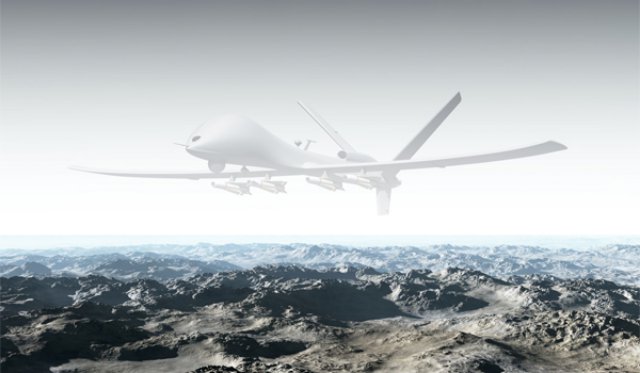
Invisible Cloak

Scientists are working on creating   a new design for a technology that redefines what the public views as imaginary. Inspired  by the  well-known Invisibility Cloak from Harry  Potter, electrical  engineers at  the University of California,  San  Diego have created a  new design  for  their cloaking device,  using  a  Teflon substrate,  studded with cylinders of ceramic,  that is  thinner than any prior development and does not alter the brightness of light around concealed  objects.  Continue reading

US Naval Research Lab’s Flying-Swimmer (Flimmer) UAV/UUV


NRL is merging two separate research areas — unmanned undersea vehicles (UUVs) and unmanned air vehicles (UAVs) — to significantly improve tactical availability of UUVs in time critical situations. Common across the services, autonomous vehicles are being seen as an effective projection of force, both above and below the water’s surface. Unlike an air-deployed Sonobuoy, ongoing research into novel bio-inspired UUV finned propulsion has potential benefits for autonomous motion beyond the insertion point. This combination of an airplane mode for UUV insertion is the thrust of the Flimmer program. Continue reading

Alaska Researchers Use Drones to Study Otters

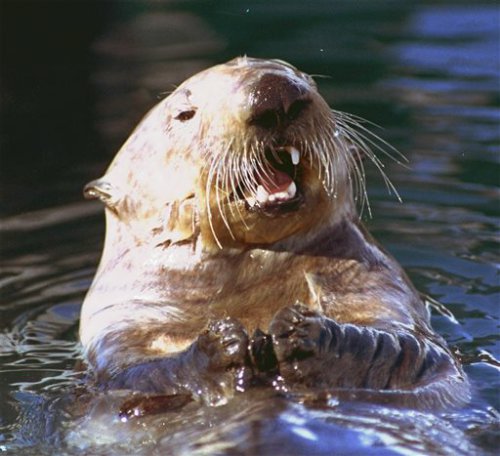
OtterScientists wanting to know what sea otters eat while floating far from shore have turned to the sky. During an April mission in Kachemak Bay, researchers tested unmanned drones to see if they could be used for future sea otter surveys. The project also used drones to study the prevalence of sea grass in intertidal flats.

Using drones for the intertidal flats mission was mostly to streamline the process, allowing a larger area to be surveyed in a shorter amount of time.

When it comes to otters, scientists want to know what the predators regularly eat to better understand how it may affect fisheries management. Current observation techniques are restricted to watching sea otters with high-powered spotting scopes. The practice is only viable on land, as swells and turbulent boats make scopes unfeasible.