
Over recent years the explosion in popularity of drones, both professionally and for amateur use, has inspired researchers to consider how to make flying robots as safe and robust as possible. Previous design methods have included producing bulky protective cages or making them as unlikely to crash as possible. Continue reading
Category Archives: Research
Oil Spill-Mapping Swarms of Drones
Inspired by bird and insect behaviour, engineers create software to enable teams of common UAVs to work together. Continue reading
Harris to Help Develop First US BVLOS Network

Harris Corp. has received a two-year grant to help develop a first-of-its-kind solution to enable beyond-visual-line-of-sight (BVLOS) operations for unmanned aircraft systems. Continue reading
‘Bee’ Drone is a Robotic Flower Pollinator

A student in Georgia wanted more people to understand the significance of bees to human life — so she created what’s essentially a “bee drone” to be a functional teaching tool that couples technology and design. In North America alone, honeybees’ role in pollination enables the production of at least 90 commercially grown crops, including apples, blueberries, melons and broccoli. Continue reading
University of North Dakota Plans Institute for Unmanned and Autonomous Research

When University of North Dakota President Mark Kennedy arrived on campus last year, he saw the same potential in the expansive North Dakota airspace as John D. Odegard did when he launched UND’s leading aerospace program in 1968. Continue reading
Using UAVs in Australia to Study Grape Pests
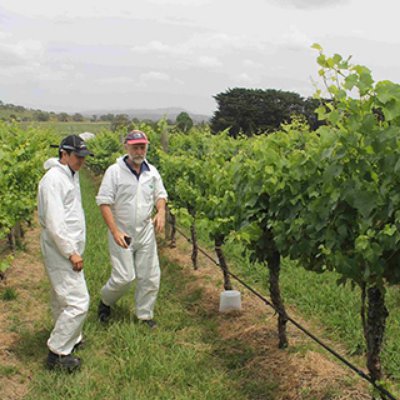 Leading scientists from Australia and the US have formed a partnership to research the role remote sensing and Unmanned Aerial Vehicles (UAVs) could play in improving surveillance capabilities for plant pests.
The multi-million dollar project is funded by the Plant Biosecurity Cooperative Research Centre (PBCRC) – of which the Department of Economic Development, Jobs, Transport and Resources (DEDJTR) is a core partner. Continue reading
DARPA SideArm Catches UAS Flying at Full Speed

Few scenes capture the U.S. Navy’s prowess as effectively as the rapid-fire takeoff and recovery of combat jets from the deck of an aircraft carrier. The ability to carry air power anywhere in the world, and both launch those aircraft to flight speed and bring them to a stop over extremely short distances, has been essential to carriers’ decades-long dominance of naval warfare. Continue reading
ADS-B Surveillance System Performance with sUAS at Low Altitudes

The MITRE Corporation‘s Center for Advanced Aviation System Development (CAASD), the Federal Aviation Administration’s (FAA) Federally Funded Research and Development Center (FFRDC), recently published a study characterizing the impact on the current Automatic Dependent Surveillance-Broadcast (ADS-B) system performance due to the potential use of ADS-B by low-flying, small unmanned aircraft systems (sUAS). Continue reading