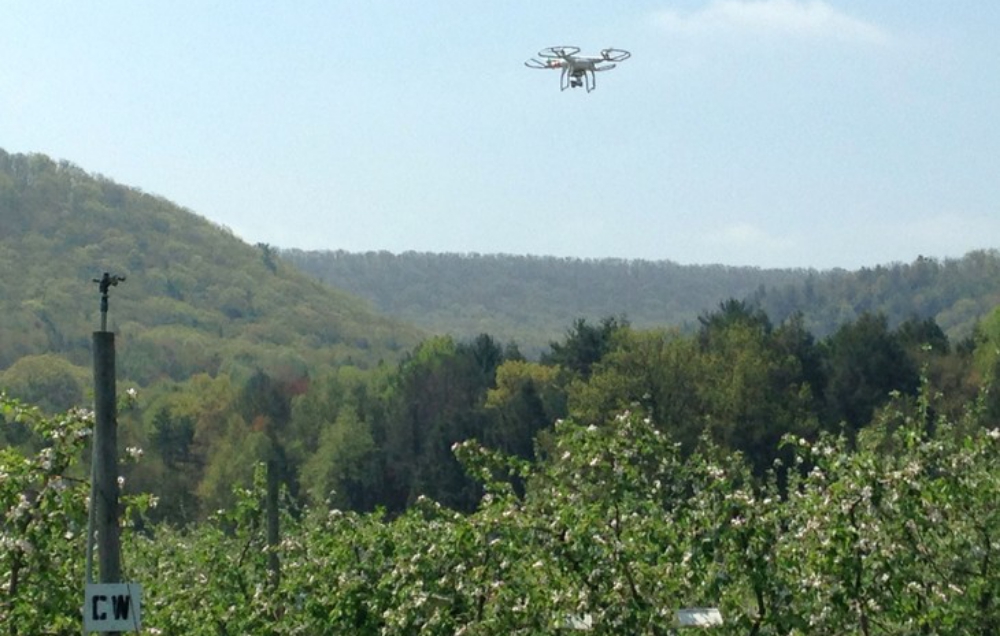
A Georgia State researcher and collaborators have been awarded a $1.2 million federal grant to develop the use of drones in wildfire management, providing more timely data that could allow authorities to give residents in affected areas more time to evacuate, as well as helping firefighters working on the ground. Continue reading
Category Archives: Research
Kansas State to Evaluate Remote-Sensing Technologies to Fight Crime

The Applied Aviation Research Center team at Kansas State University Polytechnic Campus conducts unmanned aircraft systems training for law enforcement
The Applied Aviation Research Center on the Kansas State University Polytechnic Campus is working with law enforcement partners to evaluate small unmanned aircraft remote sensing technologies to reconstruct crime scenes. Continue reading
How to Dig a Hole with Two Drones and a Parachute
The NIMBUS Lab at the University of Nebraska has been developing drones that have the unique ability to dig holes in the ground and then fill those holes with sensors. If this sounds like a complicated task, that’s because it is: The drone needs to be able to carry a portable digging system a useful distance, locate a diggable spot, land, verify that the spot it thought was diggable is in fact diggable, dig a hole and install the sensor, and then fly off again. Continue reading
University of North Dakota Tests Multi-User, BVLoS Broad-Purpose Network for Commercial Drone Activity
The University of North Dakota, along with research partners from Harris Corporation and the Northern Plains Unmanned Aircraft Systems Test Site (NPUASTS), achieved a major industry milestone on Friday, Dec. 21, with the first-ever test flights over a specially developed UAS network of technologies that opens the skies for broad commercial use of drones. Continue reading
Morphing Drone Solution for Search and Rescue
A research team from the University of Zurich and EPFL has developed a new drone that can retract its propeller arms in flight and make itself small to fit through narrow gaps and holes. This is particularly useful when searching for victims of natural disasters. Continue reading
MIT Engineers Fly Plane with No Moving Parts
MIT engineers have built and flown the first-ever plane with no moving parts. Instead of propellers or turbines, the light aircraft is powered by an “ionic wind” — a silent but mighty flow of ions that is produced aboard the plane, and that generates enough thrust to propel the plane over a sustained, steady flight. Continue reading
Small Flying Robots Lift Objects up to 40 X Weight
Researchers from EPFL and Stanford have developed small drones that can land and then move objects that are 40 times their weight, with the help of powerful winches, gecko adhesives and microspines. Continue reading
Origami Cushions Protect Drones from Collisions
To protect flying robots without hindering their flight, Imperial experts found answers in the ancient art of origami. Taking inspiration from the ancient art of paper folding, scientists at Imperial College London’s Aerial Robotics Lab have equipped drones with lightweight, impact-absorbent cushioning to protect them from bumps and scrapes. Continue reading