
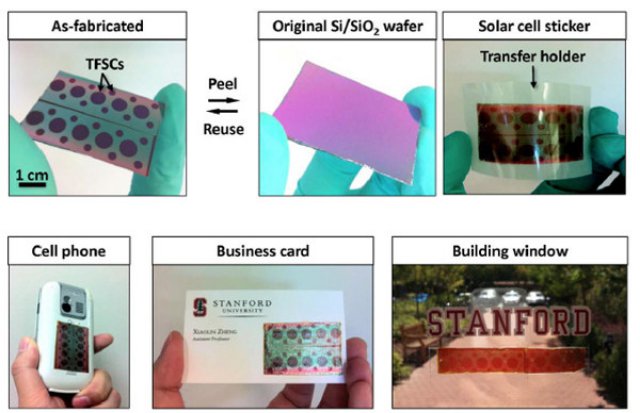
 Stanford researchers have succeeded in developing the world’s first peel-and-stick thin-film solar cells. The advance is described in a paper in the December 20th issue of Scientific Reports. Continue reading
Category Archives: Research
IAI Continues Development of Unmanned Butterfly
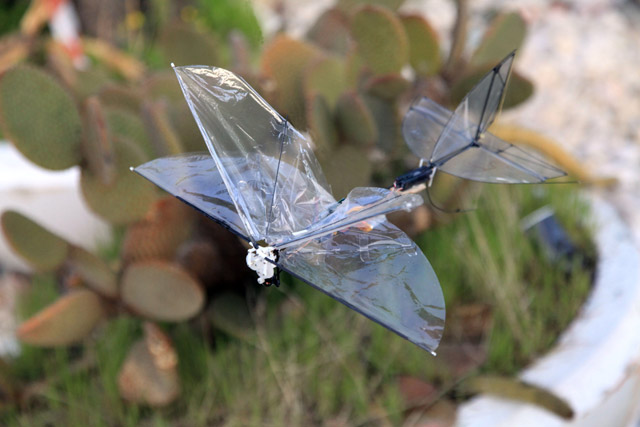 When the Israel Aerospace Industries (IAI) “butterfly” unmanned aircraft, or rather super micro aircraft, takes off in one of the company’s hangars, it looks like a toy for spoiled boys who have parents with really deep pockets. In reality, it is being developed for far more serious scenarios. Continue reading
DRONENET – The Next BIG Thing
Here’s the next BIG thing. Something that has the potential to be as big as the Internet.What is it? It’s an Internet of drones. Continue reading
NASA Sends Global Hawk into Stratosphere to Study Climate Change
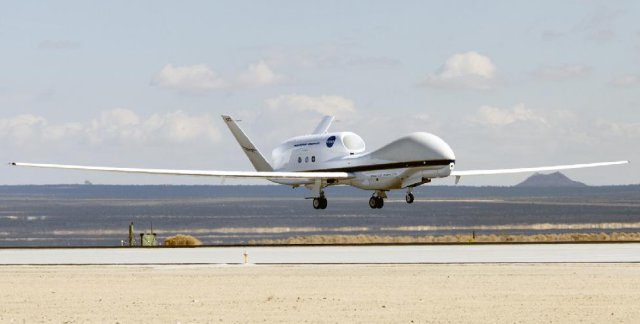 Starting this month NASA will send an autonomously flown unmanned research aircraft up to 65,000 feet over the tropical Pacific Ocean to probe unexplored regions of the upper atmosphere for answers to how Earth is changing in a warming climate. Continue reading
First Solar and Intermolecular Team to Accelerate Cadmium Telluride (CdTe) Solar Cell Technology Development
 Intermolecular, Inc. and First Solar, Inc. announced they have entered into a two-year collaboration and licensing agreement focused on further increases to the conversion efficiency of First Solar’s cadmium telluride (CdTe) solar cell technology. Continue reading
MIT Develops Autonomous UAS Flight
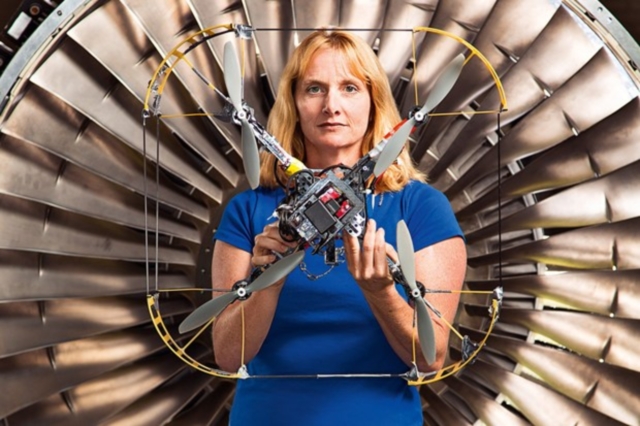 “Computers do things more precisely and faster than humans,” says Mary “Missy” Cummings, associate professor of aeronautics and astronautics at MIT. “But we need humans to deal with uncertainty. It’s this combination that interests me.” Continue reading
Carnegie Mellon Researchers Bring Down Mission-Critical GPS Networks with $2,500 Device
[youtube 6K8dD2PCI6s nolink]
Scientists have devised a series of novel and inexpensive attacks that can severely disrupt mission-critical global positioning systems relied on by the military and a variety of industrial players, including airlines, mining companies, and operators of hydroelectric plants and other critical infrastructure. Continue reading
DARPA’S Pack Horse Robot Follows its Master
[youtube hNUeSUXOc-w nolink]
For the past two weeks, in the woods of central Virginia around Fort Pickett, the Legged Squad Support System (LS3) four-legged robot has been showing off its capabilities during field-testing. Continue reading