[youtube nj1yhz5io20 nolink]
With the BionicOpter, Festo has applied the highly complex characteristics of the mechanics of dragonfly flight to an ultra-lightweight flying object at a technical level. Continue reading

UAS VISION
an independent online news service for the Unmanned Aircraft Systems world
[youtube nj1yhz5io20 nolink]
With the BionicOpter, Festo has applied the highly complex characteristics of the mechanics of dragonfly flight to an ultra-lightweight flying object at a technical level. Continue reading
“If we knew what we were doing, it wouldn’t be research,” quipped Dr. Kelvin Droegemeier, Vice-President for Research at the University of Oklahoma and a member of the National Science Board, as he quoted Albert Einstein during the Unmanned Aircraft Systems (UAS) Summit in Norman, Oklahoma, this week. Continue reading
In this 23-minute video, Professor Raffaello D’Andrea from ETH Zurich at ZURICH.MINDS presents: “Feedback Control and the Coming Machine Revolution” — an amazing display of the future capabilities of machines using flying robots. Continue reading
 What would you do with Google Glass? The company asked the public that question, with the hashtag #ifihadglass, to help find testers for its “explorer” programme. Continue reading
New Mexico State University’s Physical Science Laboratory has partnered with AeroVironment to study the safety of small, unmanned aircraft system operations at night in the National Airspace System. Study results strongly indicate nighttime operations of unmanned aircraft systems are safe, maybe even more so than daytime operations. Continue reading
The NYU chapter of Roosevelt Institute Campus Network, a nation-wide progressive student organization, has recently launched an investigation into the use of unmanned aircraft. Continue reading
For many people, the drone discussion has mostly come from Washington, but on the campus of the University of Minnesota, a group of researchers are tinkering with that discussion in their own way. Continue reading
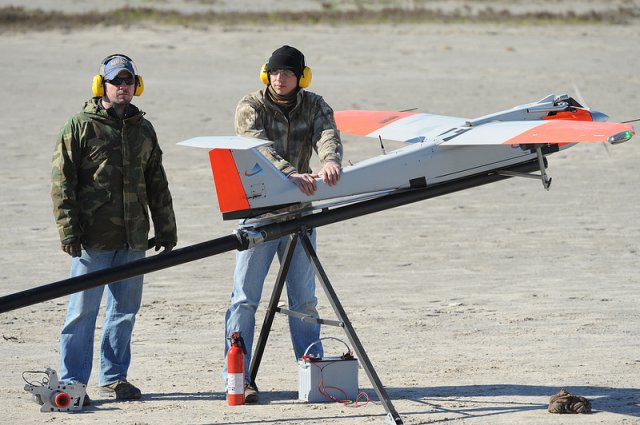 Texas A&M University-Corpus Christi will conduct the first mission over the Gulf of Mexico with their unmanned aircraft from Monday, March 11 through Friday, March 15. Continue reading