
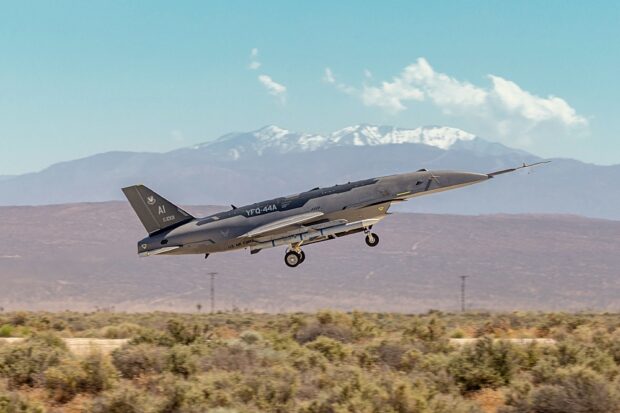
The U.S. Air Force’s Experimental Operations Unit (EOU), operating under Air Combat Command, has concluded a pivotal exercise involving Collaborative Combat Aircraft (CCA) at Edwards Air Force Base.
The event marks a significant step in applying the principles of the Warfighting Acquisition System, a new framework designed to accelerate the development and deployment of advanced military capabilities. Central to the exercise was the use of the YFQ-44A, an experimental drone developed by Anduril Industries, representing a broader shift toward operator-led experimentation early in the development cycle.
Unlike traditional acquisition models that rely heavily on engineers and test pilots, this exercise placed operational personnel at the forefront. EOU Airmen worked closely with Air Force Materiel Command’s 412th Test Wing to conduct sorties that refined both operational tactics and logistical support procedures in simulated contested environments. This hands-on approach reflects a deliberate effort to integrate feedback from warfighters earlier, enabling faster iteration and more relevant capability development.
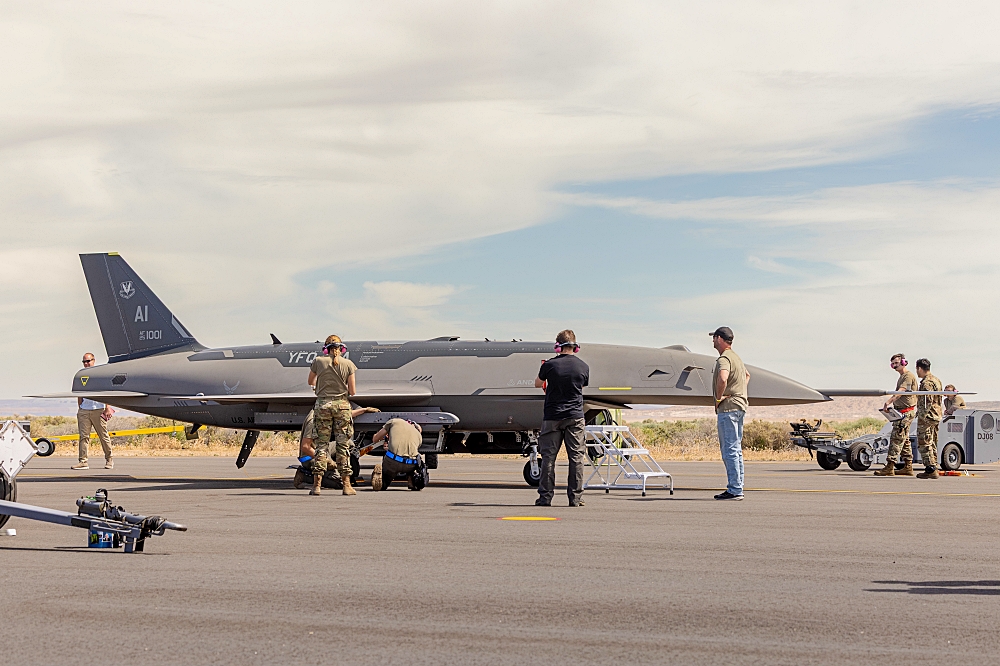
Airmen from Air Combat Command’s Experimental Operations Unit and technicians from Anduril perform maintenance on a YFQ-44A at Edwards Air Force Base, Calif. Collaboration between operators, testers and industry partners creates a tight feedback loop to accelerate the acquisition process. (U.S. Air Force photo by Ariana Ortega)
Lt. Col. Matthew Jensen, commander of the EOU, emphasized that every sortie was planned and executed by operators, underscoring a “learn by doing” philosophy. This method introduces calculated risk but is supported by senior Air Force leadership as a means of accelerating readiness. By combining the testing authority of AFMC with the operational expertise of ACC, the Air Force has created a streamlined process that allows for rapid experimentation and adaptation.
The CCA program itself is a cornerstone of the Air Force’s future force structure. These semi-autonomous drones are designed to operate alongside crewed platforms such as the F-22 Raptor and F-35 Lightning II, performing missions that include reconnaissance, strike operations, and electronic warfare. By offloading high-risk tasks to unmanned systems, CCAs enhance survivability while extending the operational reach of manned aircraft.
The exercise also highlighted the importance of collaboration between operators, developers, and industry partners. Technicians from Anduril worked alongside Air Force personnel to maintain and adapt the YFQ-44A in real time, creating a tight feedback loop that accelerates both technical refinement and tactical innovation. This approach aligns with the Warfighting Acquisition System’s emphasis on delivering “good enough” capabilities quickly, rather than waiting for perfect solutions that may arrive too late.
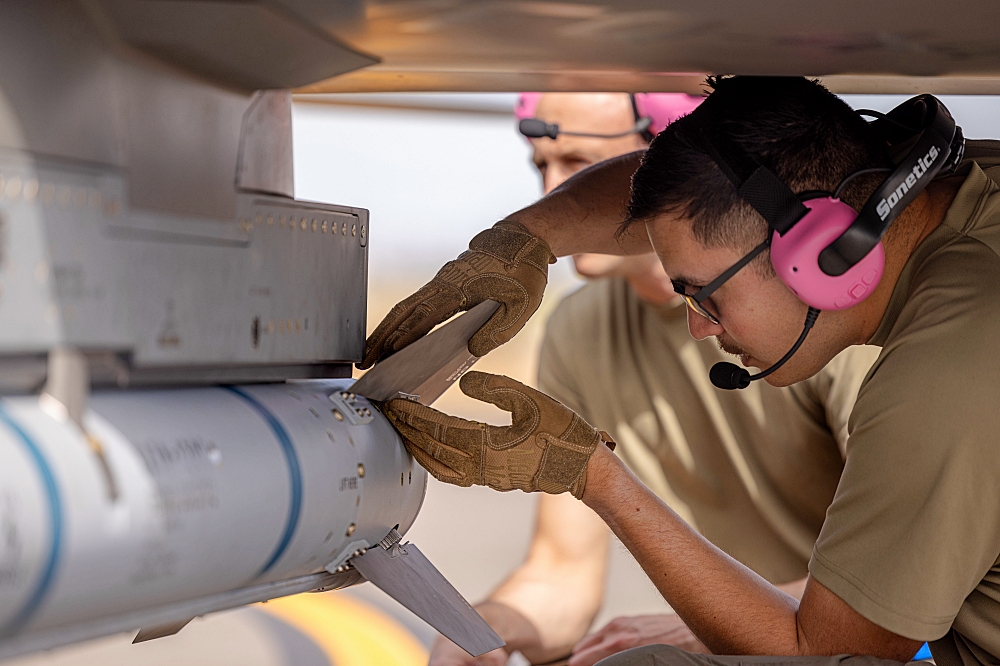
U.S. Air Force Master Sgt. Ricardo Villalva Jr. with Air Combat Command’s Experimental Operations Unit, performs pre-flight checks on an inert munition at Edwards Air Force Base, Calif. The unit enables operators to develop tactics that ensure Collaborative Combat Aircraft are viable for future operations. (U.S. Air Force photo by Ariana Ortega)
Other platforms under evaluation include the YFQ-42A by General Atomics and the YFQ-48A, derived from a design by Northrop Grumman. Together, these systems represent the foundation of a planned fleet of at least 1,000 CCAs.
Ultimately, the successful completion of this exercise demonstrates a fundamental transformation in how the Air Force develops and fields new technology. By prioritizing speed, operator input, and iterative testing, the service is positioning itself to deploy combat-effective unmanned systems at scale—reshaping the future of air warfare and strengthening its ability to respond to rapidly evolving threats.
Top Photo: A YFQ-44A takes off from the runway at Edwards Air Force Base, Calif., during a Collaborative Combat Aircraft exercise. (U.S. Air Force photo by Ariana Ortega)
Sources: U.S. Air Force; The War Zone
Why This Matters:
This exercise highlights a fundamental shift in how the U.S. Air Force develops and deploys combat capabilities. By putting operators—not engineers—at the center of experimentation, Air Combat Command is accelerating the transition from concept to battlefield reality. This reduces the long-standing gap between development and operational use, ensuring that systems are shaped by real-world demands rather than theoretical requirements.
The emphasis on speed and adaptability is particularly significant. Traditional acquisition processes often take years, leaving forces vulnerable to rapidly evolving threats. The Warfighting Acquisition System, demonstrated through the use of platforms like the YFQ-44A, prioritizes rapid iteration and early deployment of “good enough” solutions that can be improved over time. This approach reflects a broader recognition that technological superiority now depends as much on agility as on raw capability.
Strategically, Collaborative Combat Aircraft could redefine airpower by extending the reach and survivability of crewed fighters while reducing risk to human pilots. Operating alongside platforms like the F-35 Lightning II, these drones enable distributed, networked operations that are harder for adversaries to counter.
Ultimately, this model signals a move toward faster, more flexible warfare—where innovation cycles, not just hardware, determine military advantage.