
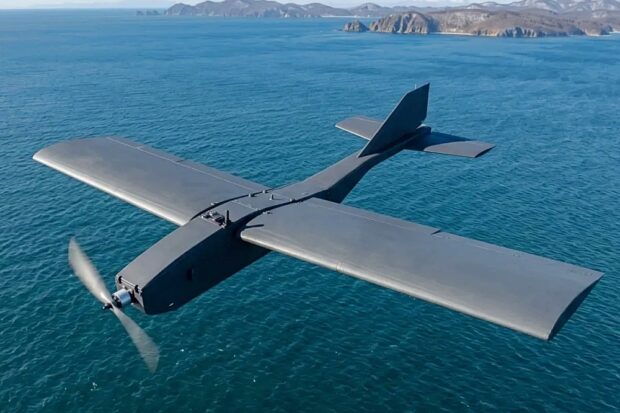
JISDA Corporation (Chiyoda-ku, Tokyo) has announced the launch of its domestically produced fixed-wing drone, the “ACM-01 Shiraha.” Designed as a lightweight, cost-effective unmanned aerial vehicle (UAV), Shiraha features a 1.9-meter wingspan and a wooden airframe.
It is fully produced in Japan, including all components, and achieves a notably low cost of approximately 70,000 yen by focusing strictly on the minimum specifications required for training and short-range operations.
Rather than prioritizing high performance or durability for elite use, Shiraha is intended for repeated use in training environments. Its design philosophy emphasizes frequent operation, wear-and-tear tolerance, and easy replacement. JISDA aims to enable broader access to fixed-wing drone training by lowering cost barriers and supporting continuous skill development across diverse locations.
Background of the Launch
JISDA, in collaboration with the Unmanned Asset Consortium “RISE,” is working to strengthen Japan’s unmanned systems ecosystem across research, manufacturing, logistics, and operations. RISE is not focused on a single product but instead seeks to connect fragmented domains—technology, policy, field operations, and supply chains—into a cohesive and continuously evolving industrial base.
In UAV operations, effectiveness depends not only on aircraft performance but also on supply chain resilience: how systems are produced, maintained, repaired, and replenished. JISDA identified a gap in Japan, where strong individual capabilities exist but lack integration into a unified operational framework. Shiraha represents a step toward building a fully domestic, scalable supply system for training drones.
This perspective is informed by extensive field research conducted by JISDA’s founding team in Ukraine over several years. Observations near active conflict zones revealed that drone effectiveness relies on constant iteration—equipment is frequently modified, repaired, and redeployed. Operational parameters such as communications, navigation, and payload configurations are often adjusted weekly. Continuous training and rapid replenishment are therefore essential components of real-world capability.
JISDA applies these lessons not for warfare, but for resilience and preparedness. Shiraha is positioned as part of a broader effort to build sustainable training infrastructure in Japan.
Complementing this is JISDA’s “Skill House” concept, which integrates training, storage, maintenance, and replenishment into a unified system. The goal is to allow operators to focus on skill development without hesitation over equipment loss or damage.
Features of “Shiraha”
1. Wooden, Fully Domestic Production
Shiraha uses a wooden airframe and is entirely produced within Japan, from materials to final assembly. This ensures supply chain independence, simplifies maintenance, and allows rapid iteration based on operational feedback.
2. Minimum-Spec, Low-Cost Design (70,000 yen)
By focusing only on essential training requirements, Shiraha achieves a highly accessible price point. This enables high-frequency use, encouraging pilots to learn through repetition, failure, and hands-on experience—key elements of effective training.
3. Expandable for Short-Range Operations
While optimized for training, Shiraha can be upgraded with extended range, improved communications, and additional payload capabilities. This modular approach allows users to scale functionality as needed while maintaining a low-cost baseline.
Comment from Representative Director Shota Kunii
Kunii emphasized that the true value of drones lies not in the airframe itself, but in the broader system surrounding it. While building a capable aircraft is technically achievable, modern drone effectiveness depends on integrated systems—network connectivity, autonomy, electronic resilience, and operational logistics.
He noted that Shiraha’s 70,000 yen price point is intended to shift mindsets in Japan, encouraging a move away from limited use of expensive platforms toward a model of continuous, service-oriented deployment. According to Kunii, value should be measured at the system level rather than in individual units.
He also downplayed the significance of materials such as wood, stressing that cost-performance balance and operational flexibility are more important. In some cases, deploying multiple low-cost drones may be more effective than relying on a single high-performance system.
Ultimately, Kunii framed Shiraha as more than a product—it is a foundation for a broader innovation cycle in Japan’s unmanned systems industry, reflecting a shift toward integrating hardware, software, and operational design into a cohesive and adaptive ecosystem.
Source: JISDA