
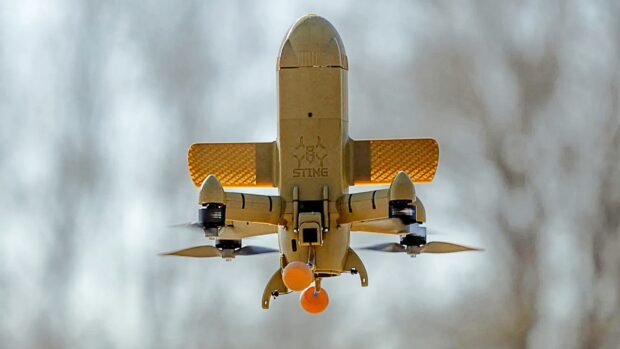
The Ukrainian defence technology company Dyki Shershni (Wild Hornets) demonstrated on April 17 what it called a “record-breaking” launch of an interceptor drone over 2,000 kilometers (1,240 miles), with the operator based in northern Ukraine.
The Sting interceptor drone was remotely controlled using Hornet Vision Ctrl technology, a proprietary system developed by the company that has already begun large-scale deployment.
The company did not specify in its statement when the mission took place, what the target was, or in which country the drone was operating.
Hornet Vision Ctrl is a remote control system that allows operators to pilot interceptor drones from far beyond the launch site.
The system is built around an upgraded ground control station and communication modules that transmit video and control signals over long distances, enabling operators to control drones from hundreds of kilometers away.
‘Wild Hornets’ unveiled its remote control technology for Sting interceptor drones in March, saying it had undergone “several months of combat testing” and proven effective.
The company aimed to begin mass production of the system, which would allow crews to control drones at distances of up to 100 kilometers (60 miles), though the technology also proved capable of longer-range operations.
Using the system, Ukrainian soldier Roman, call sign “Hulk,” of the “Bulava” unit shot down two Russian drones located 500 kilometers (310 miles) away, a feat “Wild Hornets” described as an “absolute world record.”
Source: Kyiv Independent
Why This Matters:
This development signals a major leap in the evolution of remote warfare and drone interception capabilities. By demonstrating control of an interceptor drone over 2,000 kilometers, the Ukrainian company Dyki Shershni is pushing beyond conventional limits of battlefield engagement. Traditionally, drone operations are constrained by communication range and latency, but the Hornet Vision Ctrl system suggests these barriers are rapidly diminishing.
Strategically, this capability allows operators to remain far from the front lines while still conducting precise defensive or offensive actions. This reduces risk to personnel and increases operational flexibility, particularly in contested or dangerous environments. It also complicates adversary defenses, as the geographic origin of drone control becomes harder to identify and target.
The implication extends beyond Ukraine. If scalable, such systems could redefine air defense by enabling distributed, networked interception of threats across vast distances. The reported success in neutralizing drones hundreds of kilometers away highlights the growing role of software, communications infrastructure, and electronic warfare integration in modern combat.
Ultimately, this innovation underscores a shift toward remote-centric warfare, where technological sophistication and connectivity may outweigh proximity and traditional firepower in determining battlefield advantage.