
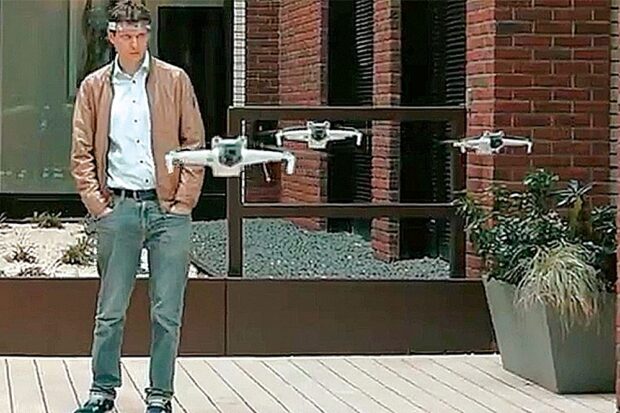
Outside a nondescript office building in the north of England in late September, a “pilot” commanded three drones to take off and fly around the courtyard.
It would have been an unremarkable feat if not for the fact that he had no screen and no joystick, and his hands were in his pockets. The only controller was a white headband that was reading his thoughts and transmitting his commands to the small, commercial drones.
The startup putting on the demonstration was NeuroDoctrine, which recently made its public debut as a defence company during a two-day conference in Manchester.
“We can literally record, process and interpret complex, noisy brain signals in real time,”
Manchester native Zied Tayeb, the company’s founder and CEO, said in an interview after the demonstration.
Tayeb was a computer scientist when his mother was diagnosed with multiple sclerosis. Hoping he could help her manage the disease, he changed course and pursued a Ph.D. in neurotechnology at the Technical University of Munich, where he was part of a team working on the Defense Advanced Research Projects Agency’s Revolutionizing Prosthetics program.
That project sought to assist warfighters who had lost limbs to control artificial arms and legs with only their thoughts. Tayeb later did work on sensors at the end of prosthetic fingers that could discriminate between hot and cold temperatures.
“The idea was to use brain signal data, decode that in real time, turn that into commands to control a prosthetic device — and more importantly — they invented some sensors which you put on the fingertips, and you could literally feel with your prosthetic hand the stiffness, the shape of different objects, the temperature, the sharpness,” he said.
Tayeb pitched some of his ideas to NASA and the Defense Department in 2019, but officials recommended he concentrate on healthcare. That resulted in him founding his first startup MyelinZ, which is using neural interface technology to help multiple sclerosis patients. His mother is now part of a clinical trial.

The conference and demonstration unveiled the defence-focused startup and showcased the technology.
The user’s headband that day had tiny pins that sensed electrical activity in the visual cortex. The sensors read the brain activity, and signal processors on the device translated them into commands, which were communicated to the drones via Bluetooth.
Since everyone has different brain patterns, calibrating the device to an individual takes about six hours of training, Tayeb said.
The need to control drones via neurolinks is twofold, he said. One, fully autonomous systems cannot be trusted with weapons, so there needs to be a human in the loop.
Secondly, unlike humans, robots cannot learn in real time. Operating on a battlefield requires immediate assessments and adjustments.
Yet, the intention is for the NeuroDoctrine tech to work hand in hand with autonomy, not to replace it, so the user can transmit a command that tells the drone to perform pre-programmed tasks, he said.
The company has controlled up to 10 drones, but as yet they are flying collectively, not all doing individual tasks. For beyond-line-of-sight applications, the user can look through a screen. The company is also developing goggles that can show the pilot on microscreens where the drone is flying, he said.
Tayeb is looking to raise funds to take his ideas further, and the company has several believers. It counts Lisa Sanders, former U.S. Special Operations Command director of science and technology, and retired U.S. Army Lt. Gen. Roger Cloutier Jr., former leader of NATO Allied Land Command, among its advisors and investors.
It is also hoping to attract the attention of larger defence contractors.
“The ultimate goal would be to integrate our technology into existing defense systems, and then just basically supply this neural operating system that would sit on top of the autonomous capabilities of munitions,”
Tayeb said.
Source: National Defense