
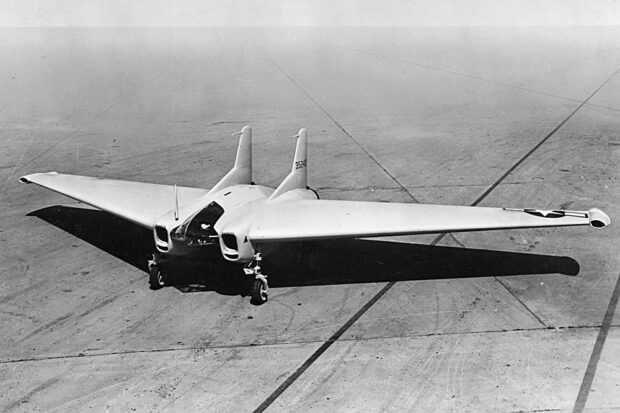
During World War II, American engineers developed one of the strangest fighter aircraft ever built: the Northrop XP-79B, a bizarre flying wing nicknamed the “Flying Chainsaw.” Unlike conventional fighters, this experimental aircraft had no tail, almost no fuselage, and forced its pilot to fly lying flat on his stomach between two jet engines.
According to later accounts, its reinforced leading edges were even intended to slice through enemy bombers during deliberate midair collisions, although surviving wartime records do not confirm that this was its actual mission.
Designed by legendary aviation pioneer Jack Northrop, the XP-79 promised extraordinary speed, maneuverability, and a completely new approach to aerial combat. But turning this radical concept into a working fighter quickly became a nightmare. Early prototypes suffered dangerous control problems, landing failures, and terrifying accidents that nearly killed test pilot Harry Crosby. One experimental flying wing suddenly rolled upside down, forcing Crosby to kick his way out of the cockpit and parachute to safety.
Engineers then experimented with a rocket-powered version that surrounded the pilot with highly dangerous chemicals, only to discover that its engine couldn’t produce enough thrust. Eventually, Northrop abandoned the rocket and installed two turbojet engines inside a reinforced magnesium-alloy wing.
The resulting XP-79B looked unlike anything flying at the time, but its most dangerous test was still ahead. During its first flight in September 1945, the aircraft suddenly entered an uncontrollable rotation, sending Crosby into a desperate struggle to escape before the experimental fighter crashed into the desert. The accident destroyed the only completed XP-79B and brought the ambitious program to an end.
This is the incredible and tragic story of America’s bizarre Flying Chainsaw, an experimental fighter so radical that its own design became one of its greatest dangers.
The Northrop XP-79, USAAF project number MX-365, was a rocket and jet-powered flying wing fighter aircraft, designed by Northrop. The pilot operated the aircraft in a prone position, permitting much greater g-forces to be resisted by the pilot in pitch. The XP-79 also used a welded magnesium monocoque structure instead of riveted aluminum.
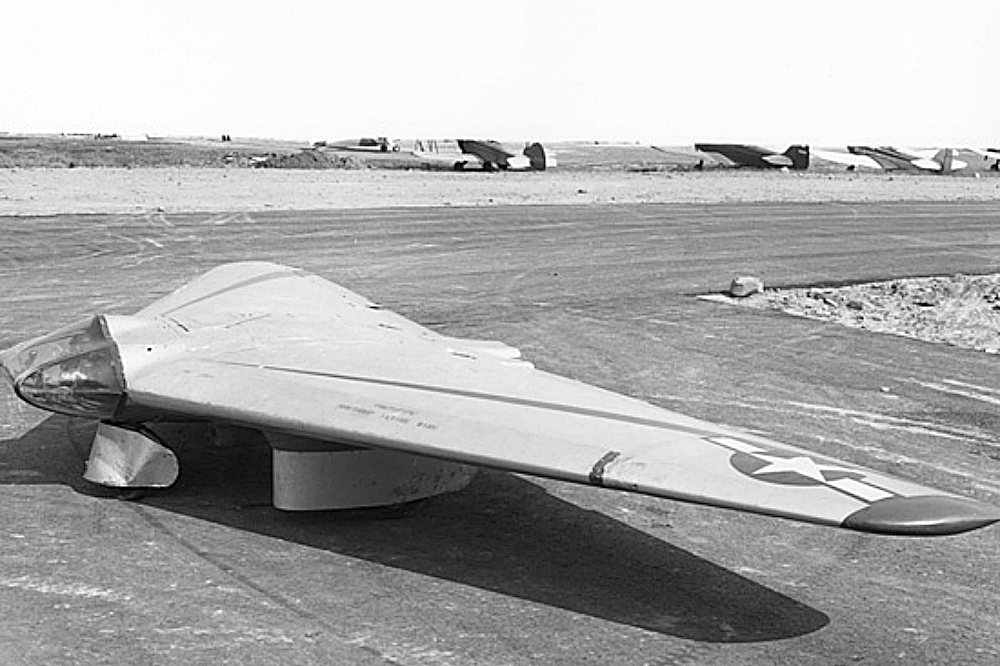
Northrop MX-334 experimental rocket-powered flying wing
Design and Development
In 1942, Jack Northrop conceived the XP-79 as a high-speed rocket-powered flying-wing fighter aircraft. In January 1943, a contract for two prototypes under the XP-79 designation was issued by the United States Army Air Forces (USAAF).
It was planned to use a 2,000 lbf (8,900 N) thrust XCALR-2000A-1 “rotojet” rocket motor from Aerojet that used mono-ethylaniline fuel and red fuming nitric acid (RFNA) oxidizer. However, the rocket motor, which used canted rockets to drive turbo-pumps was unsatisfactory and the aircraft was fitted with two Westinghouse 19B turbojets and re-designated XP-79B.
The XP-79 was built using a welded magnesium alloy monocoque structure with a leading edge thickness of 0.75 in (19 mm) which thinned out to 0.125 in (3.2 mm) at the trailing edge.
The pilot controlled the XP-79 through a tiller bar and intakes mounted at the wingtips supplied air for the unusual bellows-boosted split elevons which opened differentially to provide lateral (yaw) control, by increasing drag on one side of the aircraft, in addition to providing roll and pitch. The aircraft was also fitted with airbrakes outboard of them, also for yaw control. No rudders were used, and the vertical surfaces were simple fixed fins with no flight controls.
Testing
Following delays due to burst tyres and brake problems during taxiing trials at Muroc dry lake, the XP-79B made its first flight on 12 September 1945. 15 minutes into the flight, control was lost for unknown reasons while performing a slow roll. The nose dropped, and the roll continued with the aircraft impacting the ground in a vertical spin.
Test pilot Harry Crosby had attempted to bail out but was struck by the aircraft and died. Shortly thereafter, the project was canceled along with work on the second prototype.
Top Photo: Northrop XP-79B “Flying Ram” s/n 43-52437 – U.S. Air Force photo
Sources: YouTube; Wikipedia