
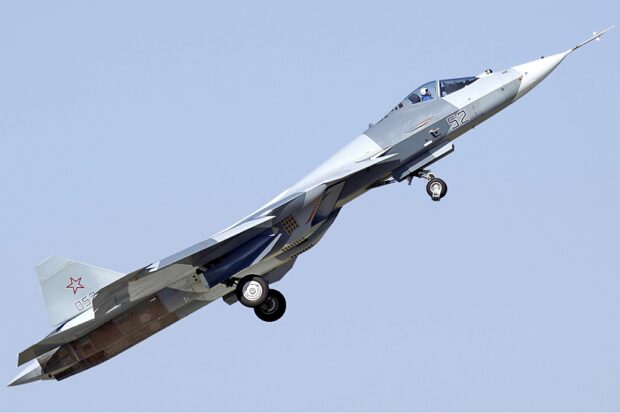
Russia calls the fighter one of the most advanced fifth-generation fighters in the world, yet nearly everything about the aircraft remains surrounded by unanswered questions. Designed as Moscow’s response to the F-22 Raptor, it took a different approach to modern air combat, sacrificing some stealth for extreme maneuverability, speed, powerful sensors, internal weapons bays, and the ability to track multiple targets across a wide field of view.
But more than 15 years after its first flight, the fighter is still operating without the next-generation engine it was originally designed around, while even basic details such as how many aircraft Russia has actually built remain disputed.
Moscow claims the fighter has proven itself in combat over Ukraine, including air-to-air victories and attacks against Ukrainian air defenses, while independent accounts describe a much more cautious role dominated by long-range missile launches from well behind the front lines.
Then, in July 2026, one crashed outside Moscow under circumstances that became another mystery, with competing reports blaming a technical failure, friendly fire, or even a possible cyberattack.
Meanwhile, potential foreign customers have repeatedly walked away, leaving Algeria as the only country described in the script as having actually purchased the fighter. This is the complicated story of an aircraft capable of spectacular airshow performances and surrounded by extraordinary claims, but whose true combat capability, production numbers, reliability, and place among the world’s most advanced fighters remain remarkably difficult to determine.
The Su-57 is a fifth-generation multirole fighter aircraft and the first operational stealth aircraft for the Russian armed forces. In addition to stealth, the fighter emphasizes supermaneuverability in all aircraft axes, capacious internal payload bays for multirole versatility, and advanced sensor systems such as active phased-array radar as well as the integration of these systems to achieve high levels of automation.
In the Su-57’s design, Sukhoi cited the Lockheed Martin F-22 as the baseline for a supermaneuverable stealth fighter, but addressed what the bureau considered to be the limitations, such as the inability to use thrust vectoring to induce roll and yaw moments, a lack of space for weapons bays between the engines resulting in insufficient payload, and complications for post-stall recovery if thrust vectoring fails. In particular, Sukhoi considered the F-22 design unsuitable as a multirole fighter required for PAK FA due to the limited payload that was too focused on air-to-air missiles.
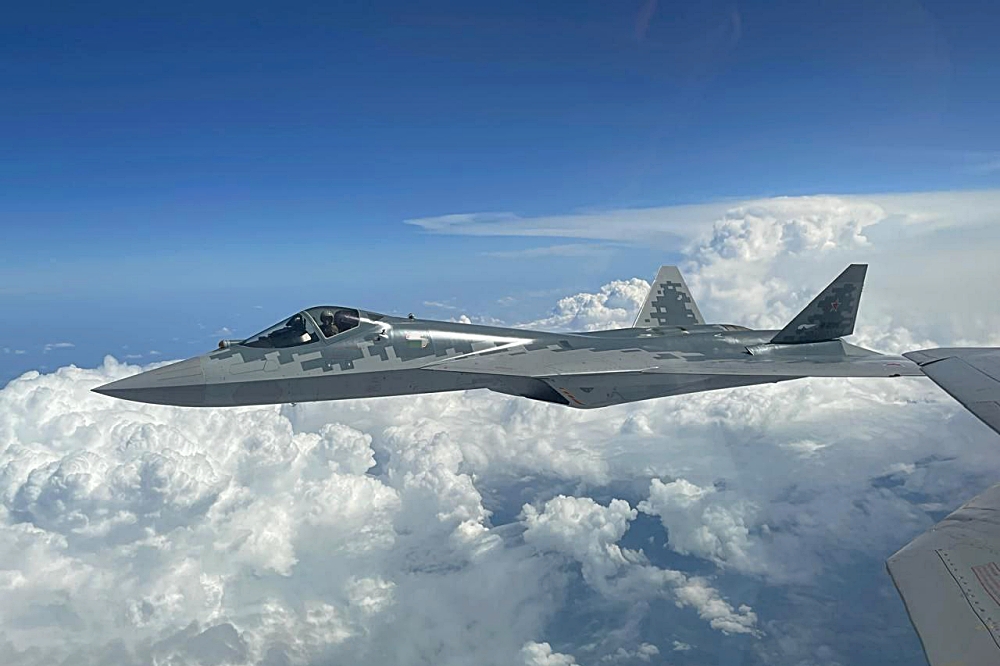
A serial production Su-57 flying in formation, 2025
The aircraft has a wide blended wing body fuselage with two widely spaced engines and has all-moving horizontal and vertical stabilisers, with the vertical stabilisers canted for stealth; the trapezoid wings have leading edge flaps, ailerons, and flaperons. The aircraft incorporates thrust vectoring and large leading edge root extensions that shift the aerodynamic center forward, increasing static instability and maneuverability. These extensions have adjustable leading–edge vortex controllers (LEVCONs) designed to control the generated vortices and can provide trim and improve high angle of attack behaviour, including a quick stall recovery if the thrust vectoring system fails.
To air-brake, the ailerons deflect up while the flaperons deflect down and the vertical stabilisers toe inward to increase drag. Although the majority of the structural materials are alloys with 40.5–44.5% aluminum alloys and 18.6% titanium alloys, the aircraft makes extensive use of composites, with the material comprising 22–26% of the structural weight and approximately 70% of the outer surface.
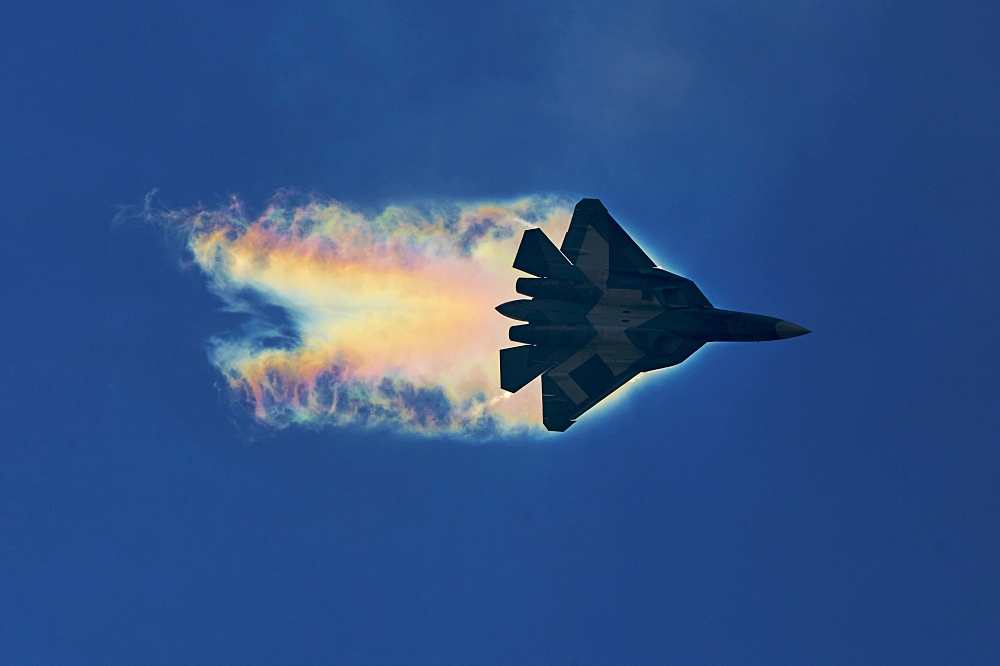
Pre-production Su-57 aerodynamic condensation at the MAKS-2015 Air Show
Designed from the outset as a multirole aircraft, the Su-57 has substantial internal payload capacity that allows the carriage of multiple large air-to-surface ordnance. Weapons are housed in two tandem main weapons bays in the large ventral volume between the widely spaced engine nacelles and smaller side bays with bulged triangular-section fairings near the wing root. Internal weapons carriage eliminates drag from external stores and enables higher performance compared to external carriage, as well as preserving the stealth shaping.
The high degree of static instability (or relaxed stability) in both pitch and yaw, advanced KSU-50 flight control system, and canted thrust vectoring nozzles make the Su-57 departure-resistant and highly maneuverable in all axes and enables the aircraft to perform very high angles of attack maneuvers such as the Pugachev’s Cobra and the bell maneuver, along with doing flat rotations with little altitude loss.
The aerodynamics and engines enable it to achieve speeds of Mach 2 and fly supersonic without afterburners, or supercruise, at Mach 1.3, giving a significant kinematic advantage and extends the effective range of missiles and bombs over previous generations of aircraft. Combined with a high fuel load, the fighter has a supersonic range of over 1,500 km (930 mi), more than twice that of the Su-27. An extendable refuelling probe is available to further increase its range.
Top Photo: Su-57 prototype climbing after takeoff, 2011
Sources: YouTube; Wikipedia