
The F-104 Starfighter was built around a brutally simple Cold War philosophy: make a fighter smaller, faster, and higher-flying than almost anything the Soviet Union could put in the sky. Designed by legendary engineer Kelly Johnson after speaking directly with American pilots fighting in Korea, the aircraft combined a massive J79 engine with razor-thin wings barely 22 feet across, creating a machine pilots nicknamed the “missile with a man in it.”
The result was extraordinary: the Starfighter could exceed Mach 2, climb beyond 80,000 feet in minutes, and in specialized versions reach altitudes above 100,000 feet. But its incredible performance came with almost no room for mistakes. Neil Armstrong narrowly survived a disastrous landing attempt, test pilot Iven Kincheloe was killed after ejecting from an early model equipped with a downward-firing seat, and Chuck Yeager nearly died when an experimental rocket-powered NF-104A entered a flat spin above 100,000 feet.
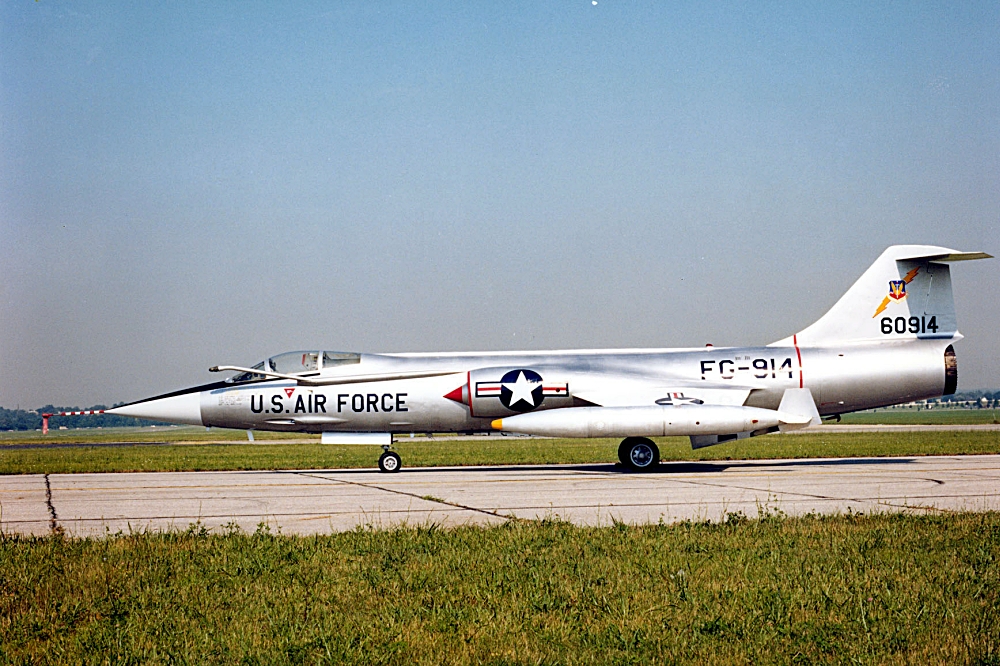
F-104C at the National Museum of the United States Air Force, Wright-Patterson AFB, Ohio
The aircraft’s darkest reputation emerged in West Germany, where increasingly demanding missions helped turn the Starfighter into what crews called the “Flying Coffin” and “Widowmaker.” Of Germany’s 916 F-104s, 292 were lost and 116 pilots died flying them.
Later revelations that Lockheed had paid millions in bribes to influence aircraft purchases overseas only deepened the controversy, although allegations involving specific German officials were never proven. Yet the Starfighter’s record varied dramatically between countries, with Spain operating its fleet for approximately 17,500 flight hours without losing a single aircraft.
This is the controversial story of an engineering masterpiece capable of astonishing speed and altitude—and how pushing it far beyond the mission it was originally designed to perform helped transform the Starfighter into the Widowmaker.
The Lockheed F-104 Starfighter is an American single-engine, supersonic interceptor. Created as a day fighter by Lockheed as one of the “Century Series” of fighter aircraft for the United States Air Force (USAF), it was developed into an all-weather multirole aircraft in the early 1960s and extensively deployed as a fighter-bomber during the Cold War. It was also produced under license by other nations and saw widespread service outside the United States.
After interviews with Korean War fighter pilots in 1951, Lockheed lead designer Kelly Johnson chose to buck the trend of ever-larger and more complex fighters to produce a simple, lightweight aircraft with maximum altitude and climb performance. On 4 March 1954, the Lockheed XF-104 took to the skies for the first time, and on 26 February 1958, the production fighter entered service with the USAF. Just a few months later, it was pressed into action during the Second Taiwan Strait Crisis to deter the use of Chinese MiG-15 and MiG-17 fighters.
Problems with the General Electric J79 engine and a preference for fighters with longer ranges and heavier payloads initially limited its service with the USAF, though it was deployed for the Berlin Crisis of 1961 and widely used during the Vietnam War, when it flew more than 5,000 combat sorties.
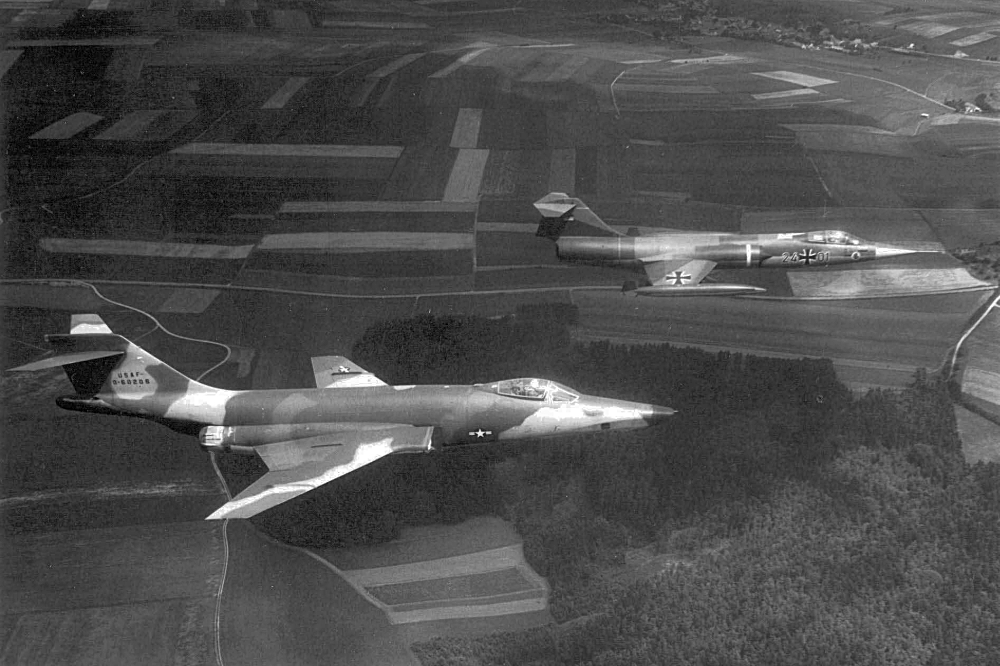
A U.S. Air Force McDonnell RF-101C-55-MC Voodoo (s/n 56-206) from the 17th Tactical Reconnaissance Squadron, 66th Tactical Reconnaissance Wing at Upper Heyford (UK), flying in formation with a West German Luftwaffe Lockheed RF-104G Starfighter (24+01) from Aufklärungsgeschwader 51 „Immelmann“ (51st Reconnaissance Wing) at Bremgarten, Germany, in the 1960s
Fifteen NATO and allied air forces eventually flew the Starfighter, many for longer than the USAF. In October 1958, West Germany chose the F-104 as its primary fighter aircraft. Canada soon followed, then the Netherlands, Belgium, Japan, and Italy. The European nations formed a construction consortium that was the largest international manufacturing program in history to that point. In 1975, it was revealed that Lockheed had bribed many foreign military and political figures to secure purchase contracts.
The Starfighter had a poor safety record, especially in Luftwaffe service. The Germans lost 292 of 916 aircraft and 116 pilots from 1961 to 1989, leading the German public to dub it Witwenmacher (“widowmaker”). The final production version, the F-104S, was an all-weather interceptor built by Aeritalia for the Italian Air Force. It was retired from military service in 2004. As of 2026, several F-104s remain in civilian operation with Florida-based Starfighters Space.
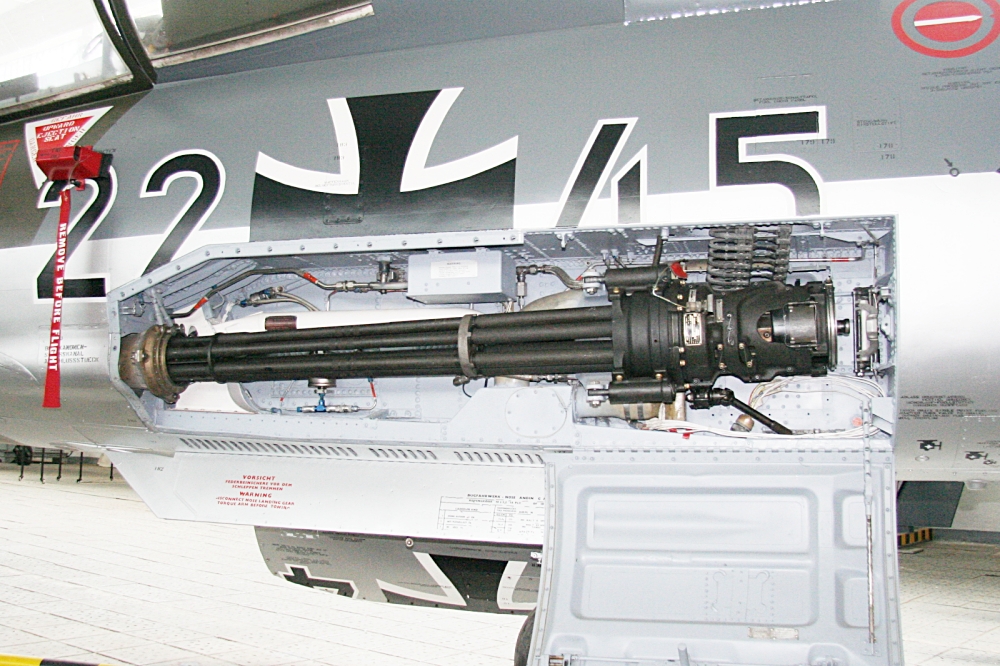
Opened weapons bay with a M61 gun installation of a Luftwaffe Lockheed F-104G in the museum of aviation and technology in Wernigerode (Saxony-Anhalt, Germany)
The Starfighter’s design was radical, with thin, stubby wings attached farther back on the fuselage than most contemporary aircraft. The wing provided excellent supersonic and high-speed, low-altitude performance, but also poor turning capability and high landing speeds. It was the first production aircraft to achieve Mach 2, and the first aircraft to reach an altitude of 100,000 ft (30,000 m) after taking off under its own power. The Starfighter established world records for airspeed, altitude, and time-to-climb in 1958, becoming the first aircraft to hold all three simultaneously. It was also the first aircraft to be equipped with the M61 Vulcan autocannon.
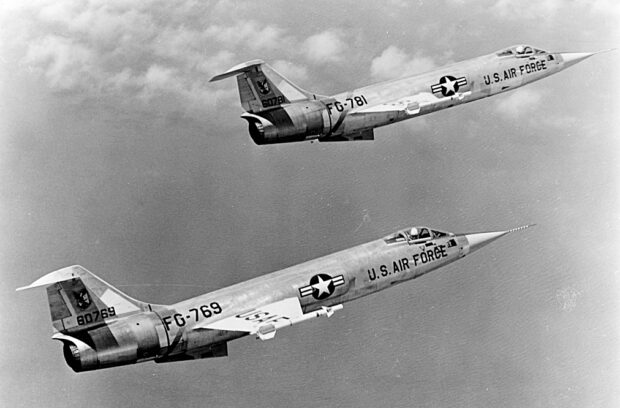
Top Photo: A formation of two U.S. Air Force Lockheed F-104A-15-LO Starfighters (s/n 56-0769 and 56-0781) in flight
Sources: YouTube; Wikipedia