
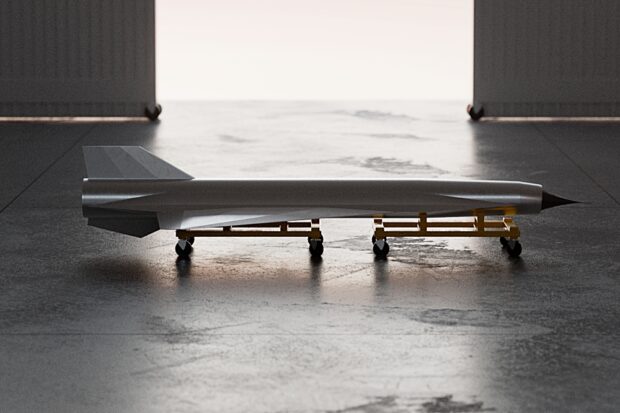
Hermeus announced recently that it is developing Ramjet-X, a low-cost, expendable ramjet-powered vehicle designed for launch from its Quarterhorse aircraft. Once released, Ramjet-X will fly at high-Mach speeds.
Ramjets require significant initial speed before they can operate effectively. Instead of relying on a large, expensive, expendable booster for every test, Hermeus will use its reusable Quarterhorse aircraft to carry Ramjet-X to the speed and altitude required for launch. Once released, Ramjet-X will commence ramjet-powered flight, while Quarterhorse returns for future flight test missions.
Ramjet-X will also enable Hermeus to offer high-Mach Flight Test as a Service (FTaaS), expanding access to flight environments that have historically been costly and difficult to reach. Customers and partners will be able to integrate payloads, sensors, communications and compute systems, autonomy, material samples, propulsion technologies, and other experimental hardware and software onto Ramjet-X for testing in representative sustained high-Mach conditions. By providing a repeatable platform, launch architecture, and flight-test infrastructure, Hermeus can allow customers to focus on the technology being evaluated rather than developing a bespoke high-speed flight vehicle and test program for every experiment.
“High-speed flight testing is extremely expensive, and you don’t get many shots at it,”
said Zach Shore, CEO of Hermeus.
“Ramjet-X gives us a way to put new systems into sustained high-Mach environments without building an expensive one-off test program every time. Bringing speed, sustained flight, and scalability all into one system lowers the barriers to gathering extremely valuable data from these conditions and accelerates programs for both us and our customers.”
Development of Ramjet-X is already well underway. Hermeus is testing Ramjet-X’s ramjet engine at its HEAT facility in Jacksonville, Florida, while high-temperature structures are in development at its headquarters in El Segundo, California. Integrated vehicle testing is currently planned for 2027.
America didn’t lose ground in high-speed flight because of a lack of ideas. We slowed down because flight tests became too expensive, too rare, and too cautious.
Meet Ramjet-X. Air-launched from the Quarterhorse program, it’s a low-cost, repeatable test vehicle built to fly and… pic.twitter.com/rMed6NhcvD
— Zach Shore (@Zsshore) September 9, 2026
Hermeus has not released detailed performance specifications for Ramjet-X, including its range, payload capacity, or the critical expected cost per flight.
Images released by the company show a relatively compact, missile-like vehicle with delta wings incorporating prominent dihedral. There are no horizontal tail surfaces, but a conventional vertical fin is complemented by a ventral fin. Axios reports that Ramjet-X is approximately 22 feet long and 7 feet wide.
The basic concept aims to address a longstanding problem with ramjet flight testing. Unlike a conventional jet engine, a ramjet cannot provide useful thrust from a standstill. The vehicle therefore has to be accelerated to a sufficiently high speed before the ramjet can take over.
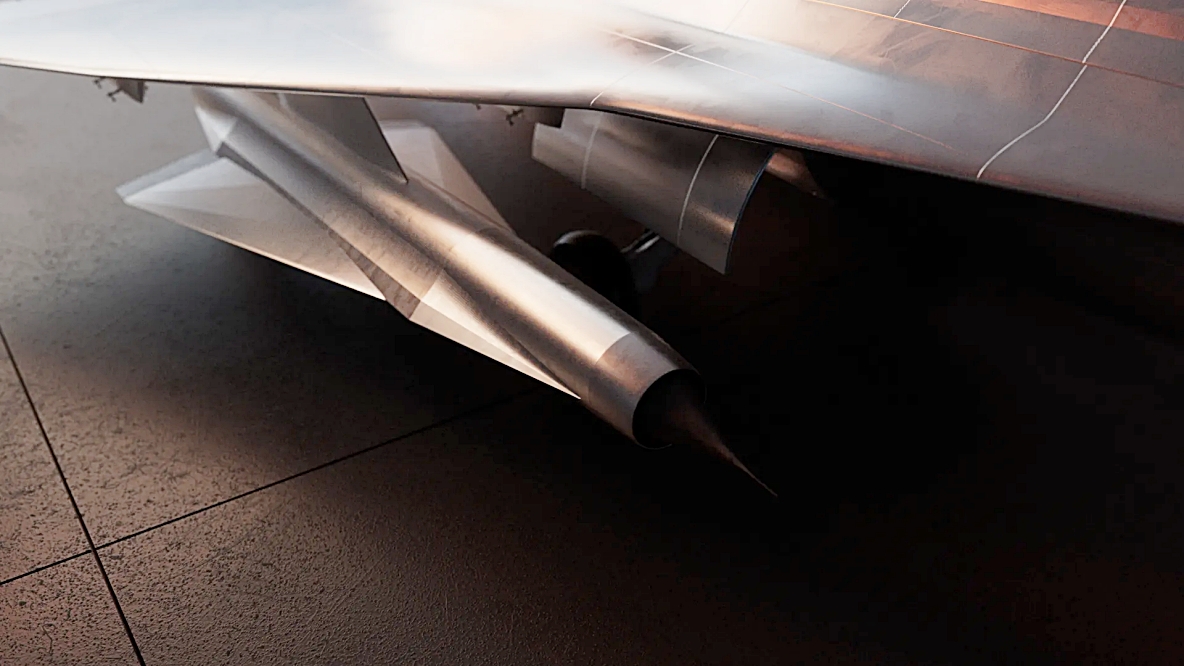
That acceleration can traditionally require another propulsion system, including an expendable rocket booster. Hermeus is proposing to substitute a reusable aircraft for that initial boost. It is unclear if the Ramjet-X vehicles are similarly recoverable, but we have asked Hermeus for more details here, too.
As it stands, flight-test programs of this kind are often constrained not only by the cost and availability of test infrastructure, but also by the limited availability of suitable airspace and range access. A reusable carrier aircraft could help address both challenges, allowing multiple Ramjet-X vehicles to be deployed from airports near a designated test range as required and launched only once the vehicle is within the approved test area. That flexibility could reduce the need for a new large booster for every experiment while also making it easier to conduct tests, including at shorter notice, within increasingly constrained airspace.
Hermeus says Ramjet-X is being designed not just for its own development work but as a potential test platform for outside customers. The company is calling the concept “Flight Test as a Service,” with customers able to fly payloads including sensors, communications equipment, computing and autonomy systems, materials, and propulsion hardware.
The program reflects a broader push toward increasing the availability of commercial high-speed flight testing that has attracted U.S. government interest.
Sources: Hermeus; The War Zone