
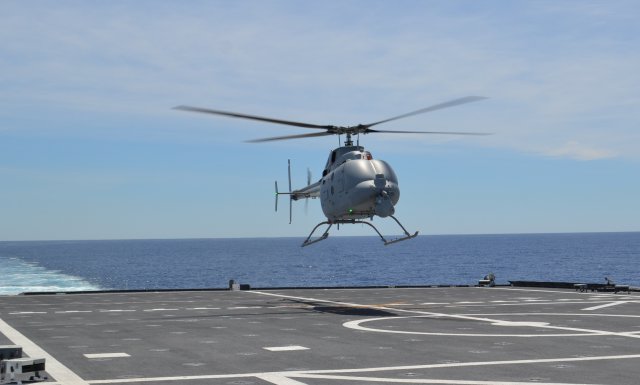
 Northrop Grumman Corporation’s autonomous helicopter, MQ-8C Fire Scout, took to the air for the first time from a U.S. Navy independence-class Littoral Combat ship, USS Montgomery (LCS-8). The flight took place off the coast of California during the second phase of Dynamic Interface testing, once again demonstrating Fire Scout’s stability and safety while operating around the ship.
Navy Gun Shoots So Fast There is No Bang – Just Brrrrr
Sailors aboard the amphibious assault ship USS Bataan (LHD 5) perform a close in weapon system live fire exercise. Bataan is underway in preparation for a scheduled upcoming deployment. Continue reading
Drone Carries Pilot Cable for Bridge in China
As China impresses the world with its efficiency in building massive bridges, builders have found a new way to construct overpasses even faster. Workers who are building the 4,629-foot-long Xingkang Bridge in Sichuan Province have used a drone to help them install cables. Continue reading
Sweden Changes Law to Make Drones Legal Again
As reported before, in the autumn of 2016, the Swedish Supreme Administrative Court ruled that a camera mounted on a drone is considered a CCTV camera for purposes of the Swedish Camera Monitoring Act. The judgment meant that using a drone equipped with a camera, where the camera will be directed at a place to which the public has access, requires a licence from the County Administrative Board. Continue reading
US Navy Research Lab Plans CICADA Swarm Tests
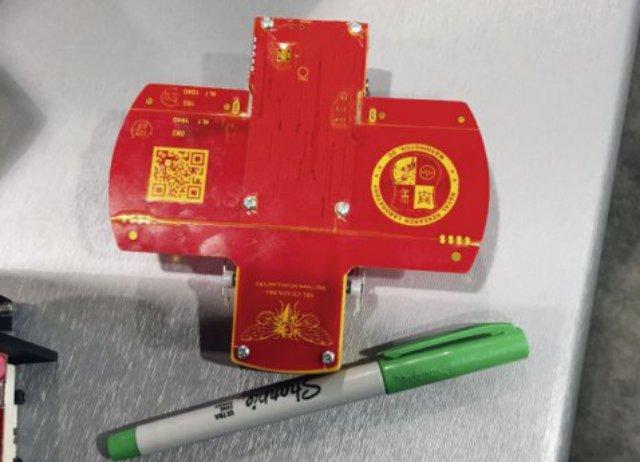 The US Naval Research Laboratory (NRL) is planning swarming tests of its Close-In Covert Autonomous Disposable Aircraft (CICADA) MK5 from a US Navy P-3 Orion aircraft. Continue reading
Sweden Bans CybAero Export to China
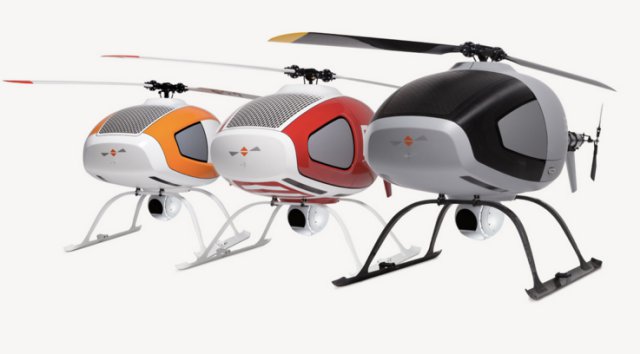 CybAero has received a recall of a previously issued export license from the ISP – The Inspectorate of Strategic Products. The export authorization referred to a helicopter system for demonstration flights in China with the end customer AVIC.
Marsupial Robot for Explosive Situations
It’s a shame that drones don’t work so hot indoors. After all, they’d be immensely useful for, say, decommissioning chemical and energy plants by providing a view of overhead pipes and such that terrestrial rovers can’t reach. Rescue roboticist Robin Murphy of Texas A&M may have solved this problem—with marsupials. Continue reading
FAA Will Release Maps to Speed up Drone Authorization Applications

The Federal Aviation Administration (FAA) plans to release the first set of unmanned aircraft systems (UAS) facility maps on April 27. The maps will depict areas and altitudes near airports where UAS may operate safely. Continue reading