In a pair of projects announced last week, researchers from MIT’s Computer Science and Artificial Intelligence Laboratory (CSAIL) demonstrated software that allow drones to stop on a dime to make hairpin movements over, under, and around some 26 distinct obstacles in a simulated “forest.” Continue reading
Category Archives: Research
Fireproof Aerial Robot System (FAROS) from Korea
This video demonstrates the FAROS (Fireproof Aerial RObot System) for fire disaster. The drone can climb the wall to pass through narrow and smoky area. It has a 2D-LiDAR sensor for self-localization. Its pose estimation result is visualized on V-REP simulator. Continue reading
Autonomous Landing on a Moving Car
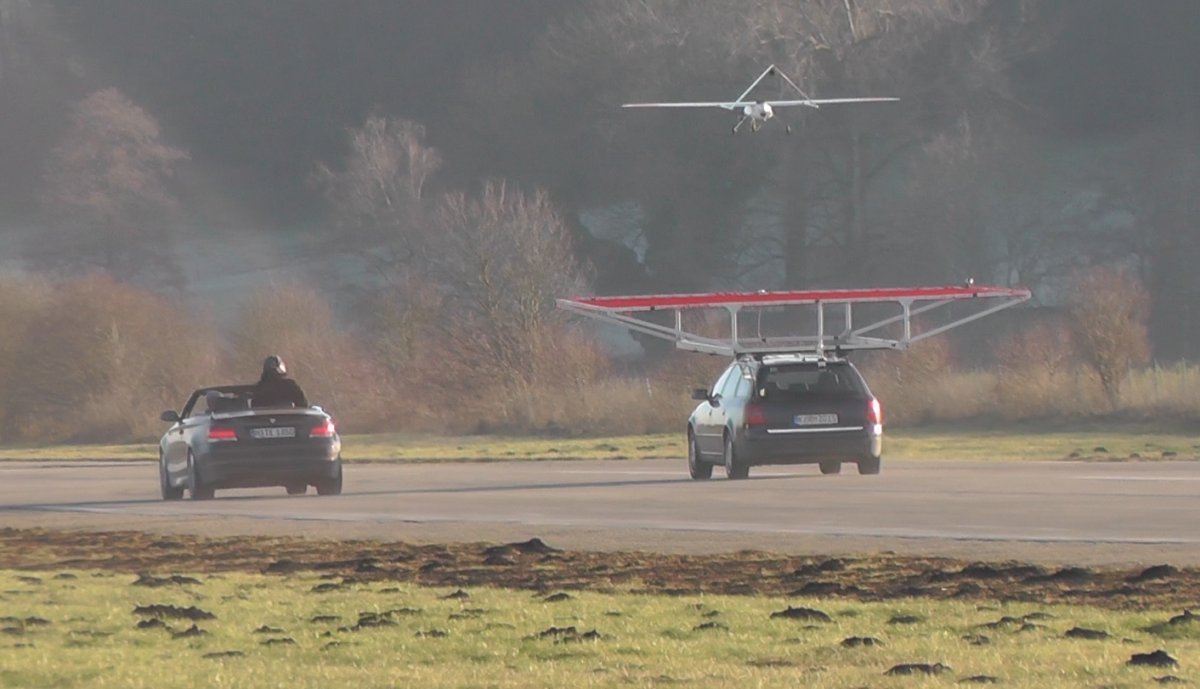 An unmanned, electric, autonomous aircraft travelling at 75 kilometres per hour lands gently on the roof of a moving car. For the first time, researchers at the German Aerospace Center (Deutsches Zentrum für Luft- und Raumfahrt; DLR) have successfully demonstrated a technique developed for this purpose.
Coyote Flies into Hurricanes for NOAA
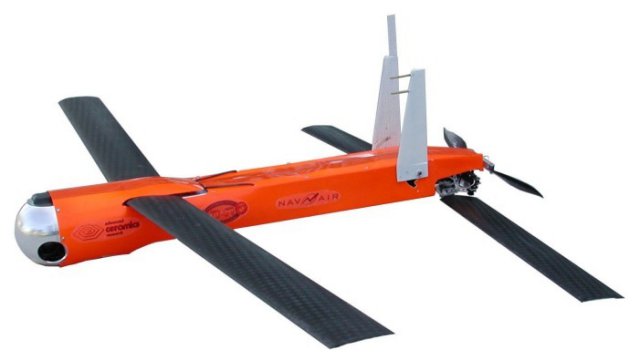
Coyote
Raytheon Company is providing its enhanced Coyote Unmanned Air System to the National Oceanic and Atmospheric Administration for hurricane tracking and modelling, giving researchers an unprecedented perspective from inside storms that build in the Atlantic Ocean. The Coyote is a small, expendable UAS that can be tube-launched from a host vehicle on the ground or in the air. Continue reading
Belgian Drone Mixes Plane and QuadCopter Technology
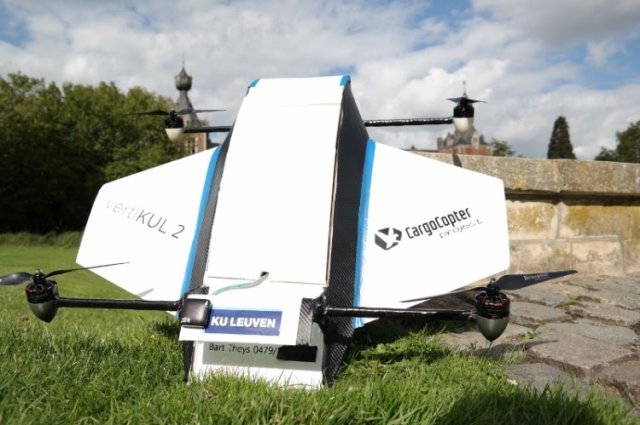 Researchers in Belgium have devised a prototype delivery drone which they say could rival the likes of Amazon Prime Air and Google’s Project Wing. The University of Leuven team behind VertiKUL 2 (KUL is the acronym for Katholieke Universiteit Leuven) say the drone combines the ability of quad-copters to take-off and land vertically with both the speed of conventional aircraft and their capacity to fly long distances.
One-Eyed Bug Vision Helps Drones Land
In an effort to build—and control—ever smaller drones, researchers have been looking at how insects navigate. Insects use a technique called optical flow, based on the apparent speed of objects passing by in their field of vision. In fact, humans use optical flow to give us a sense of how fast we’re going when we’re driving. Continue reading
NRL Tests Cooperative Soaring Concept for Sustained Flight of UAV Sailplanes

The U.S. Naval Research Laboratory (NRL), in collaboration with the Air Vehicle Intelligence and Autonomy (AVIA) Lab at Pennsylvania State University (PSU), completed testing of cooperative autonomous soaring algorithms used to keep unmanned sailplanes aloft for sustained flight duration’s — demonstrating the concept of shared soaring data between two unmanned aerial vehicles (UAVs) in flight. Continue reading
Multiple-Scenario Unmanned Aerial System Control