
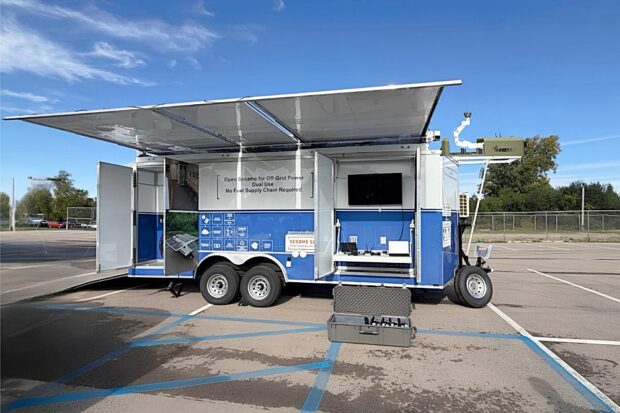
Sesame Solar, Target Arm and AG3 Labs are launching the Persistent Drone Operations Nanogrid, the first integrated solution that combines Sesame Solar’s self-generating mobile power, Target Arm’s robotic arm and drone magazines for autonomous drone launch-and-recovery, and AG3 Labs’ attritable, unmanned aircraft into a single system for training and forward expeditionary use.
“Mobile electric power is a critical fifth supply requirement along with food, water, munitions, and fuel. If a forward expeditionary team can’t power its drones, or their batteries fail from heat or cold, warfighters lose one of their most valuable assets,”
said Lauren Flanagan, CEO and co-founder of Sesame Solar.
“Together with Target Arm and AG3 Labs, we’ve built a comprehensive solution that eliminates the fuelsupply chain while keeping drones in the air for extended durations.”
The Persistent Drone Operations Nanogrid Removes Bottlenecks by Combining:
- Sesame Solar’s Mobile Power Hub, which transports, stores, and charges forward expeditionary equipment using solar and hydrogen power, battery storage, and low-pressure,solid-state hydrogen that can be safely transported by land, sea or air. No fuel supply is required.
- Target Arm’s Ralar system is an autonomous robotic arm launch and recovery system that lets drones deploy, recover, recharge and relaunch with no pilot on-site and while moving. TargetArm’s drone magazines work with the Ralar system to autonomously cycle drones throughdeployment, for persistent 24/7/365 coverage.
- AG3 Labs’ SPADE platform is a Group 1 sUAS that reconfigures for the mission, supporting ISR, communications relay and, for defense users, kinetic payloads. SPADE can be flown one-to-one or controlled one-to-many as an autonomous swarm, supporting training, first responder, law enforcement, military and special operations missions.
- Mobile Microgrid. The Persistent Drone Operations Nanogrid is available as a standalone solution or in a series of two to twelve Nanogrids, creating a turnkey MIL-STD mobile microgrid,which can also charge man-portable batteries and other forward expeditionary equipment.
The launch comes as federal policy moves decisively toward domestic production. Executive Order 14307 directs agencies to expand U.S. UAS manufacturing and reduce reliance on foreign-made drones,and the Department of Defense has moved this year to arm units with small, U.S.-sourced drones atscale. As a domestically manufactured solution, the Persistent Drone Operations Nanogrid meets these requirements, while providing a comprehensive solution that improves operational readiness and supply chain security.
“Every system we build at Target Arm starts with the same question: does this bring someone homesafe?”
said Jeffrey A. McChesney, CEO & Founder of Target Arm.
“The launch and the recovery are two of the most exposed moments of a drone mission – someone standing in the open, waiting on an aircraft.Ralar takes a person out of that moment entirely. What makes our system even more unique is that drones can be launched from a moving vehicle or a boat, so warfighters never need to stop to complete their mission.”
Potential Applications for the Integrated Solution Include:
- Defence and military operations: persistent intelligence, surveillance and reconnaissance(ISR); perimeter monitoring; distributed tactical operations; training; and counter-UAS exercises.
- Law enforcement and homeland security: remote surveillance, search and rescue, border monitoring and situational awareness.
- Critical infrastructure protection: monitoring of power infrastructure, pipelines, communications networks, transportation corridors and other geographically dispersed assets.
- Emergency management: rapid deployment of aerial assets following natural disasters or otheremergencies when conventional infrastructure may be unavailable.
- Industrial and commercial operations: remote inspection, security, agriculture and monitoring across large or difficult-to-access facilities.
“Operators shouldn’t need a different drone for every mission — they need one airframe they can reconfigure in the field and put up in numbers,”
said Nick Smock, Co-Founder/Head of Growth at AG3Labs.
“Put that on a system that launches, recovers and recharges itself, and you have persistent capability without adding a single person to the team.”
Source: Sesame Solar