
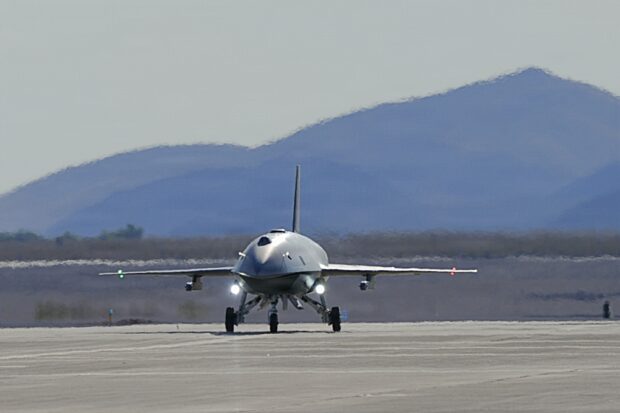
The Department of the U.S. Air Force executed airborne tactical command and in-flight control of a YFQ-44A Collaborative Combat Aircraft from an F-22 Raptor earlier this month, advancing efforts to rapidly develop, evaluate and deliver mission-autonomy capabilities to the warfighter.
During the demonstration, an F-22 pilot served as an airborne “quarterback,” issuing high-level tactical directives to a single YFQ-44A. The aircraft’s onboard autonomy software interpreted and executed those directives in real time, conducting dynamic flight maneuvers and simulated combat tasks.
“This achievement demonstrates what is possible when we are aligned with industry on a shared imperative: delivering capability to the warfighter at unprecedented speed,”
said Secretary of the Air Force Troy Meink.
“We are driving urgency into every part of acquisition from rapid integration and flight learning to disciplined assessment, so we can turn promising technology into combat capability at the pace the threat demands.”
The event brought together personnel from the 412th Test Wing, 422nd Test and Evaluation Squadron, 309th Software Engineering Group, Experimental Operations Unit, F-22 System Program Office and the CCA Software Autonomy and Teaming Branch.
The Department will use data from this test milestone to inform continued software integration, developmental testing and the Air Force’s future CCA concepts.
“This flight shows the power of manned-unmanned teaming and the advantage it provides our warfighters,”
said Air Force Chief of Staff Gen. Ken Wilsbach.
“We must test often, learn fast and give commanders what they need, when they need it.”
The CCA program is part of a broader Department of the Air Force effort to deliver affordable, adaptable and combat-ready capability at speed. The Air Force intends to have 500 combat-ready, semi-autonomous systems by 2032, with an overall fleet size of 1000 that will extend reach, awareness and survivability of American airpower in contested environments.
Anduril Industries, the manufacturer of the Fury, said in follow-up statements that the flight took place out of Edwards Air Force Base, Calif., during the week of Oct. 5.
Mark Shushnar, Anduril’s vice president of autonomous airpower, said the Fury and F-22 both took off at Edwards, and then joined up midair. The Raptor pilot then sent an updated mission plan to the Fury CCA using a tactical data link, “commanding Fury through operationally relevant maneuvers from the cockpit of the manned quarterback” fighter.
For this demonstration, the F-22 was controlling a single YFQ-44A. But the Air Force’s plan is to eventually have each fighter pilot capable of controlling multiple CCAs as a formation—extending the service’s combat mass and reach.
Photo: A YFQ-44A Fury aircraft assigned to the Collaborative Combat Aircraft Experimental Operations Unit taxis after landing at Creech Air Force Base, Nevada, July 20, 2026. The exercise integrated the semi-autonomous aircraft into simulated combat operations, focusing on rapidly deploying from dispersed locations. (U.S. Air Force photo by Senior Airman Renee Blundon)
Sources: U.S. Air Force; Air&Space Forces Magazine