
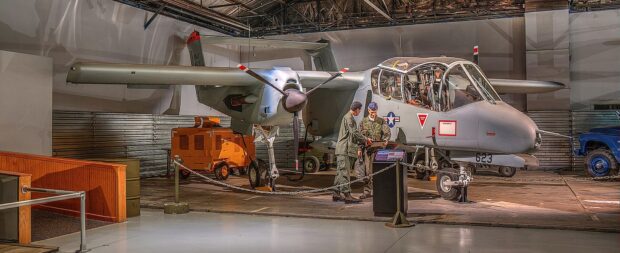
It looked outdated almost the moment it was created. In the early 1960s, as the Pentagon obsessed over supersonic jets and nuclear warfare, two frustrated Marine Corps officers believed the military was building the wrong aircraft for the wars soldiers were actually fighting. They wanted something slower, simpler, and capable of staying close to troops on the ground for hours at a time.
Working out of a garage in California, they designed a strange twin-boom aircraft that looked more improvised than revolutionary.
The Pentagon hated it at first.
It wasn’t fast. It wasn’t sleek. It carried machine guns instead of advanced missiles, and it looked completely out of place beside the jet fighters dominating military aviation. But as the war in Vietnam escalated, American forces discovered a problem their modern aircraft couldn’t solve. Jets flew too fast to properly observe the battlefield. Existing scout planes were too fragile and lightly armed. The military needed something in between.
That aircraft became the OV-10 Bronco.
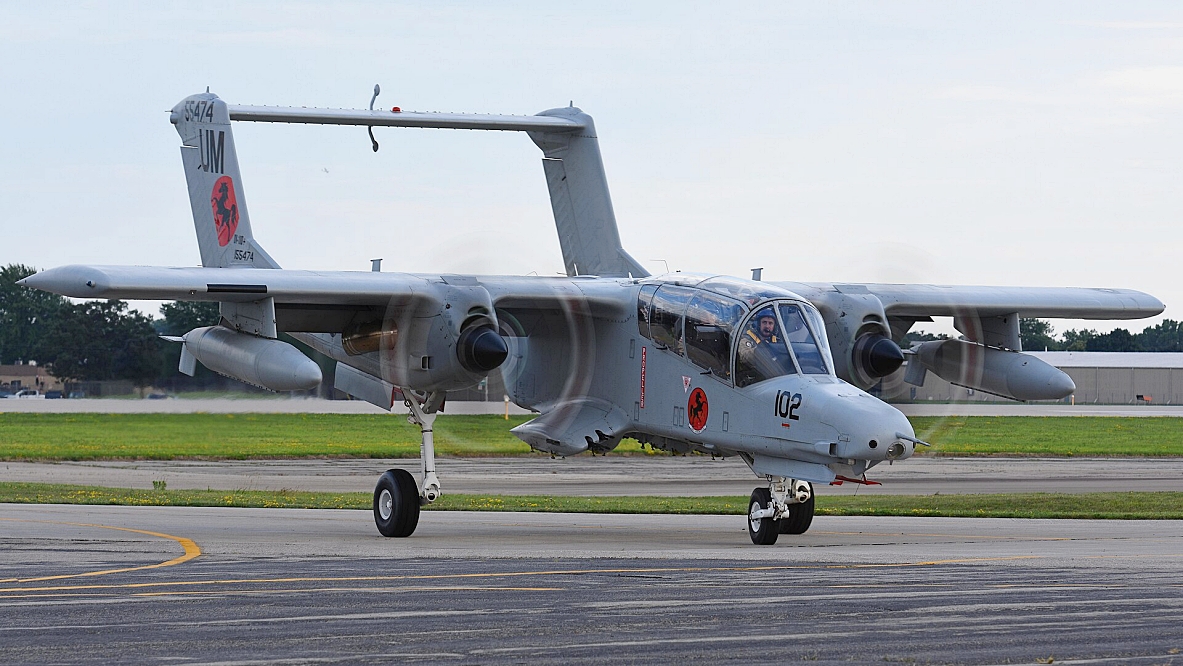
OV-10 “White Lightning” arriving at AirVenture 2025 on July 21, 2025
Flying low over jungles, rivers, and villages, Bronco crews could spot enemy movement that fast jets would miss entirely. They could orbit for hours, identify patterns on the ground, direct artillery and air strikes, and attack targets themselves with rockets and machine guns. Troops learned to trust the strange aircraft overhead because it stayed with them when other aircraft had to leave. Enemy forces learned to fear it for the exact same reason.
The Bronco adapted constantly. In Vietnam, Navy crews turned it into an improvised attack aircraft supporting patrol boats and SEAL teams deep in the Mekong Delta. Later, Air Force crews used laser-guided bombs and advanced targeting systems to hunt along the Ho Chi Minh Trail. Some pilots flew so low and so slowly that a single rifle bullet through the canopy could decide whether the crew lived or died. Others stayed in burning aircraft to save the man behind them.
After Vietnam, the aircraft refused to disappear.
Broncos fought wildfires in California, tracked drug traffickers in South America, and returned to combat during the Gulf War. Even after the U.S. military officially retired the aircraft in 1995, officers quietly admitted nothing else could fully replace what it did. Fast jets were more advanced, but they couldn’t stay over the battlefield long enough to understand it.
Then, in 2015, the impossible happened.
The U.S. military secretly brought the OV-10 back into combat against ISIS. Nearly fifty years after its first missions in Vietnam, the old twin-boom aircraft once again found itself circling above rivers, tracking small enemy boats for hours before destroying them with precision-guided rockets.
The North American Rockwell OV-10 Bronco is an American twin-turboprop light attack (V) and observation (O) aircraft. It was developed in the 1960s as a special aircraft for counter-insurgency (COIN) combat, and one of its primary missions was as a forward air control (FAC) aircraft. It can carry up to 3,200 lb (1,450 kg) of external munitions and internal loads such as paratroopers or stretchers, and can loiter for three or more hours.
Development
The aircraft was initially conceived in the early 1960s through an informal collaboration between W.H. Beckett and Colonel K.P. Rice, U.S. Marine Corps, who met at Naval Air Weapons Station China Lake, California, and who also happened to live near each other. The original concept was for a rugged, simple, close-air-support aircraft integrated with forward ground operations. At the time, the U.S. Army was still experimenting with armed helicopters, and the U.S. Air Force was not interested in close air support.
The concept aircraft was to operate from expedient forward air bases using roads as runways. Speed was to be from very slow to medium subsonic, with much longer loiter times than a pure jet. Efficient turboprop engines would give better performance than piston engines. Weapons were to be mounted on the centerline to get efficient unranged aiming. The inventors favored strafing weapons such as self-loading recoilless rifles, which could deliver aimed explosive shells with less recoil than cannons, and a lower per-round weight than rockets. The airframe was to be designed to avoid the back blast.
Beckett and Rice developed a basic platform meeting these requirements, then attempted to build a fiberglass prototype in a garage. The effort produced enthusiastic supporters and an informal pamphlet describing the concept. W.H. Beckett, who had retired from the Marine Corps, went to work at North American Aviation to sell the aircraft.
Rice states:
The military definition of STOL (500 ft to a 50-ft obstacle) allows takeoff and landing in most of the areas in which limited war might be fought. In addition, the airplane was designed to use roads so that operation would even be possible in jungle areas, where clearings are few and far between. As a result, the wingspan was to be limited to 20 feet and a heavy trailing arm-type landing gear with a tread of 6.5 ft was provided for operation from roads. Float operation was to be feasible …it is quite feasible to design the various components so that it can be disassembled easily and stored in a box that would fit in a 6×6 truck bed together with the equipment needed for re-assembly in the field. It could thus be transported by amphibious shipping and either heli-lifted or driven ashore by a 6×6 truck.
Light Armed Reconnaissance Aircraft
A “tri-service” specification for the Light Armed Reconnaissance Aircraft (LARA) was approved by the U.S. Navy, Air Force, and Army, and was issued in late 1963. The LARA requirement was based on a perceived need for a new type of “jungle fighting”, versatile, light attack and observation aircraft. Existing military aircraft in the observation role, such as the Cessna O-1 Bird Dog and Cessna O-2 Skymaster, were perceived as obsolescent, with too slow a speed and too small a load capacity for this flexible role.
The specification called for a twin-engined, two-man aircraft that could carry at least 2,400 pounds (1,100 kg) of cargo or six paratroopers or stretchers, and be stressed for +8 and −3 g (basic aerobatic ability). It also had to be able to operate from an aircraft carrier, fly at least 350 miles per hour (560 km/h), take off in 800 feet (240 m), and convert to an amphibious version. Various armaments had to be carried, including four 7.62 mm (0.300 in) machine guns with 2,000 rounds, and external weapons including a gun pod with 20 mm (0.79 in) M197 electric cannon, and AIM-9 Sidewinder air-to-air missiles.
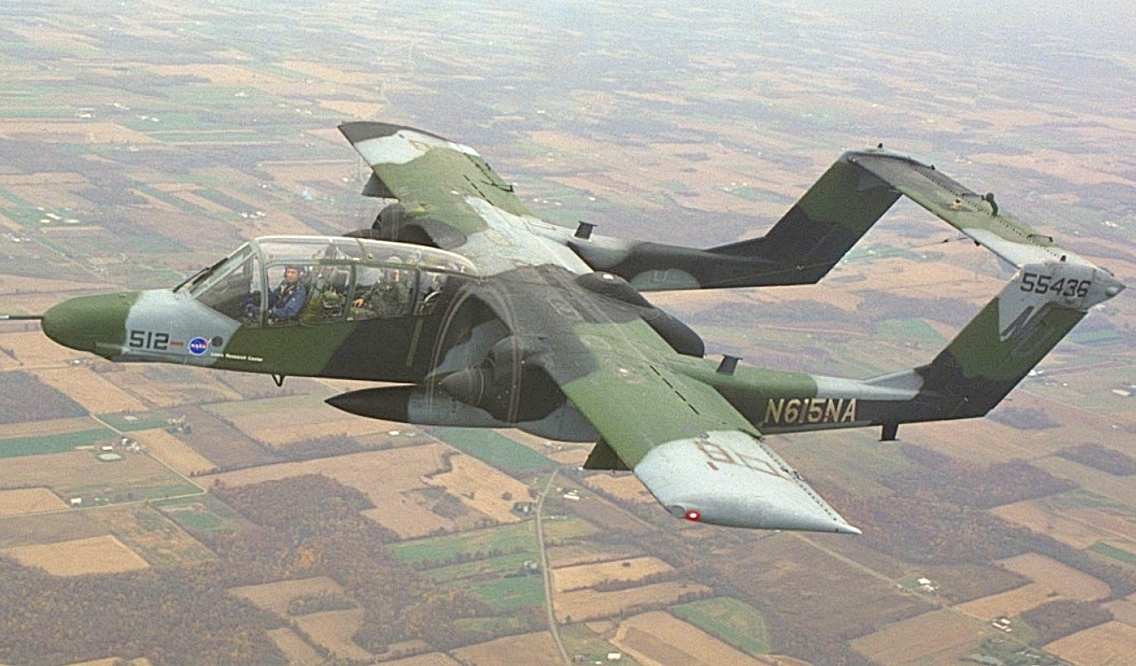
NASA LEWIS RESEARCH CENTER HANGAR AND OV-10 AIRPLANE
Eleven proposals were submitted, including the Grumman Model 134R tandem-seat version of the already fielded U.S. Army’s OV-1 Mohawk (the U.S. Marine Corps dropped out of the Mohawk program in 1958), Goodyear GA 39, Beechcraft PD-183, Douglas D-855, Convair Model 48 Charger, Helio 1320, Lockheed CL-760, a Martin design, and the North American Aviation/Rockwell NA-300.
In August 1964, the NA-300 was selected. A contract for seven prototype aircraft was issued in October 1964. Convair protested the decision and built a small-wing prototype of the Model 48 Charger anyway, which first flew on 29 November 1964. This was also a twin-boom aircraft that had a broadly similar layout to the OV-10. The Charger, while capable of outperforming the OV-10 in some respects, crashed on 19 October 1965 after 196 test flights. Convair subsequently dropped out of contention.
Top Photo: OV-10 Bronco display at the Museum of Aviation at Robins AFB
Sources: YouTube; Wikipedia