
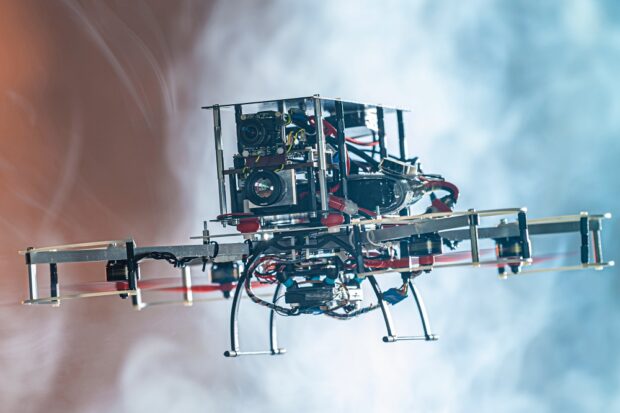
Researchers at the Karlsruhe Institute of Technology (KIT) have developed a new concept for drone defence: Thin chains are fired at incoming drones, entangled in their rotors, and bring them down in a controlled manner. Simulations and initial field tests demonstrate the basic functionality of this approach.
Drones are increasingly being used in sensitive areas such as military technology and surveillance. In Germany, drones have been repeatedly sighted near critical infrastructure in recent years. Conventional defence systems are often technically complex or have limited usability due to technical limitations. Against this backdrop, the researchers sought the simplest, most robust, and most rapidly deployable approach to drone defense.
Physical Principle from Materials Research
The researchers’ approach applies the principle of wrapping to drone defence. Thin metal chains are launched toward the drone using suitable launching devices.
“We utilize a well-known physical principle, such as the one used by shepherds in South America for their bola, and adapt it specifically for drone defence,”
says Professor Claus Mattheck, KIT Distinguished Senior Fellow at the Institute for Applied Materials at KIT, who developed the method together with external partners.
“Instead of balls on ropes, we use thin chains, which have proven superior in simulations. Upon contact, the chains wrap around the drone’s body and rotors. This causes the rotors to lose their mobility, and the drone crashes.”
Simulations Show Advantages Compared to Conventional Projectiles
Calculations by an engineering firm examined the behavior of chains with diameters of three to four millimeters upon impact with model drones. The simulations take into account factors such as friction, geometry, and motion sequences.
“We verified the fundamental suitability of the method through these computer simulations. A particular advantage of chains as projectiles is that, when falling, they have less potential for collateral damage than a compact projectile of the same mass,” explains Mattheck. “Further verifications were carried out experimentally through firing tests at the Sternenfels Ballistics Center.”
The researchers published the results of the simulations and initial tests in the journals Aerospace & Defence and Konstruktionspraxis. The team plans to expand the field trials in the next step. If these are also successful, industry could adopt the idea for implementation.