
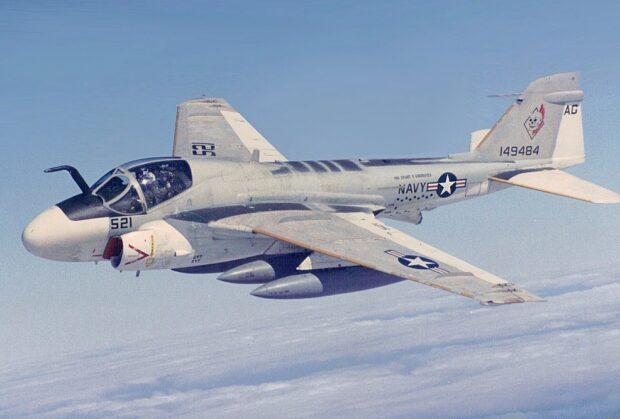
The Grumman A-6 Intruder was built for one brutal job: carry a massive bomb load, fly through bad weather, and hit targets its crew couldn’t even see.
In Vietnam, it became one of the U.S. Navy’s most important strike aircraft, flying at night, through clouds, over jungle, and into some of the most heavily defended airspace on Earth. It could haul up to 18,000 pounds of ordnance, survive punishing carrier operations, and strike when other aircraft had to turn back.
This is the story of the ugly, blunt-nosed carrier bomber that became one of the deadliest night attack aircraft of the Cold War.
The Grumman A-6 Intruder is a twinjet, all-weather subsonic attack aircraft developed and manufactured by American aircraft company Grumman Aerospace. It was formerly operated by the U.S. Navy and U.S. Marine Corps.
The A-6 was designed in response to a 1957 requirement issued by the Bureau of Aeronautics for an all-weather attack aircraft for Navy long-range interdiction missions and with short takeoff and landing (STOL) capability for Marine close air support. It was to replace the piston-engined Douglas A-1 Skyraider. The requirement allowed either single or twin-engined aircraft, as well as either turbojet or turboprop-based engines.
The winning proposal from Grumman was powered by a pair of Pratt & Whitney J52 turbojet engines. The A-6 was the first U.S. Navy aircraft to have an integrated airframe and weapons system. Operated by a crew of two in a side-by-side seating configuration, the workload was divided between the pilot and weapons officer (bombardier/navigator or BN). In addition to conventional munitions, it could also carry nuclear weapons, which would be delivered using toss bombing techniques.
On 19 April 1960, the first prototype made its maiden flight; the type was introduced to squadron service during February 1963. The A-6 was operated by both the U.S. Navy and U.S. Marine Corps as their principal all-weather/night attack aircraft between 1963 and 1997, during which time multiple variants were developed and introduced.
One derivative of the type was the EA-6B Prowler, a specialized electronic warfare aircraft. Another was the KA-6D, a dedicated aerial refueling tanker. The definitive attack version of the aircraft, which was furnished with vastly upgraded navigation and attack systems, was the A-6E. While the development of further variants, such as the A-6F, were explored, they ultimately did not come to fruition.
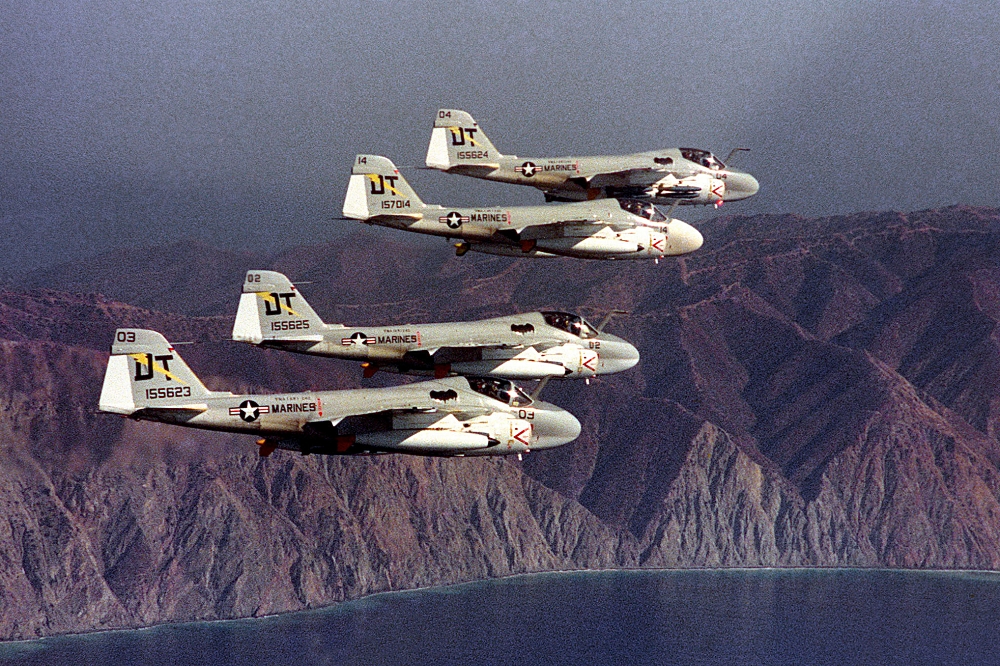
Four U.S. Marine Corps All-Weather Medium Attack Squadron 242 (VMA(AW)-242) Grumman A-6A Intruder aircraft (BuNo 155623, 155624, 155625, 157014) flying in echelon formation on 21 November 1975.
The A-6 saw active combat across multiple conflicts. Its combat debut was the Vietnam War, in which the type operated from both carriers and shore facilities. The type proved vulnerable to conventional ground fire and ground-based anti-aircraft measures, which brought down 56 A-6s.
In the 1980s, both the Multinational Force in Lebanon and Operation El Dorado Canyon made use of the type. During the Gulf War, a combination of U.S. Navy and U.S. Marine Corps A-6s conducted in excess of 4,700 combat sorties against a variety of Iraqi ground-based targets.
During the 1990s, the A-6 was intended to be superseded by the McDonnell Douglas A-12 Avenger II, but this program was ultimately canceled due to cost overruns.
Thus, when the A-6E was scheduled for retirement, its precision strike mission was initially taken over by the Grumman F-14 Tomcat equipped with a LANTIRN pod, and later passed on to the Boeing F/A-18E/F Super Hornet.
Top Photo: A U.S. Navy Grumman KA-6D Intruder (BuNo 149484) from Attack Squadron 34 (VA-34) “Blue Blasters” in flight. VA-34 was assigned to Carrier Air Wing 7 (CVW-7) aboard the aircraft carrier USS Dwight D. Eisenhower (CVN-69) for a deployment to the Mediterranean Sea from 29 February to 29 August 1988.
Sources: YouTube; Wikipedia