
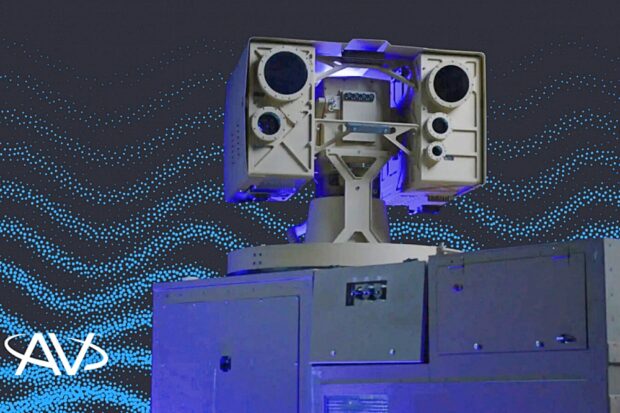
AeroVironment, Inc. has announced the successful demonstration of its palletized LOCUST Laser Weapon System (LWS) aboard the USS George H.W. Bush (CVN-77) in October 2025 in collaboration with the U.S. Navy and the U.S. Army Rapid Capabilities and Critical Technologies Office (RCCTO).
During the live-fire event, the Palletized High Energy Laser (P-HEL) system tracked, engaged, and neutralized multiple target drones—marking a major milestone toward fielding operational directed energy capabilities across all domains and platforms.
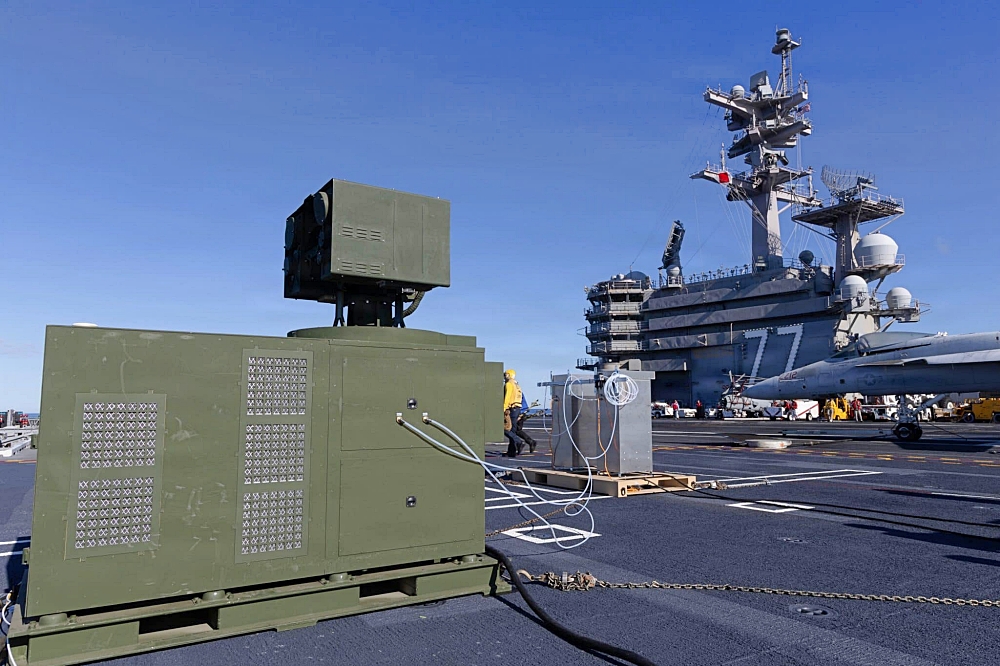
A containerized LOCUST Laser Weapon System (LWS) is set up on the flight deck of the Nimitz-class aircraft carrier, USS George H.W. Bush (CVN 77), for a live-fire test. During the live-fire event, LOCUST LWS effectively detected, tracked, engaged, and neutralized multiple unmanned aerial vehicles marking a milestone toward fielding operational directed energy capabilities. (Photo courtesy U.S. Navy)
This achievement validates that the LOCUST LWS is truly platform-agnostic, seamlessly transitioning from fixed-site and land-based mobile platforms, such as the Joint Light Tactical Vehicle (JLTV) and Infantry Squad Vehicle (ISV), to the dynamic and demanding environment of a maneuvering aircraft carrier.
“LOCUST delivers effective, all-domain protection against emerging drone threats at the speed of light—on any platform, in any domain, for any mission,” said John Garrity, Vice President of Directed Energy Systems at AV. “Rolling LOCUST onto a ship and quickly initiating operations facilitates the expanded use of high-energy lasers across the Fleet without the need for costly, time-consuming ship modifications. This is a game-changer for the Navy and for our national security.”
LOCUST’s Successful Shipboard Operation Showcases:
- True platform flexibility: Rapid integration across ground and maritime platforms
- Ship compatibility: LOCUST features roll-on, roll-off capabilities and can recharge its battery bank or fully run off ship’s power, marrying an unlimited DE magazine with an essentially unlimited power source while reducing logistical footprint and integration complexity
- Precision aim point and beam control: Accurately acquiring targets, tracking, and eliminating threats on a dynamic, moving shipboard platform
- Proven lethality: Engaging and defeating multiple aerial threats in a realistic operational environment
- Cross-service commonality: Open interfaces and a common laser weapon system architecture fulfill the requirements of multiple services
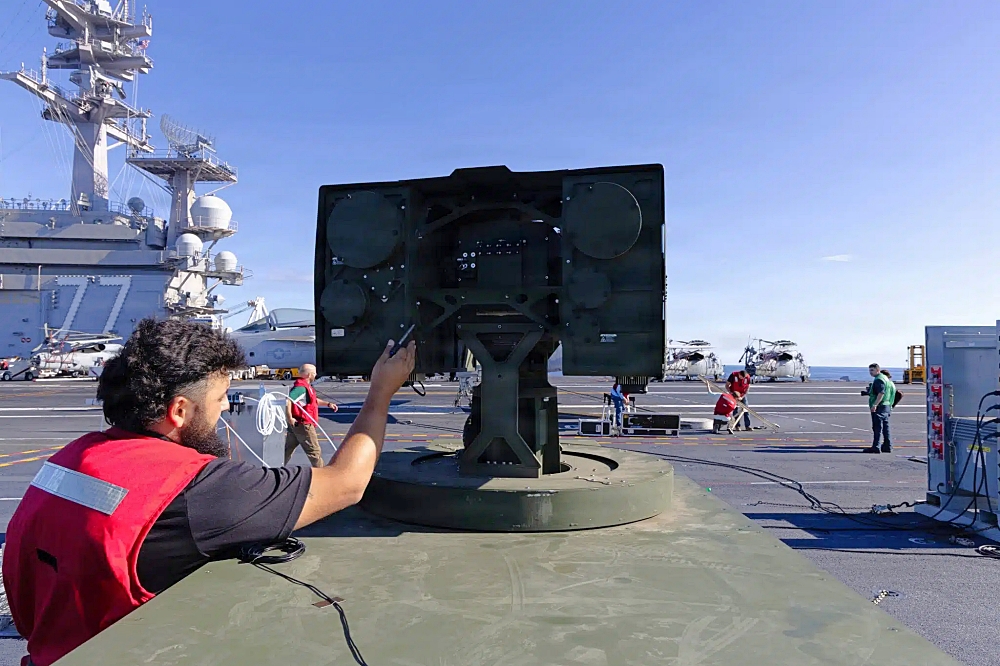
A member of the joint U.S. Navy, U.S. Army, and AeroVironment, Inc. team makes adjustments to the containerized LOCUST Laser Weapon System (LWS) on the flight deck of the Nimitz-class aircraft carrier, USS George H.W. Bush (CVN 77), for a live-fire test. During the live-fire event, LOCUST LWS effectively detected, tracked, engaged, and neutralized multiple unmanned aerial vehicles marking a milestone toward fielding operational directed energy capabilities. (Photo courtesy U.S. Navy)
AV’s LOCUST family of high-energy laser systems provides scalable, proven solutions for countering unmanned aerial systems and other evolving threats, enabling the joint force to defend against emerging challenges with unmatched precision, speed, and efficiency–on land and at sea.
LOCUST is part of AV’s suite of layered C-UAS solutions, including the radio frequency (RF)-based Titan C-UASTM family of products and the Freedom Eagle (FE-1) kinetic missile–all enabled by AV_Halo open architecture software.
Source: AV
Why This Matters
The demonstration of the LOCUST Laser Weapon System by AeroVironment, Inc. aboard the USS George H.W. Bush (CVN-77) matters because it signals a turning point in the practical deployment of directed energy weapons. Unlike traditional munitions, high-energy lasers offer near-instant engagement at the speed of light, dramatically reducing reaction times against fast-moving threats like drones. This is especially relevant as unmanned aerial systems increasingly dominate modern conflict environments.
A key implication is the system’s platform flexibility. The ability to deploy LOCUST across land vehicles and naval vessels without major modifications suggests a future where weapons are modular, rapidly deployable, and interoperable across services. Collaboration with organizations like the U.S. Navy and the U.S. Army Rapid Capabilities and Critical Technologies Office reinforces the importance of joint-force integration in accelerating adoption.
Strategically, the concept of an “unlimited magazine”—where lasers draw power rather than expend ammunition—could significantly lower long-term operational costs and logistical burdens. This changes how sustained engagements are managed, particularly in contested environments.
Ultimately, LOCUST represents a broader shift toward precision, scalability, and efficiency in warfare, while also raising questions about escalation dynamics and the global proliferation of advanced defensive and offensive technologies.