
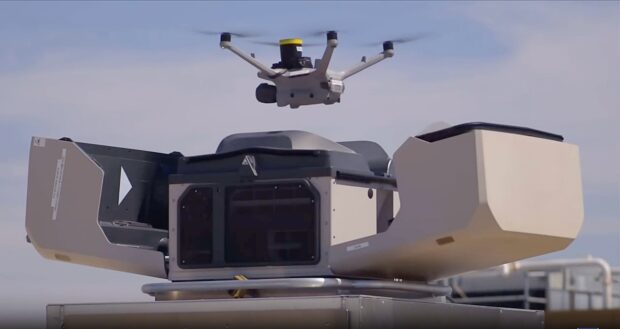
The Beverly Hills Police Department (BHPD) has announced the implementation of its innovative “Drone-in-a-Box” program, a public safety initiative designed to improve emergency response, enhance officer safety, and provide greater situational awareness across the City.
“As part of my Mayoral initiatives, I am proud to advance cutting-edge technology that keeps Beverly Hills safe ahead of the curve,” said Beverly Hills Mayor Sharona Nazarian. “Our Police Department is already exceptional, with dedicated men and women protecting our community 24 hours a day, seven days a week. Drone-in-a-Box adds another powerful tool, delivering critical real-time, life-saving information that strengthens public safety and helps keep our City secure.”
Drone-in-a-Box systems are automated drone platforms housed in secure, weather-resistant docking stations. These systems enable a rapid deployment of drones within 90 seconds, allowing officers and dispatch personnel to quickly assess incidents without delay.
“This program represents a significant advancement in how we respond to emergencies and protect our community,” said Mark G. Stainbrook, Chief of Police. “By leveraging this technology, we can make faster, more informed decisions while prioritizing the safety of both our officers and the public.”
Key Benefits of the Drone-in-a-Box Program

Faster Emergency Response
Drones can be deployed instantly from fixed locations throughout the City, significantly reducing response times and providing critical, real-time intelligence during high-priority calls.
Enhanced Officer Safety
Live aerial video allows officers to evaluate potential threats before arriving on scene, helping to de-escalate dangerous situations and minimize unnecessary exposure to risk.
Improved Situational Awareness
Equipped with high-resolution cameras and thermal imaging capabilities, drones provide a comprehensive view of incidents. This enhanced perspective supports better coordination and more effective incident management.
Increased Efficiency
With no launch lag, drones can be airborne within moments, ensuring immediate operational support when seconds matter most.
Improved Citywide Coverage
Strategically placed docking stations throughout Beverly Hills expands coverage, reduces response times, and allows drones to remain on scene longer during critical incidents.
The Drone-in-a-Box program reflects the Beverly Hills Police Department’s continued commitment to innovation, transparency, and technology to enhance public safety services.
Source: City of Beverly Hills
Why This Matters
The introduction of a “Drone-in-a-Box” program by the Beverly Hills Police Department signals a broader transformation in everyday policing: the normalization of persistent aerial surveillance as a first-response tool. What stands out is not just the technology itself, but the speed and autonomy it enables—deploying drones within 90 seconds fundamentally reshapes how incidents are assessed and managed.
On the surface, the benefits are clear. Faster response times, improved situational awareness, and enhanced officer safety all align with long-standing public safety goals. Real-time aerial views can help de-escalate volatile situations, allocate resources more efficiently, and reduce uncertainty before officers arrive on scene. In high-risk scenarios, this could prevent harm to both law enforcement and civilians.
However, the implications extend beyond operational efficiency. Embedding semi-automated drone systems across a city introduces new questions about surveillance, oversight, and civil liberties. Unlike traditional policing tools, these systems can be deployed rapidly and frequently, potentially creating a form of continuous, low-level aerial monitoring. Even if used responsibly, the infrastructure itself expands the capacity for observation in ways that may outpace existing legal and ethical frameworks.
There is also a scalability factor. While this program is being implemented in a relatively small, well-resourced city, it serves as a model that other jurisdictions may follow. As costs decrease and technology matures, similar systems could become commonplace in urban policing worldwide, accelerating a shift toward data-driven, sensor-rich environments.
Finally, this initiative reflects a convergence between technologies developed for military or specialized use and their adaptation for domestic contexts. The same capabilities that provide “situational awareness” in conflict zones are now being repurposed for civilian law enforcement.
Ultimately, this matters because it represents a turning point: policing is becoming faster, more informed, and more technologically mediated—but also more surveillant, raising important questions about balance, accountability, and public trust.