
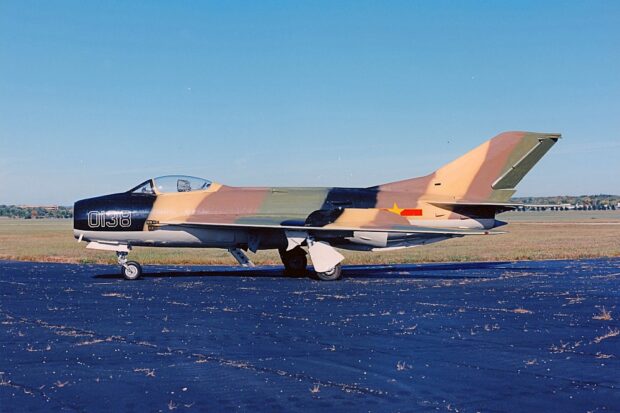
The MiG-19 was ugly, dangerous, endlessly fascinating — and it had a nasty reputation for exploding. The Soviets built over 2,000 anyway.
Created in a panic to beat the United States into the supersonic age, the Mikoyan-Gurevich MiG-19 was rushed from prototype to production before its flaws were fully understood. What emerged was the Soviet Union’s first true supersonic fighter: fast, heavily armed, and capable of astonishing performance — but also plagued by vicious handling, deadly spins, fuel tank explosions, and a reputation among crews and pilots as a ‘Flying Coffin’.
In this episode, we trace the full story of the MiG-19 from the design bureaus of early Cold War Moscow to the skies over the Soviet Union, Vietnam, Pakistan, the Middle East, and beyond. We look at the desperate race to match the American F-100, the aircraft’s terrifying operational flaws, its failure to stop the U-2, the friendly-fire chaos surrounding the Gary Powers incident, and the strange afterlife of the design as China’s J-6 and Pakistan’s F-6.
The Mikoyan-Gurevich MiG-19 (Russian: Микоян и Гуревич МиГ-19; NATO reporting name: Farmer) is a Soviet second generation, single-seat, twinjet fighter aircraft. It was the first Soviet production aircraft capable of supersonic speeds in level flight. A comparable U.S. “Century Series” fighter was the North American F-100 Super Sabre, although the MiG-19 primarily fought against the more modern McDonnell Douglas F-4 Phantom II and Republic F-105 Thunderchief over North Vietnam. This aircraft was originally used by the Soviet Union but it was later used by the People’s Liberation Army Air Force of China.
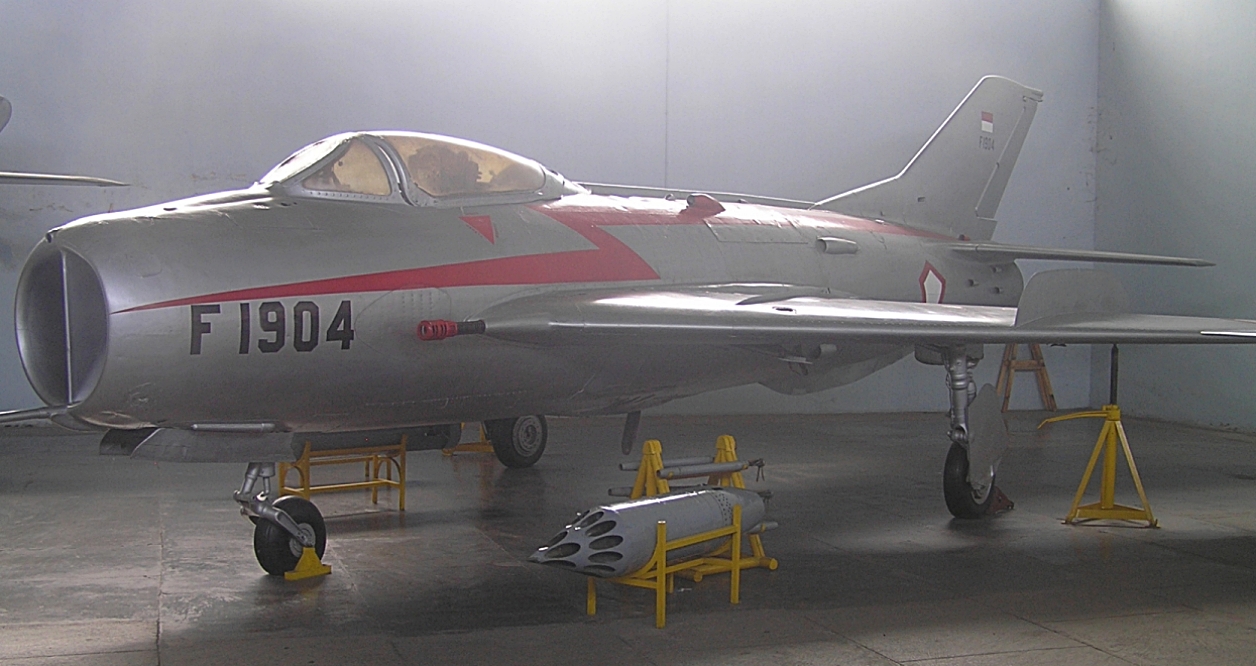
Indonesian Air Force MiG-19 at the Dirgantara Mandala Museum
Design and Development
In 1950 the Mikoyan-Gurevich (MiG) design bureau (also known as OKB-155) began work on a new fighter aircraft, intended to have a greater range than the existing MiG-15 and MiG-17 aircraft, and capable of reaching supersonic speeds in level flight.
MiG chose to use two of the new Mikulin AM-5 axial jet engines (a scaled-down version of the Mikulin AM-3 that powered the Tupolev Tu-16 bomber) for its new fighter. As a test bed for the new engine, OKB-155 was authorised on 20 April 1951 to convert one of the prototype MiG-17s, replacing the single Klimov VK-1 engine with two 19.60 kN (4,410 lbf) AM-5s (later replaced by 21.08 kN (4,740 lbf) AM-5As), with the testbed, designated SM-1 (or I-340), flying late in 1951.
While the SM-1 was a useful testbed, its performance was less than expected, and first resulted in an afterburner being designed for the AM-5, resulting in the AM-5F (reaching 26.45 kN (5,950 lbf) with afterburner).
While the SM-1 was a test bed, the SM-2 (or I-360) was intended as the required supersonic escort fighter, with work authorised on 10 August 1951. The SM-2 was a twin-engined, mid-winged aircraft. Its thin wings, which had been designed at TsAGI, the Soviet Central Aerohydrodynamic Institute, for supersonic flight were swept back at an angle of 55 degrees and had a single wing fence on each side.
Unusually, a T-tail was fitted. Armament was two Nudelman N-37 37-mm cannon located in the leading edge of the aircraft’s wings, near the wing roots – the guns had been moved compared to those in the MiG-15 and -17 to avoid ingestion of gun blast gases causing surging of the aircraft’s engines. The first SM-2, the SM-2/1 was sent to the Letno-Issledovatel’skiy Institut (en:flight research institute) (LII) in April 1952 for testing, and was flown for the first time on 24 May 1952, with test pilot G. A. Sedov at the aircraft’s controls.
With the AM-5A engines without an afterburner the SM-2 could not exceed the speed of sound in level flight. To solve this, AM-5F engines with afterburners were substituted. While the new engines improved performance, the aircraft was found to have handling problems, particularly at high angles of attack, where the aircraft was prone to spinning. To solve these problems the aircraft’s horizontal tail was lowered, with other changes including moving the aircraft’s airbrakes and deepening the wing fences, with the modifications causing the aircraft to be redesignated SM-2A and then SM-2B.
Top Photo: MiG-19S at the National Museum of the United States Air Force
Sources: YouTube; Wikipedia