
Acoustic rainbows may sound psychedelic, but the concept has nothing to do with hallucinations. By dispersing sound waves, noisy objects can potentially be made far less audible. That promise has drawn the interest of U.S. Special Operations Command, which is seeking Acoustic Rainbow Emitters (ARE) for drones under a Small Business Innovation Research solicitation that closed March 25.
According to the notice, an ARE “would provide a means to redirect the acoustic signature of a UAS and change the frequencies of the acoustic signature.” While small tactical drones are difficult to see, the buzz of their propellers can alert targets and expose the aircraft to hostile fire. SOCOM noted that acoustic sensors are becoming increasingly common on the battlefield.
The project would attach emitters to Army Special Operations Forces drones. The devices should redirect sound upward, away from the ground, and filter frequencies to levels inaudible to the human ear. The goal is to reduce a drone’s acoustic signature by at least 50 percent. Weight limits are strict: no more than 1 kilogram for a Group 1 drone (under 20 pounds) and 3 kilograms for a Group 2 drone (under 55 pounds). The emitter must also maintain a low visual signature.
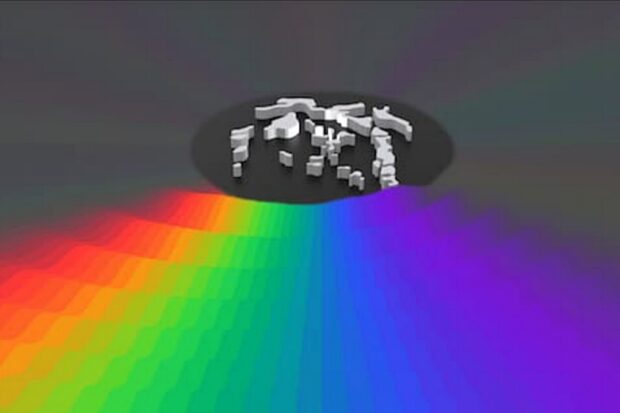
SOCOM appears particularly interested in quieter attack drones, citing use during terminal strikes. Phase I calls for a feasibility study; Phase II would produce a prototype. Researchers in Denmark and Spain recently demonstrated a 3D-printed emitter that passively scatters and redirects broadband sound without electricity.
Photo: Visualization of the acoustic rainbow emitter (ARE) The morphogenetical topology optimization method shapes the scattering inclusions, shown as grey material. When the ARE is excited by a monopolar source emitting broad-band white noise, the radiated sound creates an acoustic rainbow. The source is positioned at the centre of the emitter (illustrated using white light) and driven with equal power at all frequencies from 7600 to 12800 Hz. In the figure, the experimentally measured acoustic output (far field) is mapped to the visible spectrum of light by its magnitude and frequency content in the full 360° surrounding the ARE. (Courtesy: Christiansen et al. Sci. Adv. eads7497)
Source: Defense News