
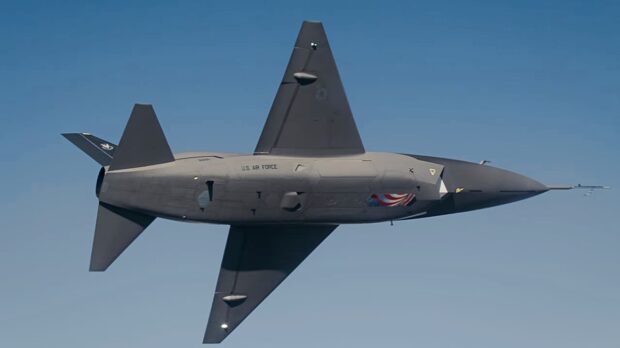
The U.S. Air Force’s Collaborative Combat Aircraft (CCA) programme recently demonstrated a significant technical milestone as one of its prototype aircraft, built by Anduril Industries, successfully switched between two separate artificial-intelligence-driven mission autonomy systems during a single flight.
On 24 February, during tests at the Air Force Association’s Warfare Symposium, the Anduril-manufactured YFQ-44A CCA took off and began its mission under the control of Shield AI’s Hivemind software suite. Once key mission objectives were completed, operators transitioned the aircraft in-air to use Anduril’s own Lattice for Mission Autonomy system without stopping or landing, and the aircraft continued its test sequence to a safe landing. The event marks one of the first demonstrations of seamless mid-flight switching between distinct autonomy stacks on a single platform.
This capability was enabled by the U.S. Air Force’s Autonomy-Government Reference Architecture (A-GRA), a standardised framework that separates basic flight control from higher-level mission autonomy. A-GRA allows different mission software to integrate reliably with any compliant aircraft hardware and flight system, fostering competition and flexibility in autonomy development.
Anduril’s YFQ-44A was selected as one of the initial prototype CCAs in April 2024 and has since made rapid progress—from achieving its first semi-autonomous flight to routinely flying under different mission autonomy frameworks. The ability to switch autonomy systems mid-flight not only highlights the modularity of the CCA approach but also opens doors to more adaptable and resilient combat operations, integrating best-in-class software from multiple developers as mission needs evolve.
As the CCA programme moves forward, this demonstration underscores the Air Force’s emphasis on open architectures and competitive innovation to advance AI-enabled air dominance capabilities.
Sources: Anduril; Air & Space Forces Magazine