
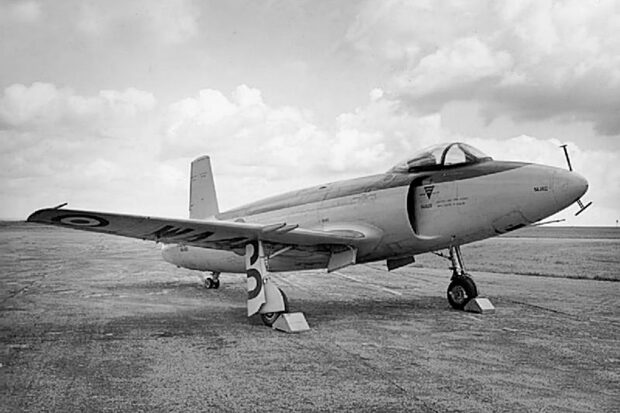
At the dawn of the jet age, Britain attempted something extraordinary: transforming the technology behind its legendary Supermarine Spitfire into a high-speed jet fighter capable of challenging the world’s most advanced aircraft. The result was the Supermarine Attacker, a bizarre combination of World War II engineering and revolutionary jet propulsion that would become the Royal Navy’s first operational jet fighter.
But the aircraft had one enormous problem: it was built like a World War II fighter in a world that had already moved beyond them.
Unlike modern jets, the Attacker retained an old-fashioned tail-wheel landing gear configuration, leaving its nose pointed upward and its powerful jet exhaust blasting toward the ground. Its experimental wings were extraordinarily sensitive to surface imperfections, while persistent stability problems made the aircraft difficult to control.
And those were only the beginning of its troubles.
During development, test pilots faced a terrifying series of accidents. One aircraft crashed during a mock dogfight, another suffered a fatal accident after releasing an external fuel tank, and a third nearly disintegrated when its wingtip suddenly folded upward during a high-speed dive.
Despite these disasters, Supermarine refused to abandon the project. With the Royal Air Force turning toward newer designs like the Gloster Meteor and de Havilland Vampire, the company made one final gamble: convincing the Royal Navy that its unconventional jet could operate from aircraft carriers.
After years of redesigns, dangerous test flights, and repeated setbacks, the Attacker finally entered naval service in 1951, capable of reaching speeds approaching 590 miles per hour.
Yet its career would be remarkably short. It never flew an operational combat mission and was already being retired just three years after entering service.
This is the extraordinary story of the Supermarine Attacker, Britain’s strange attempt to turn a World War II fighter into a modern jet, and the dangerous aircraft that helped pave the way for a new generation of British aviation.
The Supermarine Attacker is a British single-seat naval jet fighter designed and produced by aircraft manufacturer Supermarine for the Royal Navy’s Fleet Air Arm (FAA). It was the first jet fighter to enter operational service with the FAA.
In order to rapidly introduce jet aircraft to Navy service, Supermarine proposed using the wing developed for their most advanced piston-powered design, the Supermarine Spiteful, with a new fuselage for the Rolls-Royce Nene engine. Performing its maiden flight on 27 July 1946, the flight testing phase of development was protracted due to several issues, including handling difficulties. The first Attackers were introduced to FAA service in August 1951.
Common to the majority of other first-generation jet fighters, the Attacker had a relatively short service life before being replaced. This was due to increasingly advanced aircraft harnessing the jet engine, being developed during the 1950s and 1960s. Despite its retirement from front line service by the FAA during 1954, only three years following its introduction, the Attacker would be adopted by the newly formed Pakistan Air Force, who would continue to operate the type possibly as late as 1964.
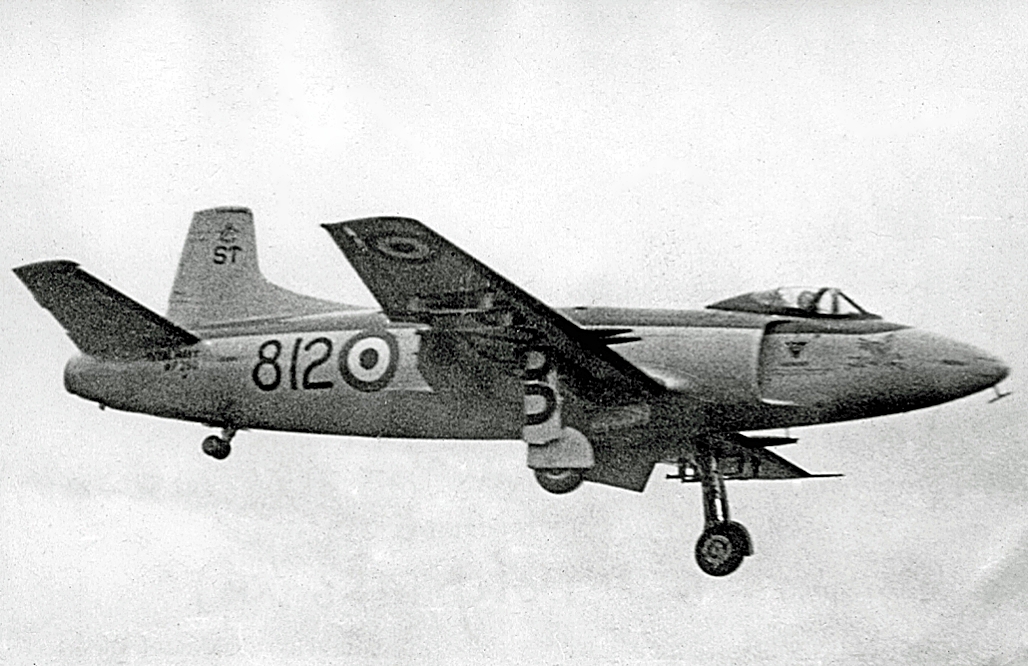
Attacker FB.2 of 1831 Squadron RNVR landing at RNAS Stretton in 1956
Origins
The origins of the Attacker can be traced back to a wartime fighter jet project requested under Specification E.10/44 (the E standing for experimental) issued by the Air Ministry during 1944, which had called for the development of a jet fighter furnished with a laminar flow wing and a single jet engine.
In response, British aircraft manufacturer Supermarine produced their submission, which involved designing a brand new fuselage, complete with bifurcated intakes to provide airflow to the Rolls-Royce Nene turbojet engine powering the type. This fuselage was mated with the pre-existing laminar flow straight wings which had been designed for the Supermarine Spiteful, a piston-engined fighter that had been intended to replace the Supermarine Spitfire.
Joe Smith presented the Type 392 for consideration and three prototypes (TS409, TS413 and TS416) were ordered. Prior to the design being officially named Attacker, the aircraft had was referred to as the “Jet Spiteful” with “Jet Seafang” for a naval version.
E.10/44 (issued February 1945) specified a maximum speed of 550 mph (885 km/h) up to 30,000 ft (9,100 m).
As originally intended, the Type 392 was supposed to provide an interim jet fighter to equip the Royal Air Force (RAF) while another aircraft, the Gloster E.1/44, that was also powered by the same Rolls-Royce Nene engine, completed development; the expectation was that, with the wing already designed, the remaining work required for the aircraft would be completed quickly.
On 30 August 1944, an order for three prototypes was placed with Supermarine; it was stipulated that the second and third prototypes were both to be navalised. On 7 July 1945, a follow-on order for 24 pre-production aircraft, six for the RAF and the remaining 18 (to Specification E1/45) for the Fleet Air Arm (FAA), was placed.
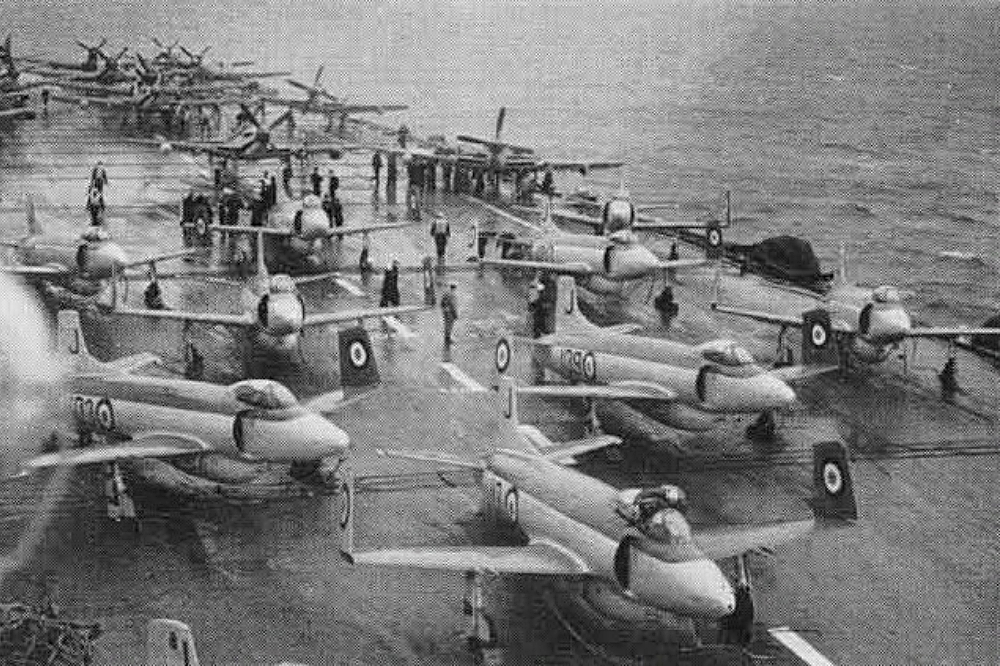
Flight deck of the Royal Navy aircraft carrier HMS Eagle; multiple Attacker FB.2 fighters are in the foreground; in the background are Fairey Firefly FR.4s, circa 1953
Handling problems with the Spiteful prototype delayed progress on the jet-powered version, leading to the pre-production order of 24 being stopped, although work on the three prototypes continued. In January 1945 Supermarine had been ordered to stop work on their Seagull air-sea rescue amphibian and give the Type 392 maximum priority. Due to the delay, the FAA instead ordered a batch of 18 de Havilland Vampire Mk. 20s for the purpose of gaining experience with jet aircraft.
After evaluating both the Jet Spiteful and the E.1/44, the RAF decided to reject both designs since neither aircraft offered any perceptible performance advantage over contemporary fighters such as the Gloster Meteor and the de Havilland Vampire, which were the RAF’s first two operational jet aircraft.
Top Photo: The first production Royal Navy Supermarine Attacker F1 in July 1950.
Sources: YouTube; Wikipedia