

Machina, a leader in advanced manufacturing and robotics, has announced that it has been selected as part of the Department of War’s Organic Industrial Base Modernization Challenge to develop and qualify a RoboCrafted airframe for a low-cost unmanned combat attack system (LUCAS)-class unmanned aircraft system (UAS)—a low-cost Class 3 aircraft—and deploy two pilot expeditionary robotic factories, known as Edge Factories, to support production.
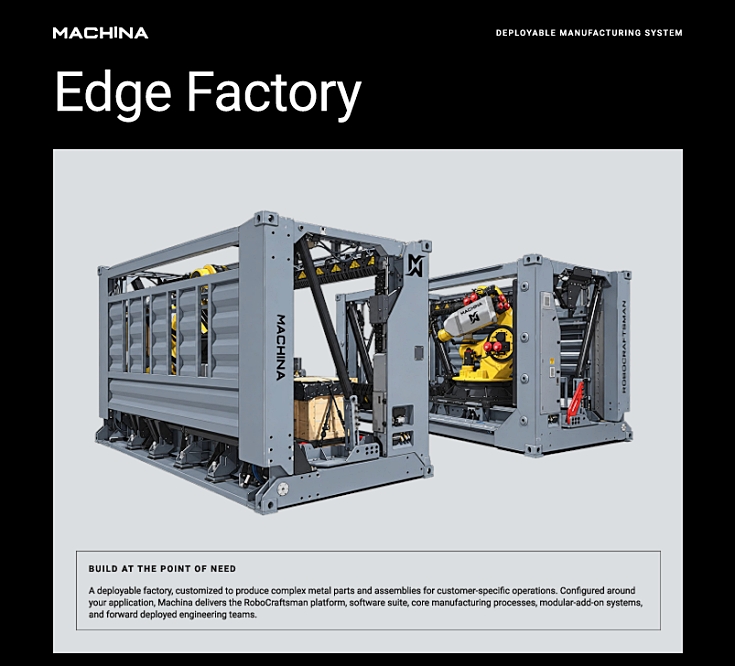
Modern conflicts are increasing demand for low-cost systems that can be produced rapidly, adapted to changing mission requirements and fielded at scale. Traditional aerospace manufacturing relies on centralized factories, specialized tooling and long supply chains that can add weeks or months to production and delivery timelines. Built on a Modular Open Systems Approach, Machina’s Edge Factories can produce a family of mission-specific drone designs from a single production cell, enabling drone airframes to be made in a fraction of the time and cost of traditional composite manufacturing.
“Producing low-cost systems at scale requires a manufacturing model that can move as quickly as mission requirements change,”
said Ed Mehr, founder and CEO of Machina. “
This program brings our ‘build anything, anywhere’ mission to life by connecting adaptable UAS design with flexible production capacity closer to the point of need.”
Each pilot Edge Factory will initially center on a containerized RoboCraftsman manufacturing cell supported by Machina forward-deployed engineers, software and complementary production equipment. Powered by Machina’s proprietary RoboForming technology, the factories can manufacture metal structures directly from digital geometry without dies or hard tooling and deploy with minimal site preparation.
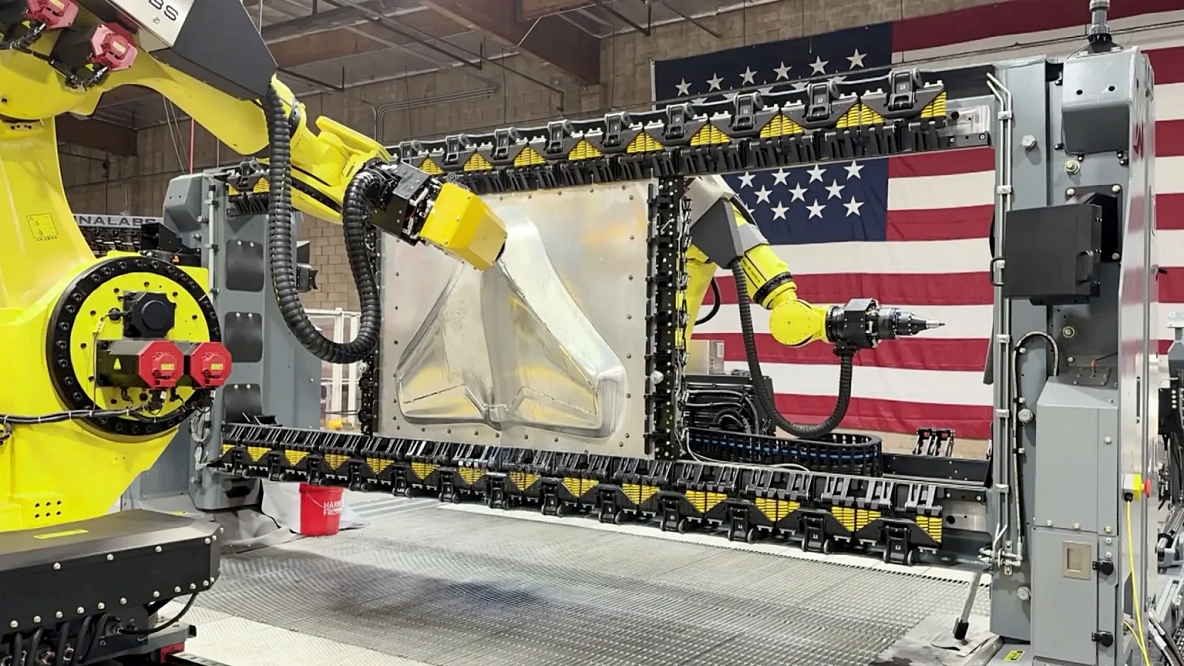
The Edge Factories consist of the company’s containerized RoboCraftsman manufacturing cells, Mehr told us. A 20-foot by 36-foot system that weighs 120,000 pounds fully installed, it is essentially two robotic arms that form the airframe out of metal using reductive manufacturing based on a variety of requirements. Payload weight, range and other factors are punched into a software system designed by the nTop company and the robotic arms then cut the metal into the desired form factor based on the required specifications.
Machina uses metal instead of composites that many drones are made out of because
“not only it is cheaper, it is more widely available and now can be processed with an automated process like ours versus composites, which are all done by hand layup,”
Ed Mehr, founder and CEO of Machina, explained.
This avoids having to use equipment like dies and rolls, dramatically speeding the process and allowing production at scale, Mehr stated.
“Basically, the agentic AI agents can explore and generate whole different versions of an airframe with different parameters,”
Mehr proffered.
“Because now it’s parameterized, you can just change the parameters and you get another airframe, and then evaluate if that airframe is good for the requirement they want.”
This way, the RoboCraftsman system
“can easily generate 20, 30, 40, 50 different designs just in software, and then put it through simulations to figure out which one actually meets the requirement for that,”
the Machina CEO added.
The company has already produced a six-foot, half-scale airframe that was recently tested at Edwards Air Force Base, said Mehr. However, that initial test proved problematic.
“The first design had some challenges with crosswind mitigation,” Mehr told us. “Since then, we have moved the location of the engine slightly to enable better crosswind mitigation, and now we’re running again. And the beauty is for us to go from one design to the next is just like a couple of months, a maximum of three months. Like we can just then try it again.”
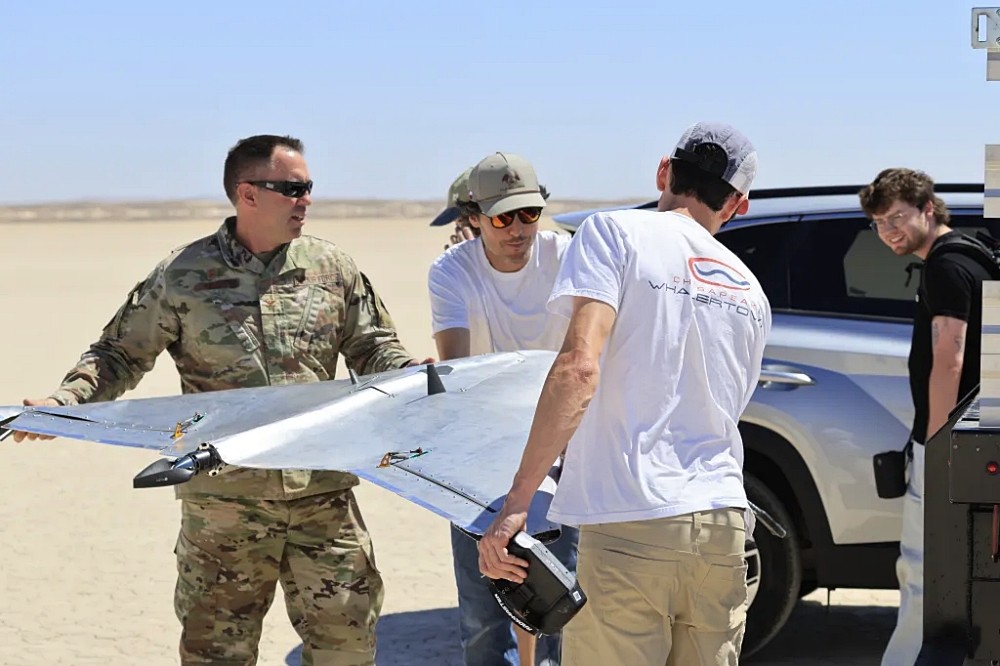
A LUCAS drone six-foot half-scale test model created by Machina’s RoboCraftsman system during a flight test at Edwards Air Force Base. (Machina)
Read the full story on UAS NEWS | PRO
Sources: Machina; The War Zone