

General Atomics says that it is working on a new hybrid electric propulsion powered flying-wing-type strike/reconnaissance drone called NextGen that could be able to stay aloft for more than 60 hours.
Work on NextGen will also feed into one of the designs within the company’s Gambit family of drones, which are also based around a common modular core ‘chassis’ concept.
Separate progress is being made on the newest member of that family, the air-to-surface optimized Gambit 6, with plans now for a live-fire air-to-ground ordnance demonstration early next year.
C. Mark Brinkley, a spokesperson for General Atomics, shared these and other details with TWZ as part of an update on the status of the entire Gambit effort.
“When we announced the Gambit Series in 2022, we knew that it was an ambitious, multi-stage concept that would require many years before its full power would be realized across all variants,” Brinkley said. “It’s not complicated to understand, but it is revolutionary, and revolutions take time.”
When the Gambit family was first rolled out four years ago, General Atomics presented four distinct design concepts. These were the intelligence, surveillance, and reconnaissance (ISR) focused Gambit 1, the air-to-air combat-optimized Gambit 2, an uncrewed ‘red air’ aggressor called Gambit 3, and the stealthy flying wing Gambit 4. Since then, the company has also added the Gambit 5, intended for carrier-based operations, and the aforementioned Gambit 6.
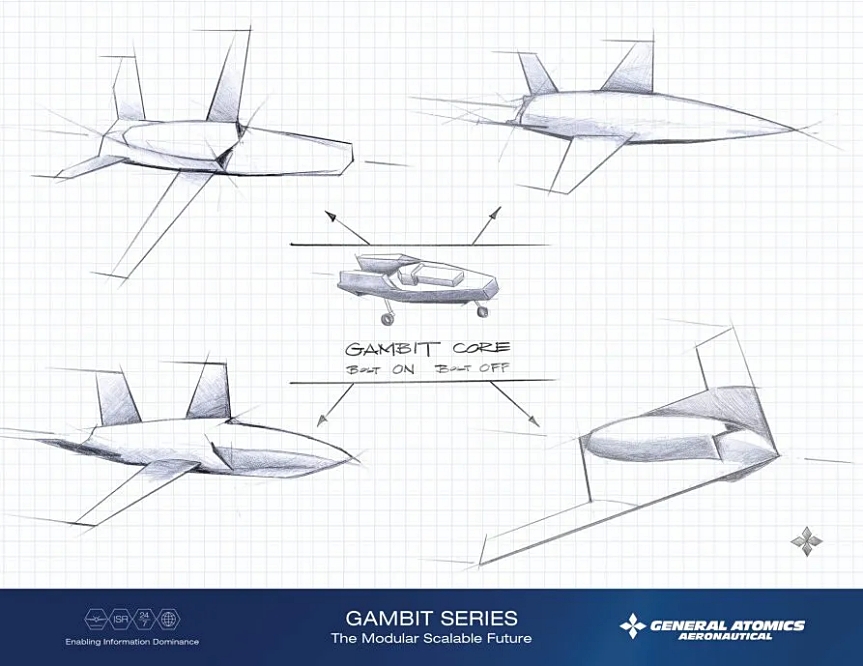
A graphic that General Atomics released in 2022 underlining the core ‘chassis’ component of the Gambit concept. General Atomics
All of the Gambit concepts are designed to leverage a common ‘chassis’ that includes landing gear, baseline avionics, and other core hardware. General Atomics touts this as helping to reduce costs and accelerate the development of very different drone designs.
“Gambit 4 is a flying wing. This is where things get interesting. General Atomics is currently working on a much larger flying wing we call NextGen. It’s not a CCA. We’re talking novel hybrid-electric propulsion on a fully armed, fully outfitted, ISR/Strike wing. Our engine team has promised 60+ hours unrefueled. That work is happening in parallel with everything else we’re working on.
I don’t think people realize how deep GA-ASI’s bandwidth is, or how much we dedicate to R&D. We have things I’m talking about here, and things I’m not talking about here, and five million square feet of manufacturing plus multiple flight test facilities. We’ve built and delivered more than 1,600 aircraft in 34 years. We’ve invented a lot of things, and we’re inventing other things. NextGen is coming, and the work we’re doing on that flying wing program will funnel into Gambit 4 so that when customers are ready for this, we’re not starting from scratch here either.”
From the beginning, Gambit 4 has been something of an outlier that is completely different from the other concepts in the family. This is only reinforced by the new details Brinkley has shared here about the NextGen design. The mention of “novel hybrid electric propulsion” is particularly eye-catching. In general, this kind of propulsion arrangement offers improved fuel economy, and the potential for other benefits, like reduced infrared and acoustic signatures, through the combination of fuel-powered engines and electric motors.
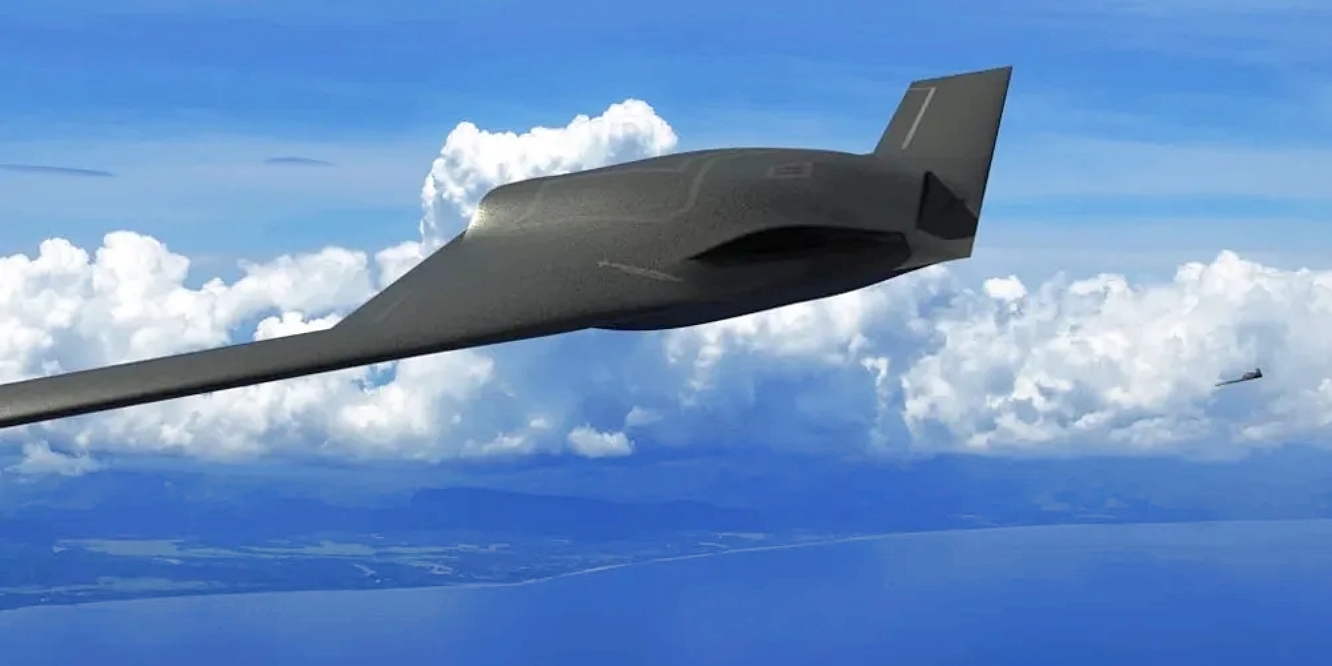
A rendering of the MQ-Next concept General Atomics released in 2021, the year before rolling out the Gambit family. General Atomics
General Atomics has talked in the past about hybrid electric propulsion technology helping to achieve a 60-hour-endurance target in the context of an earlier stealthy flying wing drone concept called MQ-Next. Last year, AFRL also awarded the company a contract for what it described as a “hybrid-electric propulsion ducted fan next-generation intelligence, surveillance, reconnaissance/strike unmanned aerial system,” or GHOST.
“We’ve been promising something impressive related to hybrid-electric propulsion, and now I can’t talk about it anymore,”
Brinkley told TWZ at the time when asked for more information about GHOST. It remains unclear how that program may be intertwined with the previous MQ-Next concept, as well as work now on NextGen and future plans for Gambit 4.
It does remain to be seen how many members of the Gambit family beyond the FQ-42A will ultimately be produced in significant numbers. For now, a Gambit 4 design, in particular, is still an ambitious future concept that will rely heavily on success with NextGen and related work.
Read the full 2,400-word post on UAS NEWS| PRO
Top Photo: A notional rendering General Atomics has previously released showing a flying-wing-type drone. General Atomics
Source: The War Zone