
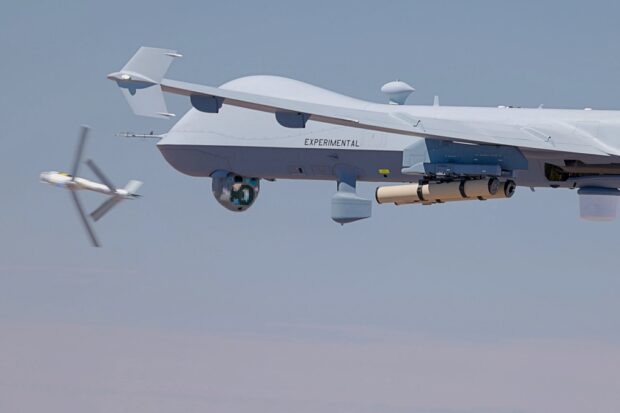
US Special Operations Command (SOCOM) has requested increased funding in its fiscal 2027 budget to transform the MQ-9 Reaper remotely piloted aircraft system into a drone “mothership,” while scaling back its planned fleet of armed reconnaissance and light attack aircraft.
A total of $75.8 million has been requested for the MQ-9 program, more than triple the current fiscal year’s $24.9 million allocation. In parallel, the planned fleet of OA-1K Skyraider II aircraft has been reduced from 75 to 53.
SOCOM selected L3Harris’ AT-802U Sky Warden — its company designation for the OA-1K — in 2022 as the winner of its Armed Overwatch program.
The $3-billion contract originally called for 75 aircraft to perform light attack, close air support, and intelligence, surveillance, and reconnaissance (ISR) missions, roles previously carried out by multiple platforms, particularly in counterinsurgency operations.
The shift suggests a gradual reorientation from counterinsurgency toward operations in the Indo-Pacific, where airspace is expected to be far more contested.
Drone Mothership
The MQ-9 proposal builds on the service’s Adaptive Airborne Enterprise effort, which aims to evolve the General Atomics long-endurance platform beyond its traditional strike and ISR roles into an airborne command-and-control node.
In this capacity, the aircraft would coordinate a network of drones conducting sensing and targeting missions deep inside contested territory.
The fiscal 2027 budget request represents an increase of roughly $50 million over the current fiscal year, with most of the additional funding allocated to procuring drones, carrier pods, and ground-system interfaces to support human-machine teaming, Air & Space Forces Magazine reported, citing budget documents.
The request includes 93 Group 2 drones (weighing up to 55 pounds/25 kilograms), 10 Group 3 drones (up to 1,320 pounds/599 kilograms), 16 swarm carrier pods, and five ground-system interfaces.
While the number of drones to be paired with each MQ-9 has not been disclosed, the planned procurement marks a significant increase from fiscal 2026, when only 29 Group 2 drones were requested.
In November, Anduril Industries was awarded a $50-million contract to supply ALTIUS-600 Group 2 unmanned aerial systems.
Group 2 drones typically operate at altitudes up to 3,500 feet (1,067 meters), while Group 3 systems can reach up to 18,000 feet (5,486 meters). Both categories have maximum speeds below 250 knots (288 miles/463 kilometers per hour).
Group 2 drones will primarily support ISR missions, while Group 3 systems are expected to incorporate enhanced stealth features — suggesting a role in kinetic operations, such as targeting air defense infrastructure.
Source: The Defense Post