
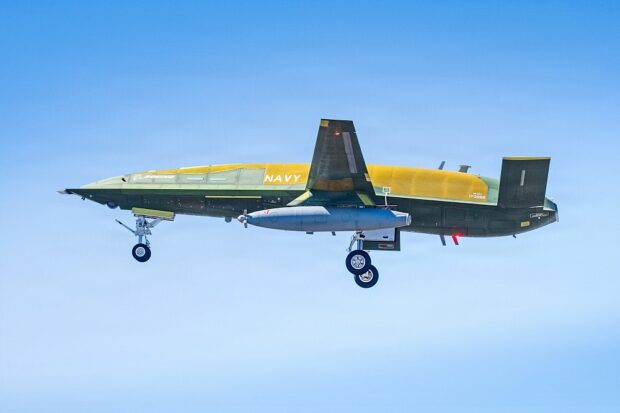
The U.S. Navy’s production representative MQ-25 Stingray unmanned aerial refuelling aircraft has successfully completed its first flight on Apr. 25, 2026. The flight, initially planned by the end of 2025, marks a major milestone in the service’s effort to field the first operational carrier-based unmanned aircraft.
The MQ-25 took off from MidAmerica St. Louis Airport, Missouri, home of Boeing’s production facilities, accompanied by a company-owned TA-4J Skyhawk and a U.S. Navy UC-12M Huron as chase aircraft
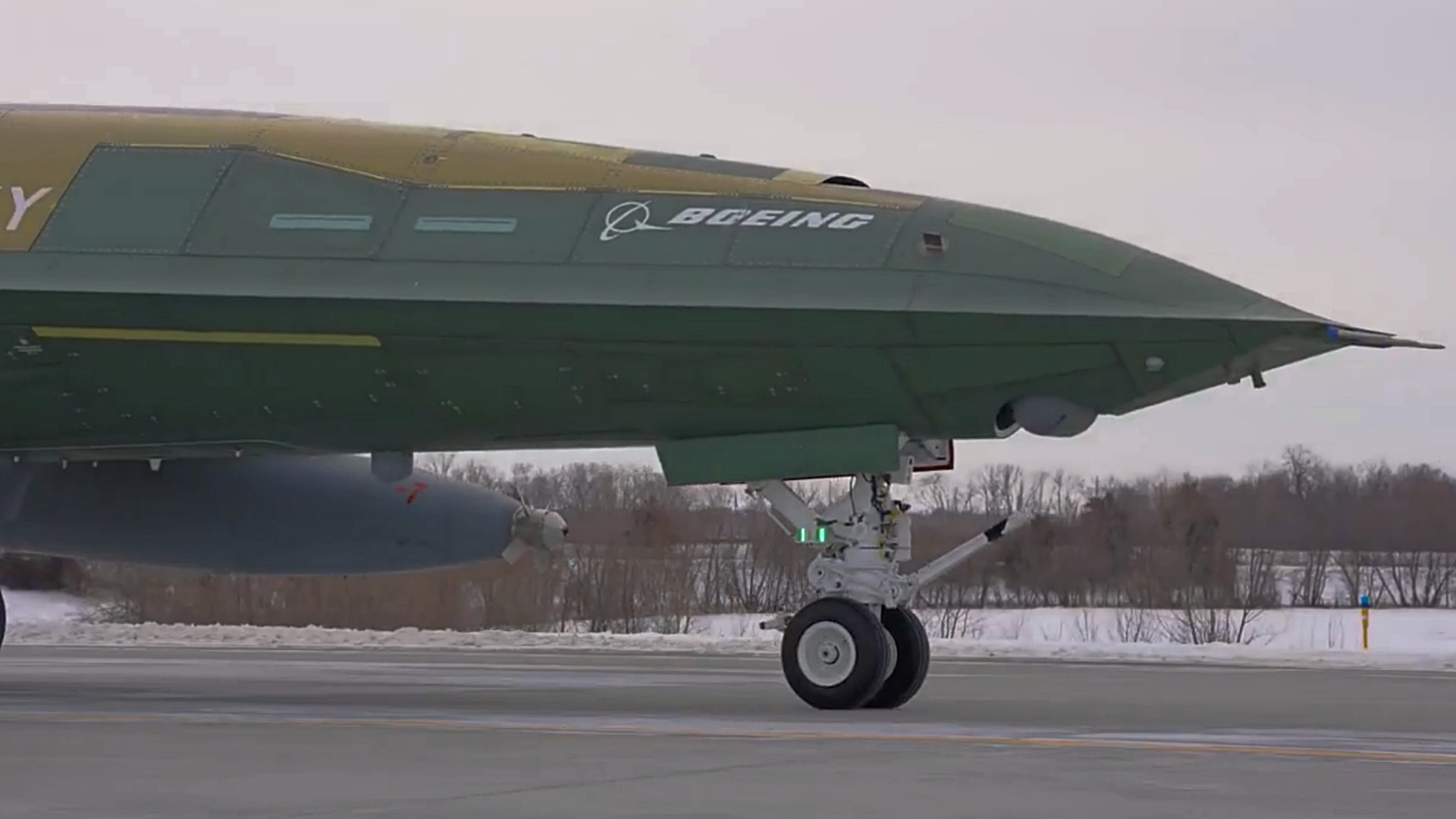
The maiden flight was first attempted on Apr. 22, although the takeoff was aborted for unknown reasons. The first flight of the production representative MQ-25 comes almost seven years after the first flight of the T1 test asset on Sept. 19, 2019. The new aircraft features some modifications compared to T1, including a retractable electro-optical/infrared (EO/IR).
During the two-hour flight, the unmanned aircraft successfully demonstrated its ability to autonomously taxi, take off, fly, land and respond to commands from the Unmanned Carrier Aviation Mission Control System MD-5 Ground Control Station (GCS). Boeing and U.S. Navy Air Vehicle Pilots facilitated the mission by sending the aircraft commands and then monitored its performance from the GCS at MidAmerica St. Louis Airport in Mascoutah, Ill., where the program is based. Once airborne, the Stingray executed a pre-determined mission plan that validated its flight controls, navigation, and safe integration with the GCS.
“Today’s successful flight builds on years of learning from our MQ-25A T1 prototype and represents a major maturation of the program,” said Dan Gillian, vice president and general manager, Boeing Air Dominance. “The MQ-25A is the most complex autonomous system ever developed for the carrier environment, and this historic achievement advances us closer to safely integrating the Stingray into the carrier air wing.”
“The first flight of the MQ-25A is a landmark achievement for the Navy-Boeing team and a critical step toward the future of the carrier air wing,” said Rear Adm. Tony Rossi, who oversees the Program Executive Office for Unmanned Aviation and Strike Weapons. “This flight demonstrates our progress in delivering a carrier-based refueling capability that will significantly extend the reach and lethality of our fleet.”
The MQ-25A is the Navy’s gateway to integrating unmanned aircraft on the carrier deck, enabling manned-unmanned teaming. Its autonomous aerial refueling capability will significantly extend the operational range of the carrier air wing and allow F/A-18 Super Hornets currently performing the aerial refueling role to focus on their primary role as a multi-role strike fighter.
The aircraft is the first of four Engineering Development Model aircraft that will be delivered to the Navy under the original $805M Engineering and Manufacturing Development contract.
“Watching our first Navy aircraft complete an autonomous flight underscores what disciplined teamwork and rigorous testing deliver,” said Troy Rutherford, vice president, Boeing MQ-25 program. “Today would not have been possible without the hard work and dedication of our Boeing, Navy, and industry team. Together, we are redefining the future of naval aviation and pushing the boundaries of what’s possible with autonomy.”
Boeing and the Navy will conduct additional test flights out of MidAmerica St. Louis Airport to further validate the aircraft’s flight controls and capabilities before transitioning to Naval Air Station Patuxent River, Maryland, to prepare for carrier qualifications.
Transition to Flight Test
The maiden flight follows an extended ground test phase that included low- and high-speed autonomous taxi trials, system integration checks, and verification work conducted at Boeing’s MidAmerica facility, which the manufacturer expanded with a $200 million production line in 2024. Taxi trials were carried out by US Navy Air Test and Evaluation Squadron 23 (VX-23) and Air Test and Evaluation Squadron 24 (UX-24), with the latter specializing in unmanned systems developmental testing. The two squadrons will continue to share responsibility for the flight test campaign.
Although the T1 demonstrator already validated the unmanned aerial refueling concept, including contact tests with the Cobham ARS pod carried by F/A-18 Super Hornets, further testing will be required to certify the capability in the production configuration.
Once envelope expansion work is complete, the US Navy is expected to move to carrier-environment testing. The T1 previously completed deck-handling demonstrations aboard USS George H.W. Bush (CVN 77) in late 2021, but did not fly during that phase.
Tanking and Carrier Integration
The Stingray’s primary role is to take over aerial refueling duties currently performed by F/A-18E/F Super Hornets, which dedicate between 20% and 30% of their flight hours to tanking missions. Carrying the same Cobham ARS pod as the Super Hornet, the MQ-25 is expected to deliver between 14,000 and 16,000 lb of fuel at 500 nautical miles, according to figures the US Navy submitted to Congress in an August 2025 report.
Boeing has already demonstrated software allowing an F/A-18 pilot to command an MQ-25 directly from the cockpit during refueling operations.
The aircraft is also intended to carry secondary intelligence, surveillance and reconnaissance (ISR) payloads through its new sensor turret, including signals intelligence and Automatic Identification System receivers.
The US Navy is also working with Lockheed Martin on the Unmanned Carrier Aviation Mission Control System (UMCS), which has been installed aboard USS George H.W. Bush and at shore sites since 2024. US Navy Air Vehicle Pilots have used the system to command both the MQ-25 and the General Atomics MQ-20 Avenger.
Schedule and Cost Pressure
The program has slipped significantly from its initial timeline. According to Pentagon Selected Acquisition Reports and Government Accountability Office (GAO) assessments cited in the August 2025 congressional report, major program milestones, including the first engineering and manufacturing development (EMD) aircraft flight and IOC, have shifted by approximately two years over successive development cycles.
The GAO has also flagged cost risk if low-rate initial production begins before flight testing matures. The US Navy’s fiscal year 2026 budget request includes $1.04 billion for procurement and research, development, test, and evaluation funding, covering the first three low-rate initial production aircraft and continued UMCS development.
Top Photo: The Navy’s MQ-25A Stingray takes its first flight April 25 at Boeing’s facility at MidAmerica Airport in Mascoutah, Ill. The MQ-25 is the Navy’s first operational carrier-based unmanned aircraft. (Photo courtesy of Boeing)