
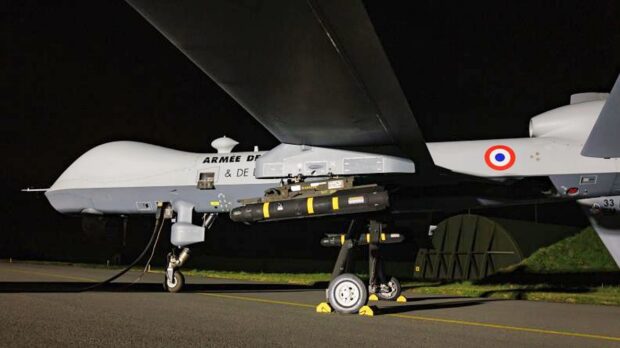
France is trialling its General Atomics Aeronautical Systems Inc MQ-9A Reaper Block 5 Extended Range (ER) unmanned aerial vehicles in the counter-unmanned aircraft system (C-UAS) role, the Ministry of the Armed Forces disclosed on 8 April.
At the beginning of April, at the Île du Levant firing range (Var, southeastern France), the French Air and Space Force (AAE), in coordination with the French Defence Procurement Agency (DGA), successfully conducted experimental firings of the Lockheed Martin AGM-114 Hellfire missile from a Reaper UAV against unmanned aerial targets.
The Ministry said that it had taken three months after the Hellfire had entered service on the Reaper to expand its use beyond ground targets.
“This success provides a new operational capability to counter the drone threat. Integrating this counter-drone warfare capability on the Reaper also enables the Air and Space Force to deploy a complementary, graduated, and adaptable range of responses to the diversity of threats,”
the Ministry added.
France has 12 Reaper Block 5 ER UAVs, the first of which were delivered in 2020, including six Reaper Block 1s that were upgraded to the same standard. The Block 5 ER has a 30 hour endurance (compared with 24 hours for the Block 1), and a range of 2,592 km (compared with 1,850 km).
While the earlier Block 1 UAVs had been unarmed and used exclusively for intelligence, surveillance, and reconnaissance (ISR) missions, the Block 5 ER UAVs are armed with GBU-12/49 Paveway precision-guided bombs and Hellfire missiles, and are equipped with a Foreign Military Sales (FMS)-acquired pod for electronic intelligence gathering.
The payload issue is central to the value of this concept. Because the MQ-9A can carry multiple external stores and remain on station for extended periods, a Hellfire-armed Reaper could potentially engage more than one drone during a single patrol, giving France a form of airborne magazine for lower-tier aerial threats.
The cost logic behind such an approach also explains why the French trial matters. Hellfire is not a cheap missile in absolute terms, but using a Reaper carrying several such weapons may still prove more proportionate than deploying scarce and high-value air-defence assets against relatively low-cost drones. Official U.S. Navy material notes that Hellfire, although originally developed as an air-to-ground laser-guided missile, can also be used as an air-to-air weapon against helicopters or slow-moving fixed-wing aircraft. Applied to the French anti-drone mission, this makes the missile a practical bridge between traditional precision strike and lower-tier aerial interception.
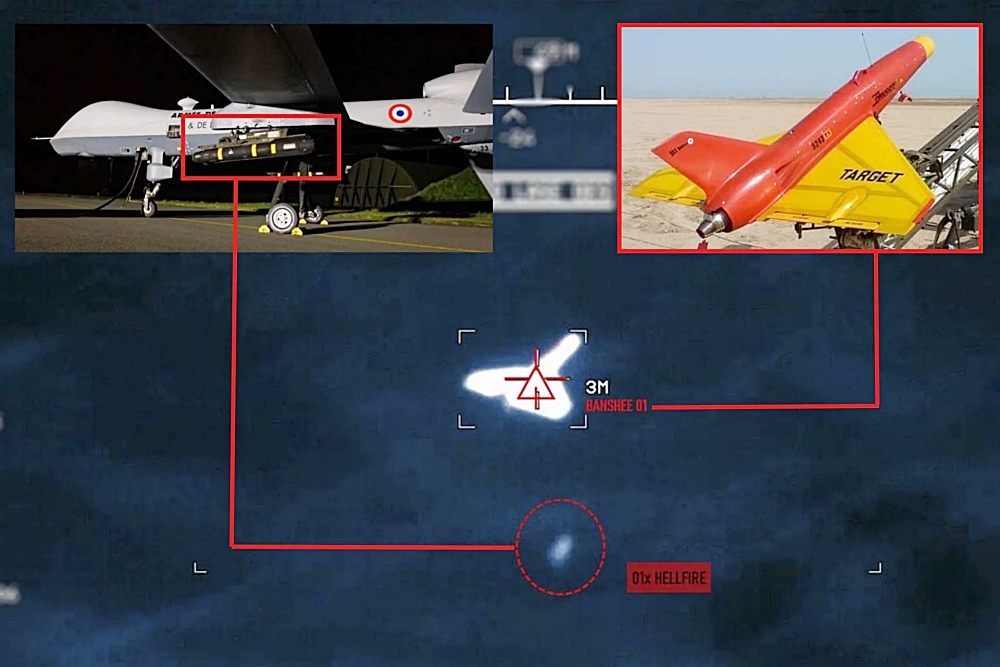
Another element that adds technical interest to the trial is the likely identity of the target drone. Based on imagery released by the French Ministry of the Armed Forces, the destroyed target appears consistent with a Banshee-type target drone. QinetiQ reports describe the Banshee family as an aerial target system used for military operational training and threat representation, and notes that several variants are compatible with surface-to-air, air-to-air, and gunnery weapon systems.
Sources: Janes; Army Recognition