
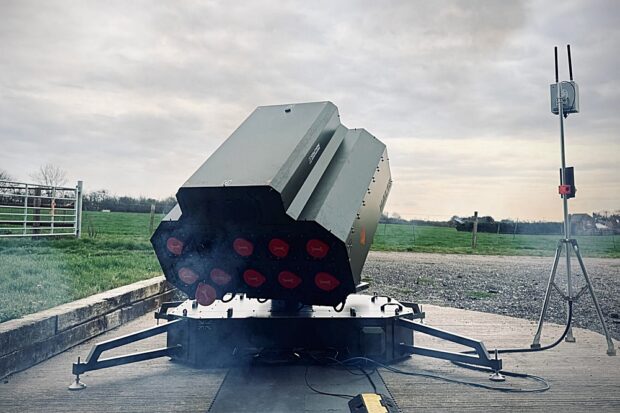
At the beginning of March 2026, ISS Aerospace conducted a firing test of its HAL10 Hybrid Air-Systems Launcher, positioning it as armed forces increasingly seek compact, scalable, and rapidly deployable unmanned solutions for contested environments.
HAL10 is designed as a modular launch architecture capable of supporting multiple classes of unmanned aerial systems, including the ISSOS WASP. By combining launcher density with a flexible UAV ecosystem, the HAL10-WASP pairing reflects the growing military interest in systems able to generate mass, persistence and flexibility at lower cost.
Its relevance lies in the way it could support faster battlefield awareness, distributed operations and a more resilient use of tactical drone capabilities.
The HAL10 has been designed as a multi-bay launcher intended to deliver a rapid and repeatable deployment capability for unmanned air systems. ISS Aerospace states that the system uses a 10-bay cassette architecture arranged in a five-by-two configuration, giving operators the ability to launch multiple UAVs from a single compact platform.
The launcher is presented as modular and platform-agnostic, which means it is not limited to one employment concept and can be integrated into broader operational architectures depending on user requirements. This design approach gives HAL10 a value that goes beyond simple launch capacity, as it points to a system built for flexibility, responsiveness and operational scaling.
The launcher’s relevance becomes clearer when paired with the ISSOS WASP UAV, which ISS Aerospace presents as a tube-launched, rocket-propelled system intended for rapid intelligence and tactical mission sets in demanding environments.
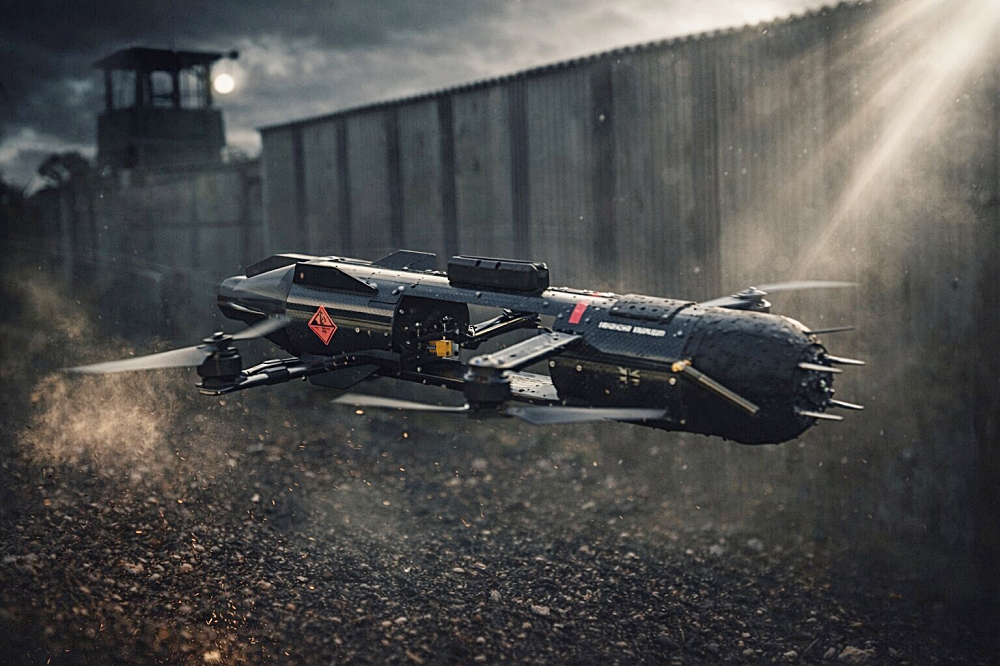
ISSOS WASP
The company states that WASP offers an operational range of up to 45 kilometers, endurance of up to 30 minutes without payload or 22 minutes with full payload, and a maximum payload capacity of 1 kilogram. It is also described as capable of operating in winds up to 18 meters per second. Beyond its raw specifications, WASP has been designed with a modular payload bay, semi-autonomous architecture and optional swarming capability, giving it potential relevance for ISR, rapid-response deployment, counter-UAS tasks and missions requiring distributed aerial coverage from confined or exposed launch locations.
The combination of HAL10 and WASP gives the system a clear tactical advantage in fast-moving combat environments. A launcher able to release multiple UAVs in rapid succession can shorten the time needed to establish battlefield awareness, maintain aerial persistence or saturate an area with multiple airborne assets.
Instead of relying on one drone at a time, a unit could launch several WASP systems for reconnaissance, reserve others for force protection, or stagger releases to maintain continuous surveillance over a target area. This reduces gaps in coverage and gives commanders more flexibility in how they manage attrition, prioritize sectors and respond to emerging threats. The launcher’s autonomous sequencing also suggests value in missions that require rapid saturation, staggered launches or sustained deployment over time, depending on operational needs.
From a military perspective, the HAL10-WASP combination reflects the growing importance of deployable mass in contemporary land warfare. Rather than depending on a single high-value sortie, a force equipped with a 10-bay launcher can create layered effects across reconnaissance, local security and tactical target support within a compressed timeframe.
Such a system could complicate an adversary’s response by presenting multiple aerial tracks at once, forcing enemy air defenses and electronic warfare assets to divide attention and resources. In an operational environment shaped by dispersion, short sensor-to-shooter timelines and the constant risk of drone losses, this architecture offers a practical way to maintain battlefield presence while limiting direct exposure of operators.
This assessment is an analytical reading of the officially stated launcher and UAV characteristics.
Sources: Army Recognition; ISS Aerospace