
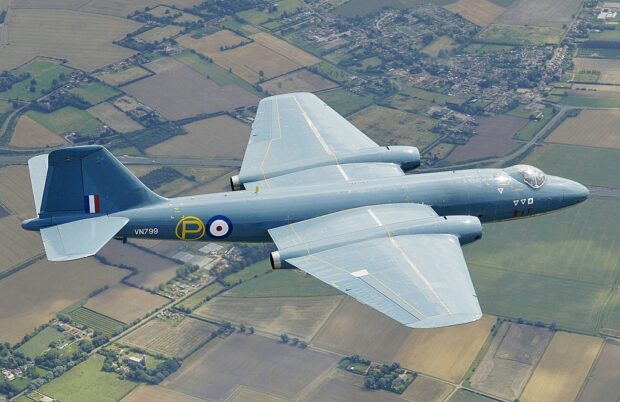
In the summer of 1953, a British jet crossed into Soviet airspace at over 50,000 feet, photographed a secret missile site, took fire from MiG-15s, and made it home. Officially, Britain still denies the mission ever happened. This is the story of the English Electric Canberra — the aircraft that turned altitude into a weapon, set a 63,668-foot world record, and kept flying from the early Cold War all the way into Iraq and Afghanistan.
From secret reconnaissance over the Soviet Union to combat over Suez, Syria, and the Falklands, the Canberra kept adapting long after most aircraft of its generation were gone. It flew nuclear sampling missions through atomic clouds, evolved into the high-altitude PR.9 spy platform, and in 2003 was still producing vital imagery over Iraq decades after its first flight.
This episode covers how the Canberra was designed, why it was so difficult to intercept, how it helped confirm one of the USSR’s most sensitive missile sites, and why the RAF finally retired it in 2006 after 55 years of service.
The English Electric Canberra is a British first-generation, jet-powered medium bomber. It was developed by English Electric during the mid- to late 1940s in response to a 1944 Air Ministry requirement for a successor to the wartime de Havilland Mosquito fast bomber.
Among the performance requirements for the type was an outstanding high-altitude bombing capability and high speed. These were partly accomplished by making use of newly developed jet-propulsion technology. When the Canberra was introduced to service with the Royal Air Force (RAF), the type’s first operator, in May 1951, it became the service’s first jet-powered bomber.
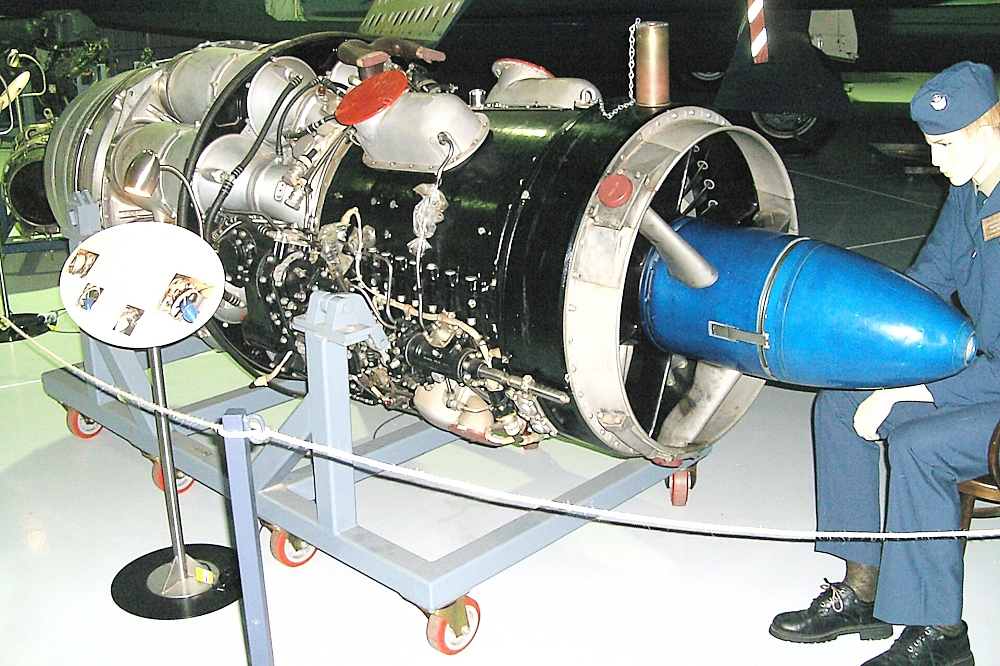
Rolls-Royce Avon engine on display, Temora Aviation Museum, 2011
In February 1951, a Canberra set a world distance record when it became the first jet aircraft to make a nonstop transatlantic flight. Throughout most of the 1950s, the Canberra could fly at a higher altitude than any other aircraft in the world, and in 1957, a Canberra established a world altitude record of 70,310 feet (21,430 m).
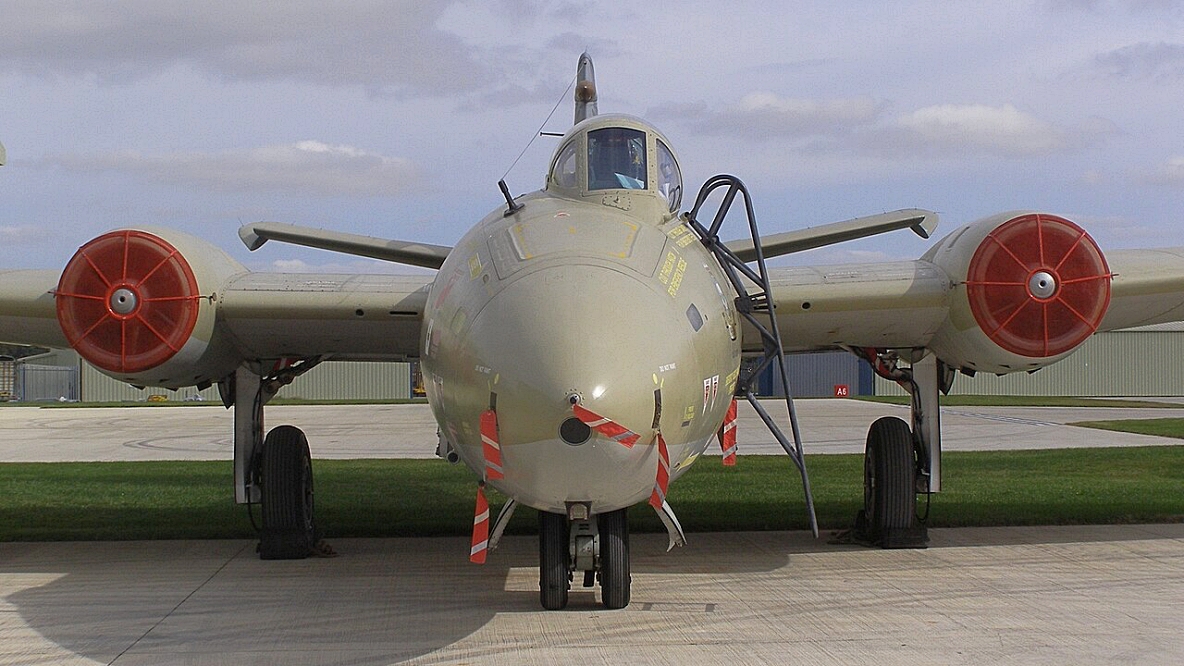
Preserved PR.9 XH135 at Kemble Airport. Note the offset pilot’s canopy. The navigator sits inside the nose section.
Due to its ability to evade the early jet interceptor aircraft, and its significant performance advancement over contemporary piston-engined bombers, the Canberra became a popular aircraft on the export market, being procured for service in the air forces of many nations both inside and outside of the Commonwealth of Nations.
The type was also licence-produced in Australia by Government Aircraft Factories (GAF) and in the US by Martin as the B-57 Canberra. The latter produced both the slightly modified B-57A Canberra and the significantly updated B-57B.
In addition to being a tactical nuclear strike aircraft, the Canberra proved to be highly adaptable, serving in varied roles such as tactical bombing and photographic and electronic reconnaissance. Canberras served throughout the Cold War, in the Suez Crisis, Vietnam War, Falklands War, Indo-Pakistani wars, and numerous African conflicts. In several wars, each of the opposing sides had Canberras in its air force.
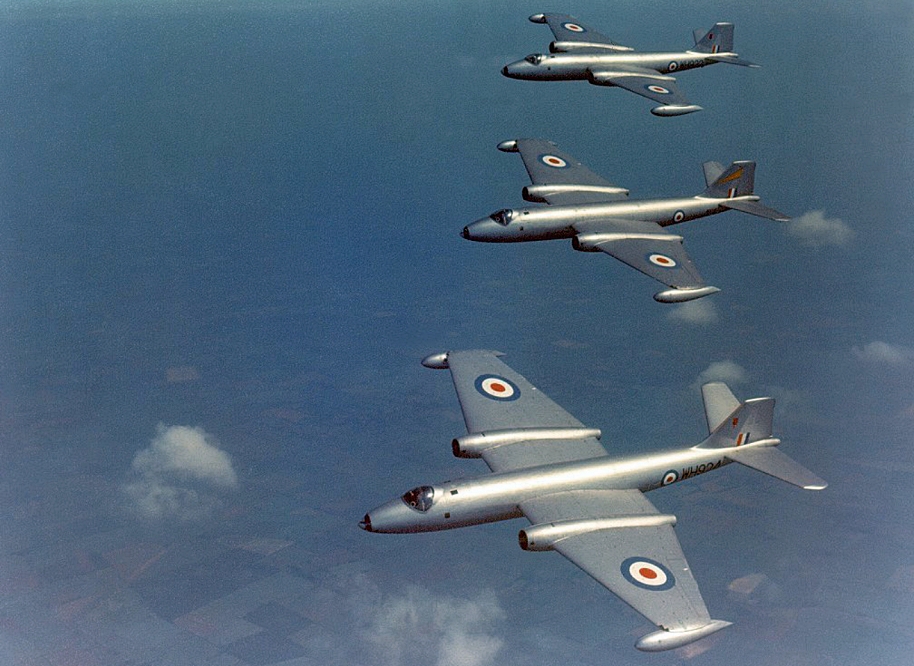
A flight of three RAF Canberra B.2s flying in formation during the 1950s
The Canberra served for more than 50 years with some operators. In June 2006, the RAF retired the last three of its Canberras 57 years after its first flight. Three of the Martin B-57 variants remain in service, performing meteorological and re-entry tracking work for NASA, as well as providing electronic communication (Battlefield Airborne Communications Node) testing for deployment to Afghanistan.
Top Photo: Pictured during a routine sortie, aircraft WJ874 was painted to represent the first prototype Canberra, VN799, when it flew for the first time on 13 May 1949 at Warton airfield, where it had been built.
Sources: YouTube; Wikipedia