
All-American has just finished her run. Her bomb bays are empty, and Messerschmitts are right on her tail. One of them comes in for a pass, but it’s too close. The Bf-109 flies straight through the aft section of the bomber and is gone. The rear fuselage is split open by a long gash. One stabilizer is simply gone.
In what’s left of the tail, the gunner stays strapped in, gripping bare structure as freezing wind tears through the aircraft at 20,000 feet over the open desert.
There is no friendly ground below, and a long stretch of water is still ahead. And decades later, what actually happened in the sky that day would never quite settle.
The Boeing B-17 Flying Fortress is an American four-engined heavy bomber developed in the 1930s for the United States Army Air Corps (USAAC). Designed as a fast, high-altitude, long-range bomber, it became one of the most important aircraft of World War II. Used primarily in the European Theater of Operations, the B-17 dropped more bombs than any other aircraft in the conflict.
It is the third-most produced bomber in history, behind the Consolidated B-24 Liberator and the German Junkers Ju 88. In addition to bombing missions, B-17s served in transport, anti-submarine, and search-and-rescue roles.
In a USAAC competition, Boeing’s prototype Model 299 (XB-17) outperformed rival designs but crashed, costing Boeing an initial production contract that went instead to the Douglas B-18 Bolo. Despite the setback, the Air Corps ordered 13 YB-17s for evaluation, and the aircraft entered service in 1938. Continual improvements led to multiple variants, culminating in the heavily armed B-17G.
Though it carried a smaller bomb load than some contemporaries, it combined speed, altitude, range, and formidable defensive firepower. Its reputation for ruggedness grew from numerous accounts and photographs of severely damaged aircraft returning safely to base.
The B-17 first saw combat in the Pacific but became synonymous with the daylight strategic bombing campaign over Europe, conducted by the United States Army Air Forces alongside the RAF’s night bombers. Of the roughly 1.5 million tons of bombs dropped on Nazi Germany, more than 640,000 tons were delivered by B-17s.
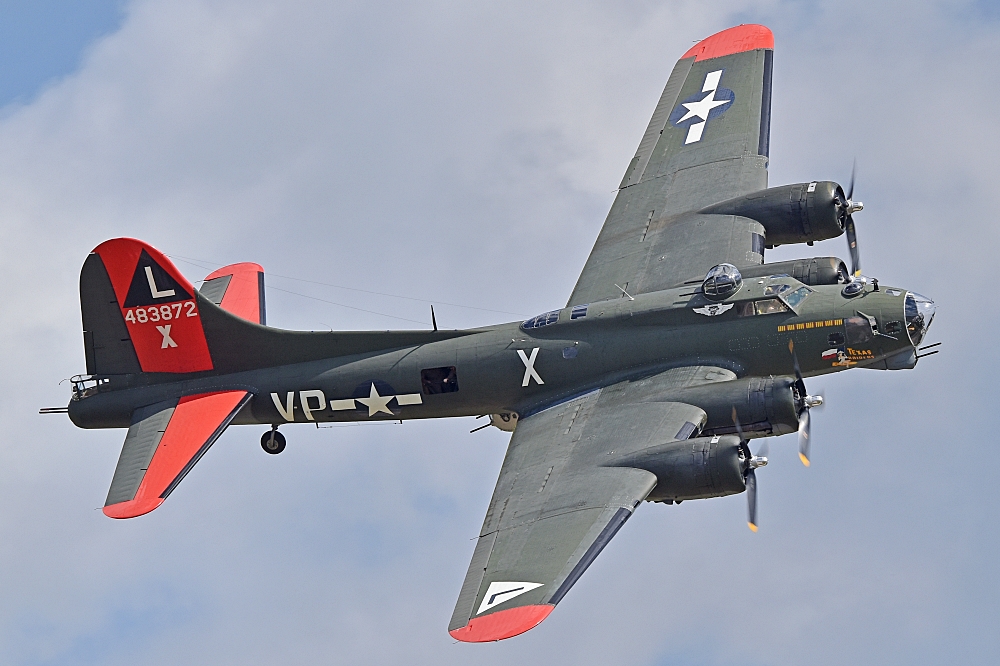
The B-17G Texas Raider that was lost 2022, shown here in 2019. It was destroyed in a mid-air collision at an air show
Today, only a handful remain airworthy. Around 50 survive in museums or storage, including “The Swoose,” a rare early-model B-17D. In 2022, the B-17G “Texas Raiders” was destroyed in a fatal mid-air collision at a U.S. airshow, renewing public attention to these historic aircraft.
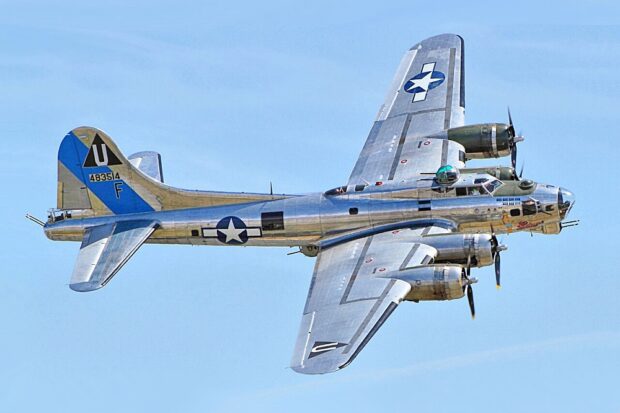
Top Photo: B-17 – Chino Airshow 2014
Sources: YouTube: Wikipedia