
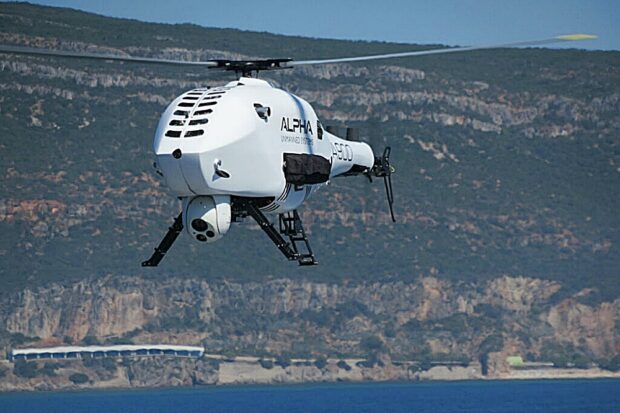
Parallel Flight Technologies, Inc., a developer of next-generation unmanned aircraft systems, and Alpha Unmanned Systems, a European manufacturer of fuel-powered helicopter UAVs, have announced a collaboration to advance heavy-fuel propulsion for unmanned aviation in support of the U.S. Office of Naval Research (ONR).
Under an ONR program, Parallel Flight is adapting its Firefly UAS to operate on heavy fuel, enabling long-endurance, heavy-lift operations in demanding naval and expeditionary environments. The contract builds on Firefly’s hybrid-electric architecture and extends its operational reach into maritime and other missions that require aviation-grade fuel.
“We are very pleased to work with Alpha Unmanned Systems,” said Craig Stevens, CEO of Parallel Flight Technologies. “Alpha’s real-world experience with heavy-fuel propulsion has helped us refine and validate our hybrid architecture to meet the unique demands of naval and expeditionary missions.”
Alpha Unmanned Systems brings more than a decade of experience designing, integrating, and operating heavy-fuel helicopter UAVs for defense, maritime, and security applications. Working with Parallel Flight’s engineering team, Alpha is accelerating the conversion of Parallel Flight’s proprietary Parallel Hybrid Electric Multirotor (PHEM) propulsion system to heavy-fuel compatibility—an important step toward aligning unmanned aircraft with existing military logistics and fuel infrastructure.
“The use of heavy-fuel engines is essential for unmanned aircraft operating in challenging defense and maritime environments,” said Álvaro Escarpenter, CTO of Alpha Unmanned Systems. “We are proud to support Parallel Flight’s efforts and contribute our expertise in heavy-fuel UAV propulsion to this important program.”
Parallel Flight’s NDAA-compliant Firefly is a U.S.-produced Group 3 UAS widely regarded as a heavy-lift workhorse. This two-person-portable quadcopter fits in the back of a pickup truck and is optimized for expeditionary defense and industrial missions. Its patented Parallel Hybrid Electric Multirotor (PHEM) propulsion system enables payloads up to 100 lb (45 kg) and endurance up to ten times greater than comparable all-electric UAS, while supplying 2 kW of continuous in-flight power to payloads. The platform is protected by five patents and supported by DIU, USDA, NASA, and NSF.
Source: Alpha Unmanned Systems