
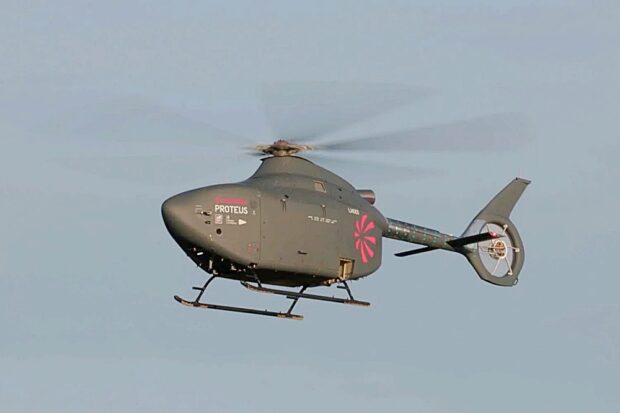
British aviation history has been made with the UK’s first truly autonomous, full-size helicopter completing its maiden flight at Predannack airfield in Cornwall.
Designed and built by Leonardo as a technology demonstrator for the Royal Navy, the aircraft, known as Proteus, showcases the potential of unmanned systems operating alongside crewed aircraft within a future “hybrid air wing.” It is expected to play a key role in future anti-submarine warfare missions as part of the UK’s Atlantic Bastion strategy.
The milestone follows weeks of intensive ground-running trials at Leonardo’s Yeovil facility, where Proteus’ engines, sensors, and systems were rigorously tested. Engineers and representatives from Leonardo, the Royal Navy, and UK Defence Innovation observed the historic flight on the Lizard Peninsula. Predannack, a satellite airfield for RNAS Culdrose, also serves as the National Drone Hub, supporting the development of autonomous aviation systems.
The successful flight supports commitments outlined in the Strategic Defence Review, which calls for a “New Hybrid Navy” combining autonomous and crewed platforms. While the Royal Navy already operates drones such as Malloy octocopters and the Peregrine surveillance helicopter, Proteus represents a major leap in scale, complexity, and autonomy.
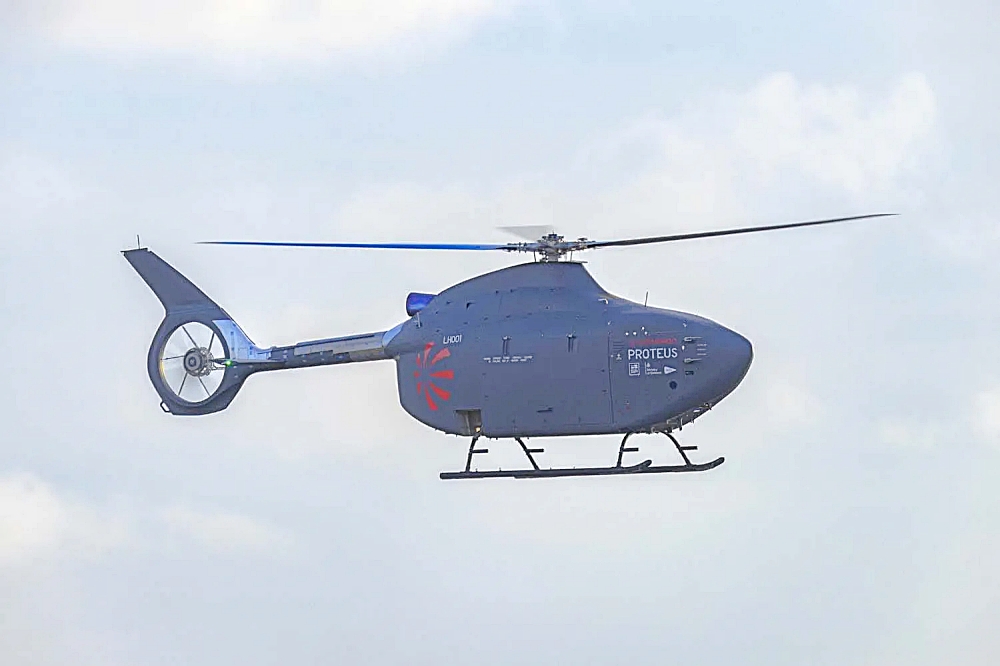
Developed under a £60 million programme supporting around 100 highly skilled UK jobs, Proteus is believed to be among the world’s first full-size autonomous helicopters. In place of a crew, advanced sensors and onboard computing allow the aircraft to perceive its environment, make decisions, and act independently.
With a payload capacity exceeding one tonne, Proteus can carry mission equipment in demanding weather conditions, freeing crewed aircraft for other critical operations. During its first flight, the helicopter executed a short test profile, autonomously controlling its flight while being closely monitored by ground-based test pilots.
Proteus is designed for missions including maritime patrol and anti-submarine warfare, operating as part of a networked force of ships, aircraft, submarines, and sensors. Such capabilities are central to the Atlantic Bastion programme, aimed at defending the UK and NATO allies across vast ocean areas against evolving threats.
Source: UK Royal Navy