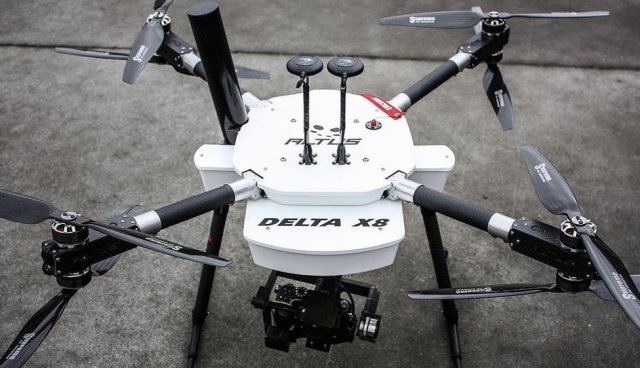
A new drone from Parrot does double duty, flying through the air like any other quadcopter but converting in a snap to propel a small hydrofoil boat. By attaching the drone perpendicular to the body of the boat, the gadget sends its thrust rearward instead of down, causing the boat to move forward and rise up on its little pontoons. Continue reading
NATO Global Hawk to be Tested at Edwards AFB
Rentokil May use Drones for Bird Control
Pest control firm Rentokil Initial is looking into using drones for bird pest control, according to the firm’s global director of enterprise, Anthony Meadows.
Meadows, who was speaking at Computing‘s Enterprise Mobility and Application Management Summit 2015 , said that the company has to carry out a lot of ‘bird work’, and that it is looking into the use of drones as an alternative control method.
Gray Eagle’s Advanced Communications Gear Tested
Soldiers have put the MQ-1C Gray Eagle unmanned aircraft system, or UAS, through its paces this month using advanced ground controls. Continue reading
Drone to Fly Autonomously Inside Fukushima Reactor
A drone is being developed to survey the interior of reactor buildings at Tokyo Electric Power Co.’s Fukushima No. 1 plant. The unmanned aircraft will use lasers to detect and avoid obstacles in flight and will be able to land to replace its batteries in the absence of an operator. Continue reading
Microsoft to use Drones to Predict Disease Outbreaks
Microsoft, founded by a man who is not a fan of mosquitoes, wants to develop drones to detect and catch mosquitoes. Researchers on the ominously named Project Premonition will then take blood samples from the mosquitoes to determine if they are carrying diseases from animals they’ve bitten, or any diseases they’re carrying themselves. Continue reading
Alaska Researchers Use Drones to Study Otters
Scientists wanting to know what sea otters eat while floating far from shore have turned to the sky. During an April mission in Kachemak Bay, researchers tested unmanned drones to see if they could be used for future sea otter surveys. The project also used drones to study the prevalence of sea grass in intertidal flats.
Using drones for the intertidal flats mission was mostly to streamline the process, allowing a larger area to be surveyed in a shorter amount of time.
When it comes to otters, scientists want to know what the predators regularly eat to better understand how it may affect fisheries management. Current observation techniques are restricted to watching sea otters with high-powered spotting scopes. The practice is only viable on land, as swells and turbulent boats make scopes unfeasible.
Underground Drone Racing Takes off in Australia
Aviation enthusiasts across Australia are gathering in derelict warehouses to race custom-built drones in a new sport that is flying under the strict laws that regulate the aircraft. Continue reading