
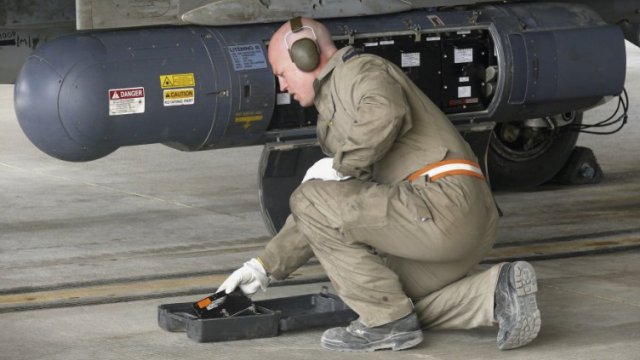
 The US Air Force is to integrate the Northrop Grumman AN/AAQ-28(V) Litening targeting and designation pod onto the General Atomics Aeronautical Systems Inc MQ-9 Reaper unmanned aircraft system (UAS) to demonstrate the capability, it was disclosed on 12 April.
Airbus Group and Local Motors Launch UAS Challenge
 Airbus Group and Local Motors have launched a global co-creation challenge to identify the next generation of commercial UAS (drone) technology. The two companies are inviting amateurs and professionals alike into a joint project that includes a series of co-creation activities, online competitions, open-source projects, and hackathons all focused on designing a next-generation commercial UAS solution.
Property Drone Consortium Announces Charter Members

The Property Drone Consortium (PDC), a collaboration that consists of insurance carriers, construction industry leaders and supporting enterprises announced its roster of charter members that includes: Allstate Corporation, American Family Insurance, Auto-Owners Insurance, EagleView Technologies, Inc., Erie Insurance and Pilot Catastrophe Services. Continue reading
Launching the Shadow at Yuma
Marine Unmanned Aerial Vehicle Squadron 1 (VMU-1) conducts its first launch of an RQ-7Bv2 “Shadow” unmanned aircraft system at the Canon Air Defense Complex aboard Marine Corps Air Station Yuma, Arizona, Saturday, March 26, 2016. Continue reading
6,000 Ton Ice Breaker
USS Hartford (SSN-768) surfaces near Ice Camp Sargo during ICEX 2016 in the Arctic Circle. Continue reading
USAF Global Strike Command Seeks Interceptor UAS
The US Air Force unit charged with guarding a nuclear arsenal is searching for mini-drones designed to electronically dogfight other mini-drones. Continue reading
Festo’s Balloon-Like Drone Swallow Objects for Delivery
German-based robotics company Festo unveiled a new flying robot that looks like a giant, blown-up representation of Saturn with its balloon like shape and ring of propellers. The drone can detect objects and fly autonomously, but the most interesting part about it is how it grabs items – it pretty much swallows them whole and then pushes them back out. Continue reading
DARPA XS-1 Program Enters Phase 2
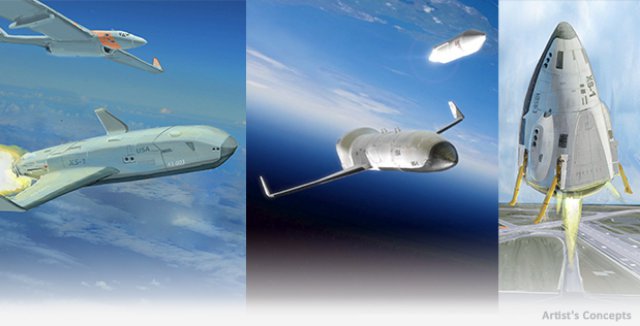 In an era of declining budgets and adversaries’ evolving capabilities, quick, affordable and routine access to space is increasingly critical for both national and economic security. Current satellite launch systems, however, require scheduling years in advance for an extremely limited inventory of available slots. Moreover, launches often cost hundreds of millions of dollars each, due in large part to the massive amounts of dedicated infrastructure and large number of personnel required. DARPA created its Experimental Spaceplane (XS-1) program to help overcome these challenges and create a new paradigm for more routine, responsive and affordable space operations, reducing the time to get capabilities to space.