
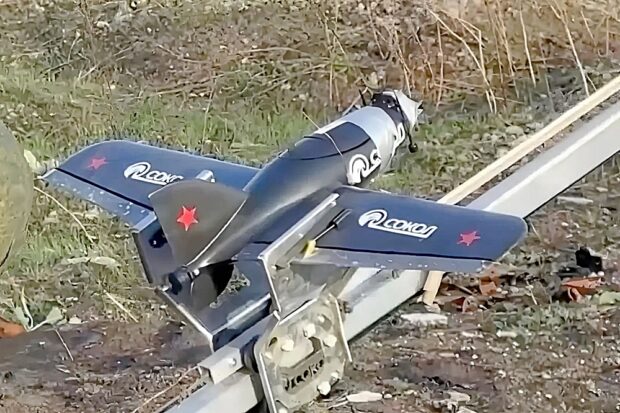
Russia has introduced a new version of its Sokol interceptor drone, claiming the system can engage faster aerial threats, including jet-powered unmanned aircraft, as the country seeks to strengthen its defences against Ukrainian drone attacks.
The Russian Ministry of Defence said that a Sokol-3 drone team from the Tsentr (Center) Group of Forces intercepted high-speed Ukrainian strike drones in the Dnipropetrovsk direction. The ministry published footage of the system in operation, describing the aircraft as an interceptor designed to destroy incoming unmanned aerial vehicles.
The announcement follows the emergence of the Sokol-3 in Russian military media, where officials have highlighted its claimed ability to intercept jet-powered targets. However, publicly available footage and reporting have not independently established that the system has successfully engaged a jet-powered drone. Nor is there evidence that it has intercepted a manned jet aircraft.
A Faster Successor to the Sokol-I
Sokol-3 appears to be an evolution of Russia’s earlier Sokol-I interceptor, which has been deployed against Ukrainian reconnaissance and attack drones.
The Sokol-I is a relatively simple fixed-wing unmanned aircraft that uses a forward-facing camera and operator-controlled flight to locate and engage aerial targets. Russian military reporting has described its use against several Ukrainian drone types, including the Leleka, Blyskavka, and Hornet.
According to statements attributed to a Russian military official, Sokol-3 is approximately half the size of its predecessor and twice as fast. It also reportedly carries a different warhead, suggesting changes intended to improve its ability to engage smaller or faster-moving targets.
Images of the newer aircraft show a conventional fixed-wing configuration, with a rear-mounted pusher propeller, a straight wing, and movable control surfaces. Unlike the hand-launched Sokol-I, Sokol-3 appears to use a catapult launch system, allowing it to accelerate into flight without requiring a runway.
Russia has not released independently verifiable specifications for the new interceptor, including its maximum speed, endurance, operating altitude, detection range, or warhead characteristics.
Why Russia wants Faster Interceptor Drones
The development comes as both Russia and Ukraine face growing challenges from increasingly fast unmanned aircraft. Traditional propeller-driven reconnaissance and attack drones can be engaged by relatively inexpensive interceptor systems, but faster jet-powered variants reduce the time available for detection and interception.
Reuters reported in September 2026 that Russia had sharply increased its use of jet-powered attack drones, with Ukrainian military data indicating that launches of drones traveling at approximately 240–500 km/h had risen substantially during the summer. These aircraft are harder to intercept than slower propeller-driven designs.
That creates demand for defensive systems that can reach targets quickly while remaining considerably cheaper than conventional surface-to-air missiles.
Interceptor drones offer one possible solution. Rather than relying on expensive missile systems for every incoming UAV, defenders can use smaller unmanned aircraft to pursue and destroy threats closer to the front line. Depending on their design, they can destroy targets through direct impact or an explosive payload.
Russia has already deployed the Sokol-I as part of this approach. Its newer Sokol-3 appears intended to extend the concept toward faster aerial threats, although its actual performance remains unclear.
Source: Interesting Engineering